








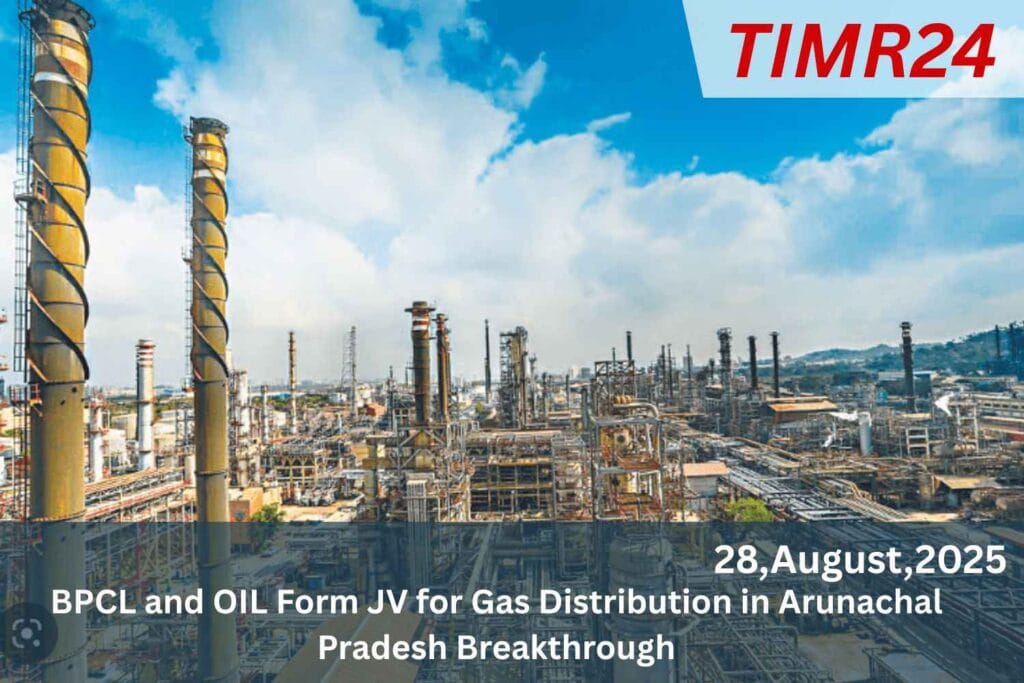
Bharat Petroleum Corporation Limited (BPCL) and Oil India Limited (OIL) have signed a Joint Venture Agreement to establish a gas distribution network in Arunachal Pradesh. The agreement aims to expand access to clean energy and support socio-economic growth in line with the government’s vision of developing a gas-based economy. The joint venture will set up CNG stations and provide Piped Natural Gas (PNG) to domestic, commercial, and industrial users across the state. The initiative aims to drive sustainable growth, improve quality of life, and support India’s gas-based economy. The energy landscape of India is undergoing a major transformation with a strong push towards natural gas as a cleaner and sustainable fuel.
In a significant development, Bharat Petroleum Corporation Limited (BPCL) and Oil India Limited (OIL) have joined hands to form a joint venture (JV) for city gas distribution (CGD) in Arunachal Pradesh, marking a milestone in the North-Eastern region’s energy infrastructure (OIL) This collaboration is expected to accelerate the government’s mission of increasing the share of natural gas in India’s energy mix from the current levels to 15% by 2030. The joint venture not only highlights the commitment of public sector giants to expand the reach of natural gas but also addresses the unique energy needs of a geographically challenging state like Arunachal Pradesh, where connectivity and access remain key hurdles.
The project is strategically aligned with India’s vision of One Nation, One Gas Grid, as it brings natural gas closer to households, industries, transport, and commercial establishments in the region. With this partnership, both BPCL and OIL aim to create sustainable energy access in remote locations, while also promoting industrial growth and reducing dependency on conventional fuels. Natural gas distribution networks are set to be rolled out in urban and semi-urban areas of Arunachal Pradesh, paving the way for clean cooking fuel alternatives such as piped natural gas (PNG) and eco-friendly transport solutions through compressed natural gas (CNG) stations. The JV is likely to provide an impetus to local employment opportunities.
Small businesses, and logistics, further integrating the state with the national energy ecosystem From an economic perspective, the collaboration is expected to attract fresh investments into Arunachal Pradesh’s energy sector. With city gas distribution networks gradually expanding in other states, this development fills an important gap in the energy infrastructure of the North-East. Industries in the region, especially those engaged in food processing, small-scale manufacturing, and transport, will greatly benefit from the availability of reliable and affordable natural gas. Moreover, the JV between BPCL and OIL brings together complementary strengths: BPCL’s strong downstream presence and expertise in distribution, and OIL’s deep-rooted.
compressed natural gas (CNG)
Experience in exploration and production in the North-East. Together, they form a synergy that ensures both operational efficiency and long-term sustainability of the project In the broader context, the gas distribution initiative also supports India’s climate commitments under COP28 and sustainable development goals (SDGs). By providing access to natural gas, the project directly contributes to reducing carbon emissions, improving air quality, and enhancing the standard of living for people in Arunachal Pradesh. It also complements parallel developments such as the expansion of renewable energy projects and the government’s emphasis on clean fuels in the transport sector.
This is particularly significant for Arunachal Pradesh, a state rich in natural resources yet often constrained by limited infrastructure. The gas distribution network is expected to serve as a backbone for both households and industries, thereby bridging the urban-rural energy divide This breakthrough also reflects India’s policy momentum under the Petroleum and Natural Gas Regulatory Board (PNGRB), which has been actively pushing for CGD expansion across multiple geographical areas. With the BPCL-OIL joint venture, Arunachal Pradesh is set to be a part of this nationwide push, bringing the benefits of gas-based economy to its people. For readers interested in broader policy initiatives.
Looking ahead, the BPCL and OIL joint venture is poised to transform Arunachal Pradesh into a hub for cleaner energy distribution. As the infrastructure takes shape, residents will soon experience the benefits of piped natural gas connections at home, efficient CNG fuelling stations for vehicles, OIL and reliable gas supplies for local industries. This breakthrough represents not just a business collaboration but also a socio-economic milestone for the North-East, reinforcing the role of public sector companies in steering India towards a sustainable, inclusive, and energy-secure future.
Q1. What is the purpose of the BPCL and OIL joint venture in Arunachal Pradesh?
The JV aims to develop city gas distribution networks, providing PNG and CNG access for households, industries, and transport.
Q2. How will this project benefit the people of Arunachal Pradesh?
It will ensure cleaner, affordable fuel access, generate jobs, support industries, and improve environmental sustainability.
Q3. Which government policies support this initiative?
It aligns with PNGRB’s city gas distribution framework and India’s “One Nation, One Gas Grid” policy.
Q4. What role will BPCL and OIL play individually?
BPCL brings downstream distribution expertise, while OIL contributes regional experience in exploration and operations.
Q5. How does this project contribute to India’s energy transition?
By expanding natural gas use, it reduces carbon emissions, supports COP28 commitments, and accelerates India’s clean energy targets.