


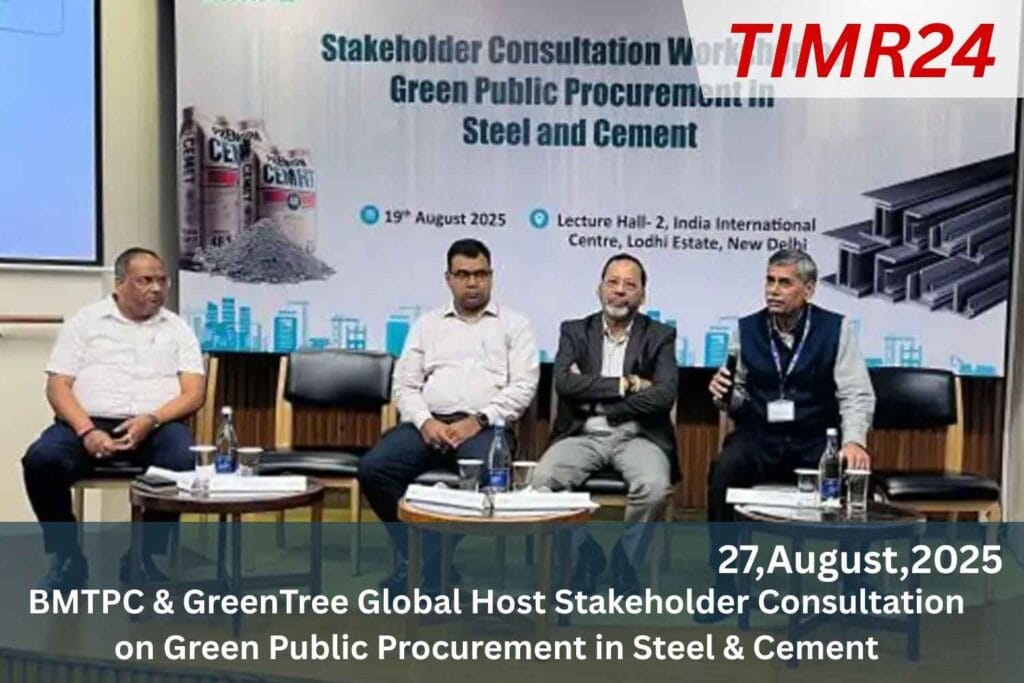
The Steel Building Materials & Technology Promotion Council (BMTPC) and Greentree Global have organized a Stakeholder Consultation Workshop on Green Public Procurement in Steel and Cement (GPPSC) in New Delhi. The two sectors contribute significantly to India’s emissions, with steel accounting for 10-12% and cement accounting for 5.8%. The GPPSC initiative aims to drive this transition through sector-specific frameworks, adoption of green alternatives, and energy-efficient procurement practices. The workshop brought together policymakers, industry leaders, research institutions, and global experts. The sessions focused on policy insights, challenges in green procurement, barriers faced by manufacturers and buyers, and possible solutions.
The workshop saw 45 participants, creating a platform for dialogue between policymakers, industry leaders, research institutions, and global experts. Panellists stressed that public procurement can be a transformative driver of low-carbon development, provided clear policy mandates, verified green standards, and market-aligned procurement criteria are adopted The conversation around (Mumbai Metro) sustainable infrastructure is rapidly gaining momentum in India, particularly in carbon-intensive industries such as steel and cement. In this context, the Building Materials & Technology Promotion Council in collaboration with Greentree Global, recently hosted a high-level stakeholder consultation focused on Green Public Procurement (GPP) for the steel and cement sectors.
This initiative comes at a crucial time when the nation is aligning its infrastructure growth with its climate commitments under the Paris Agreement and India’s ambitious goal of achieving net zero emissions by 2070. The consultation sought to engage policymakers, industry leaders, researchers, and sustainability experts in exploring actionable pathways for embedding low-carbon practices into the public procurement process, which is one of the most powerful tools governments have to influence markets and accelerate decarbonization.
Green Public Procurement refers to the practice where government agencies and public institutions prioritize sustainability in their purchase of goods and services. In the case of steel and cement, two of the most resource-intensive and high-emission industries, introducing GPP can drive large-scale transformation. As public infrastructure projects—ranging from highways to housing schemes form a significant portion of demand, integrating eco-friendly benchmarks into tendering and contracting can shift the entire market towards greener practices. This is in line with India’s broader climate strategies, where initiatives like the National Green Hydrogen Mission and the Energy Efficiency Financing initiatives are shaping the future of clean industries.
The Consultation Highlights
The consultation hosted by BMTPC and Greentree Global highlighted how green procurement policies can serve as a catalyst for innovation and competitiveness within the steel and cement industries. Senior officials from government departments emphasized the importance of developing clear standards and benchmarks for materials used in construction. Industry experts added that technological interventions such as the use of blended cements, alternative fuels in kilns, and low-carbon steelmaking methods can be incentivized if procurement rules are designed around sustainability parameters. For readers interested in related developments, discussion also touched upon the growing demand for sustainable infrastructure.
While the benefits of GPP are evident, the consultation also acknowledged the practical challenges. The absence of universally accepted green standards for steel and cement in India makes it difficult for procurement authorities to evaluate bids on sustainability grounds. Moreover, cost considerations often outweigh environmental performance in decision-making, leading to hesitation among contractors and suppliers to adopt greener technologies. These challenges echo the concerns raised in other infrastructure discussions, such as, where project viability and environmental safeguards are often in tension. Addressing these hurdles will require collaborative efforts from regulatory bodies.
Standard-setting agencies, and industry associations to create a transparent and reliable framework for green procurement One of the central takeaways from the consultation was the need for capacity building and awareness creation across different levels of government. Procurement officials, project managers, and suppliers must be trained to understand and implement GPP practices effectively. Another pathway discussed was the gradual introduction of mandatory environmental criteria in large-scale infrastructure tenders, especially those related to housing, metro rail, and highway development. By making sustainability a non-negotiable requirement, public procurement can set the tone for private sector participation as well.
Industry Readiness and Opportunities
The consultation also highlighted how lessons can be drawn from other sectors such as renewable energy, where strong policy and procurement frameworks have spurred rapid growth. A related example is seen in which reflects how clear procurement signals encourage manufacturers to scale up cleaner solutions. From the industry perspective, many steel and cement producers are already experimenting with innovative technologies that lower emissions. The transition to clinker substitution, energy-efficient kilns, and carbon capture technologies demonstrates the sector’s willingness to align with global sustainability trends. With GPP acting as a demand-side enabler, these innovations can become commercially viable and scalable.
The consultation also highlighted opportunities for financing institutions and investors to support industries in upgrading to cleaner technologies. Similar to technology-driven transformation in urban mobility, green procurement can showcase India’s leadership in sustainable building materials. Embedding GPP into steel and cement procurement will not only reduce the carbon footprint of infrastructure projects but also create ripple effects across supply chains, workforce skills, and investor confidence. The consultation emphasized that this is not merely an environmental agenda but also an economic opportunity for India to position itself as a global leader in sustainable construction. In the long run, it can also open up new markets for Indian products,
As international buyers increasingly demand compliance with green standards. For stakeholders tracking India’s journey towards a circular economy, initiatives like this align closely (Green Project) with the country’s push towards resource efficiency, renewable energy, and low-carbon pathways
Q1 What is Green Public Procurement (GPP) in steel and cement?
GPP is the practice of integrating environmental considerations in the procurement process of steel and cement to promote low-carbon, sustainable alternatives.
Q2 Why is GPP important for the construction industry?
A: It reduces carbon emissions, encourages sustainable materials, and supports India’s climate goals while ensuring infrastructure development.
Q3 Who organized the consultation on GPP in steel and cement?
The Building Materials and Technology Promotion Council (BMTPC) and Greentree Global jointly hosted the consultation.
Q4 What were the key takeaways from the consultation?
Policy recommendations, industry collaboration, promotion of low-carbon technologies, and creation of a green market ecosystem.
Q5 How does GPP support India’s net-zero targets?
By mandating sustainable procurement, GPP encourages industries to innovate, reduce emissions, and align with India’s 2070 net-zero pledge.