


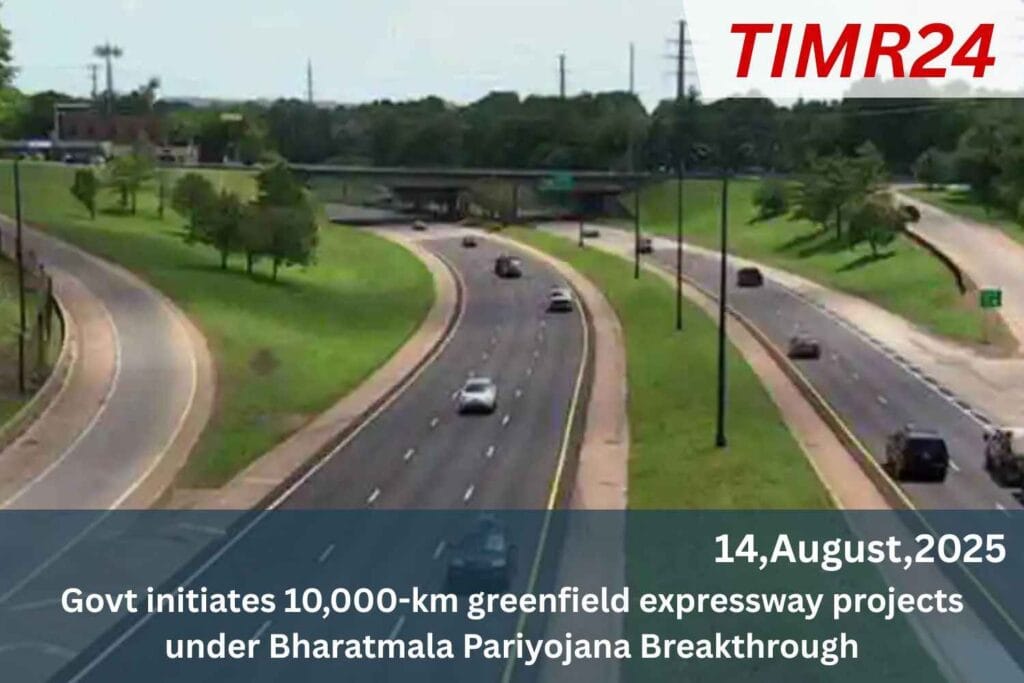
India’s Union Minister, Nitin Gadkari, has announced plans to construct 10,000 km of greenfield expressway projects across the country at a cost of Rs 4.5 lakh crore. These projects are part of the Bharatmala Pariyojana, aiming to develop 65,000 km of highways. The National Highways Authority of India has already generated over Rs 70,000 crore for the construction. he Indian government’s ambitious Bharatmala Pariyojana is transforming the nation’s infrastructure landscape, with a significant focus on constructing 10,000 kilometres of greenfield expressways. These projects, estimated at ₹4.5 lakh crore, aim to enhance connectivity, reduce travel time, and stimulate economic growth across the country.
Launched in 2017, the Bharatmala Pariyojana envisions the development of 65,000 kilometres of highways, encompassing economic corridors, border roads, coastal roads, and greenfield expressways. The greenfield component, totaling 10,000 kilometres, is designed to provide high-speed, access-controlled routes that bypass congested urban areas and environmentally sensitive zones. This strategic approach aims to optimize logistics efficiency and foster balanced regional development (Nitin Gadkari) The construction of these expressways is expected to yield substantial economic benefits. By reducing travel distances and time, the projects will lower transportation costs, benefiting industries such as manufacturing, agriculture, and e-commerce. .
Improved connectivity will also facilitate smoother movement of goods and people, enhancing trade and commerce across states. Additionally, the development is anticipated to spur local economies through job creation and increased access to markets. While the greenfield promise significant economic advantages, they also present environmental and social challenges. The construction process involves land acquisition, which can lead to displacement and affect local communities. (Highways) Moreover, the development of infrastructure in ecologically sensitive areas requires careful planning to mitigate adverse environmental impacts. The government is committed to addressing these concerns by implementing sustainable practices and ensuring that affected communities are adequately compensated and rehabilitated.
Modern technology plays a crucial role in the development of these expressways. The integration of intelligent transportation systems (ITS) will enable real-time traffic monitoring and management, improving safety and efficiency. Features such as electronic toll collection, advanced signage, and surveillance systems are being incorporated to enhance user experience and security. Additionally, the expressways are being designed to accommodate future advancements in transportation, including electric vehicles and autonomous systems.
Regional Development and Connectivity
The greenfield expressways are strategically planned to connect major economic hubs, ports, and border areas, thereby integrating regional economies. For instance, the Delhi–Mumbai Expressway aims to reduce travel time between the two cities significantly, fostering economic ties and facilitating smoother movement of goods. Similarly, corridors in the Northeast are expected to enhance connectivity with neighbouring countries, promoting trade and cultural exchange. As of early 2025, substantial progress has been made in the development of these expressways. A significant portion of the projects has been awarded, with many stretches already under construction.
The government is focused on expediting the completion of these corridors to realize the full benefits of the Bharatmala Pariyojana. Looking ahead, the successful implementation of these greenfield is poised to play a pivotal role in India’s economic growth and infrastructural. In conclusion, the 10,000-kilometer greenfield expressway initiative under the Bharatmala Pariyojana represents a transformative step in India’s infrastructure development. By enhancing connectivity, promoting economic growth, and addressing regional disparities, these projects are set to redefine the nation’s transportation landscape. While challenges remain, the government’s commitment to sustainable and inclusive development ensures that the benefits of these expressways will be realized across the country.
q1. What is the Bharatmala Pariyojana?
The Bharatmala Pariyojana is a flagship national highway development program initiated by the Government of India to enhance road infrastructure, improve logistics efficiency, and reduce travel time across the country.
q2. How many greenfield expressways are being constructed?
The government plans to construct 10,000 km of greenfield expressways under the Bharatmala Pariyojana, aiming to improve connectivity and reduce travel time.
q3. What is the estimated cost of these projects?
The total investment for the 10,000 km greenfield expressway projects is approximately ₹4.5 lakh crore.
q4. Which states are covered by these expressways?
The greenfield expressways span across multiple states, including Delhi, Haryana, Uttar Pradesh, Rajasthan, Gujarat, Madhya Pradesh, Dadra and Nagar Haveli, Maharashtra, Karnataka, Andhra Pradesh, and Tamil Nadu.
q5. What are the expected benefits of these expressways?
The greenfield expressways are expected to reduce travel time by 40-50% between key economic nodes, improve logistics efficiency, and enhance connectivity to tribal, aspirational, and Left Wing Extremism (LWE)-affected districts.