








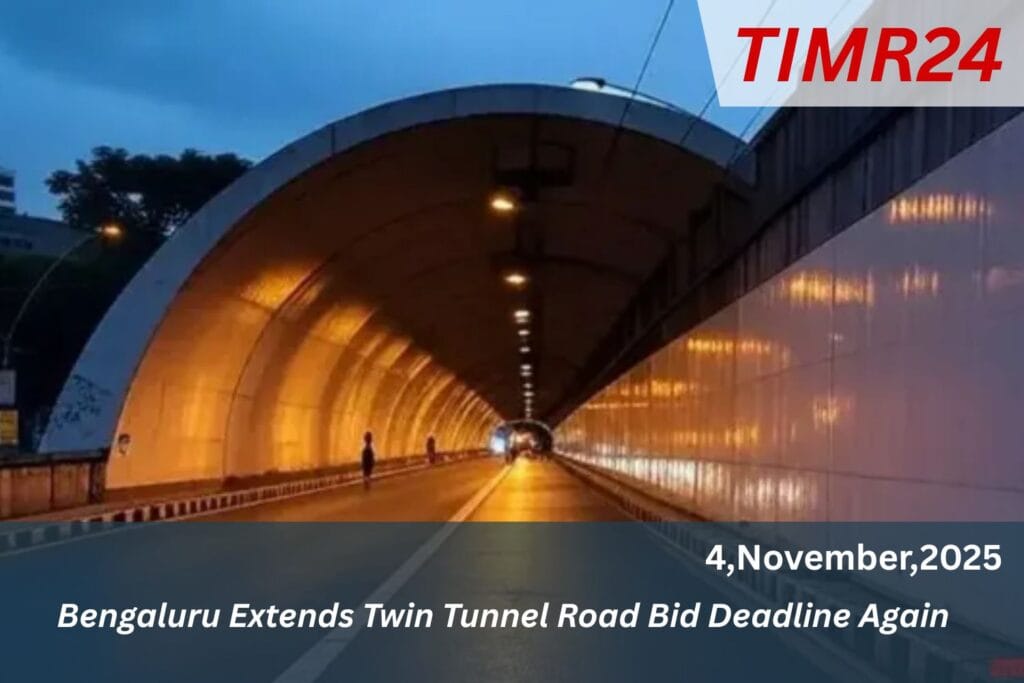
The Bengaluru Smart Infrastructure Limited (B-SMILE) has extended the bidding deadline for the Twin Tunnel Roads project, which connects Hebbal Esteem Mall to the Central Silk Board Junction, due to low interest from major infrastructure players. Initially announced on 16 July with a deadline of 3 September, the deadline has now been pushed three times, ultimately to 11 November. The project, valued at Rs 176.98 billion, aims to alleviate traffic congestion in Bengaluru and is structured under a build-operate-transfer (BOOT) model. Although around 10 agencies expressed initial interest, the extensions highlight potential reluctance from bidders, possibly due to.
Concerns over legal issues and public opposition. Deputy Chief Minister D.K. Sivakumar remains optimistic about the project’s progression amid these challenges The government of Karnataka, through its infrastructure vehicle Bengaluru Smart Infrastructure Limited (B-SMILE), has once again pushed back the bidding deadline for the ambitious twin-tunnel road project linking the Hebbal Esteem Mall junction to the Central Silk Board junction in Bengaluru’s north-south corridor. This change underscores the many challenges that the project is facing ranging from tender-response tepidness, financial and legal structuring uncertainties, to larger questions about feasibility.
Tunnel Scheme
And urban mobility strategy On the surface, the decision to extend the deadline seems procedural, but the implications cut to the core of how mega-urban infrastructure is being delivered in a rapidly growing city like Bengaluru From the outset, the twin-tunnel scheme was framed as a visionary solution to one of Bengaluru’s most chronic problems: north-south traffic congestion. The 16.7 km corridor between the Hebbal junction (near the Esteem Mall) and the Silk Board junction in BTM Layout was approved by the state cabinet earlier in the year, with estimated cost figures around ₹17,780 crore (roughly Rs 17.7 k crore) The model of delivery selected.
For the twin-tube, three-lane in each direction tunnel road was a Build Own Operate Transfer (BOOT) or similar concession-based model, involving tolling and long concession periods for private bidders The idea was that by routing a major corridor underground, surface traffic pressure would ease, travel time would shrink, and the constraint of land acquisition and right-of-way so often the bane of Indian urban road projects would be lessened Yet, despite the ambition, the bidding process has struggled. Originally tenders were invited on 16 July 2025, with a last date of 3 September. That date was extended to 30 September, then again to 29 October, and now.
Manifold Industry Watchers Point
The latest extension sets the deadline at 11 November Each postponement signals deeper hesitation among potential contractors and investors. According to Government Sources, around ten agencies including major names such as Tata Projects and Adani Group had initially expressed interest That interest, however, has not translated into formal bids, raising concerns that the project may be entering a vulnerable phase The reasons for the slow response are manifold. Industry watchers point to Fears over project viability given the high cost, technical complexity (tunnelling under urban Bengaluru is no small feat), and uncertain toll revenue projections.
Legal and environmental risks also loom large; indeed, public interest litigations (PILs) have been filed challenging aspects of the project’s feasibility report and DPR (detailed project report) Moreover, some contractors may fear that the project could meet the same fate as earlier shelved or delayed mega-projects in Bengaluru: for instance, a steel flyover that was proposed during former Chief Minister Siddaramaiah’s first term (2013-18) and was subsequently abandoned. That comparison has been expressly drawn by local media The government’s vantage, the repeated extensions are a pragmatic step: they provide additional time for the market to mature responses.
D.K. Sivakumar Has Publicly Expressed
For bidders to digest complexities, and for the infrastructure agency to perhaps refine the terms of engagement. Deputy Chief Minister D.K. Sivakumar has publicly expressed confidence in the project’s eventual implementation, noting that “people are supporting us” and signaling that the government remains committed Indeed, the role of the special purpose vehicle structure through B-SMILE under the aegis of the Greater Bengaluru Authority (GBA) is meant to create institutional clarity and streamline delivery While the bidding timetable is a key operational detail, the underlying structuring of the corridor remains critical. The project is divided into two packages under.
The BOOT or similar concession model, allowing special purpose vehicle(s) to design, build, operate and transfer the infrastructure back to the authority after a concession period. The state may provide viability gap funding or other incentives to make the economics attractive. Some earlier reporting noted that in the approval stage the cabinet had indicated that around 40 % of the cost may be subsidised by the municipal agency Tolling is expected to form the revenue basis for the concessionaire.
Q1. What-is-the-twin-tunnel-road-project
It’s an underground twin-tunnel linking Hebbal (Esteem Mall) to Silk Board junction, intended to ease the city’s north-south traffic corridor
Q2. why-was-the-bid-deadline-extended
Because major infrastructure firms showed limited interest, prompting the organising body to push back the deadline multiple times
Q3. What is the cost estimate and procurement model of the project?
The project is valued at around ₹17,698 crore (~₹176.98 billion) and will be developed under a Build-Operate-Transfer (BOT/BOOT) or BOOT model through a Special Purpose Vehicle SPV.
Q4. Who were the expected bidders and what concerns are holding them back?
Firms like Tata Projects and Adani Group initially expressed interest. However, concerns about legal hurdles, feasibility and comparison with a previously shelved flyover project have dampened enthusiasm.
Q5. What are the next steps and timeline for this project?
After the bid submission deadline (now moved to 11 Nov in latest reports) the approval of bids and issue of work order will follow. The project will commence once the SPV is in place.