









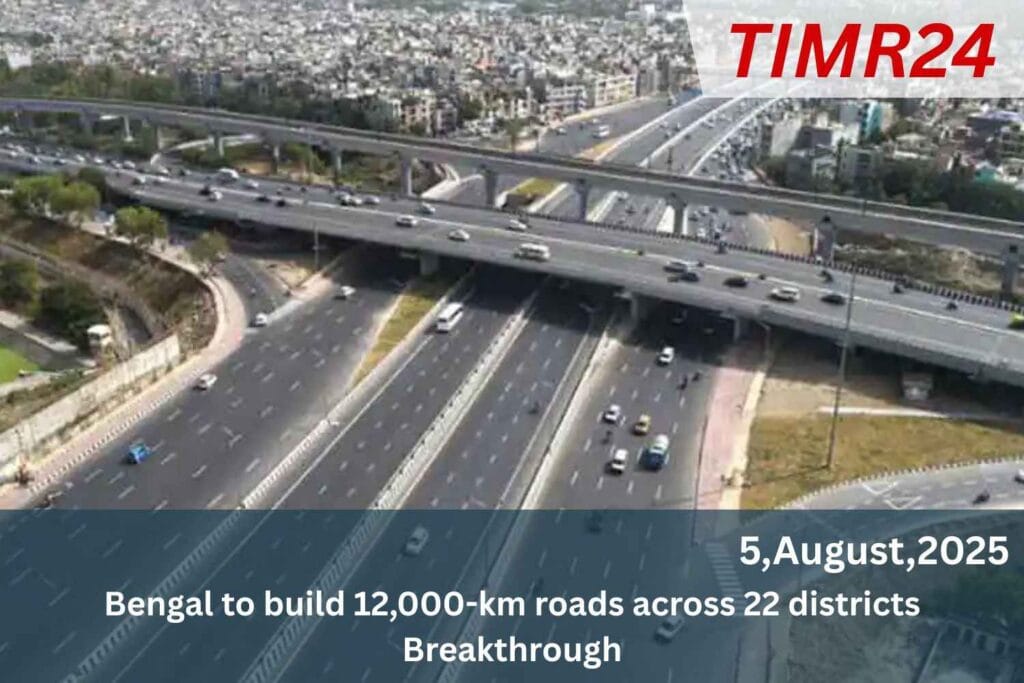
West Bengal’s Chief Minister has launched the “Pathashree-Rastashree” project, aiming to strengthen road infrastructure and improve connectivity in remote villages. The initiative covers over 30,000 villages, with 7,219 new roads and 1,548 upgrades. The project also aims to generate employment opportunities by deploying job card holders under the Mahatma Gandhi National Rural Employment Guarantee Act scheme. The West Bengal government has announced a landmark initiative to construct 12,000 km of roads spanning 22 districts, aiming to boost regional connectivity, rural development, and economic integration. This ambitious project, led by the represents one of the largest road infrastructure expansions in the state’s history.
Project Overview and District Coverage
The road construction drive will cover key districts including (North 24 Jalpaiguri), Purulia, Jalpaiguri, Murshidabad, and Paschim Medinipur, among others. These areas were chosen based on current connectivity gaps, developmental potential, and strategic importance in the state’s broader infrastructure blueprint. The project includes both rural road upgrades and new highway developments, facilitating smoother inter-district movement and access to markets, schools, and healthcare.
Economic and Rural Development Impact
This 12,000-km road expansion is expected to create significant employment opportunities, particularly in rural areas where local labor will be engaged during the construction phase. Additionally, improved roads will allow to transport their produce more efficiently, reducing post-harvest losses and boosting rural income. The government also expects the project to accelerate tourism, especially in districts like Darjeeling, Bankura, and Birbhum, by making travel more accessible and reliable.
Technology, Materials, and Sustainability
In a historic infrastructure move, the Government of West Bengal has announced the construction of 12,000 kilometres of roads across 22 districts, aiming to improve last-mile connectivity, stimulate economic growth, and bring critical services closer to rural and semi-urban populations. The project is expected to enhance intra-state mobility and integrate remote villages into the mainstream economy. In keeping with modern construction standards, the project will incorporate bituminous surfacing, geo-textile reinforcement, and drainage systems to enhance durability. Officials have confirmed that (Green Construction) will be integrated, such as tree plantation.
Funding and Implementation Timeline
The estimated cost of the project runs into several thousand crores and will be financed through a mix of state budget allocations, World Bank assistance, and The entire 12,000 km network is expected to be completed within four to five years, with the first 3,000 km scheduled for completion by the end of the current financial year To ensure transparency and timely execution, the government will appoint dedicated nodal agencies, including third-party auditors, to monitor progress at the block and district levels. along highways, use of recycled plastic in road surfacing, and rainwater harvesting pits where feasible. Additionally, digital monitoring tools and satellite-based tracking will be used for real-time project management and quality control.
Political and Administrative Significance
This initiative comes at a time when infrastructure development is being used as a key governance tool by the to drive growth and ensure equitable access to services. By focusing on infrastructure in both underdeveloped and rapidly urbanizing districts, the state aims to reduce developmental disparities across regions. West Bengal’s 12,000-km road construction plan is a transformative move that will redefine connectivity and boost economic growth across the state. As implementation gathers pace, stakeholders from rural communities to urban centres stand to benefit from this massive infrastructure thrust.
Q1. What is the total length of roads West Bengal plans to build?
The state aims to construct 12,000 km of roads across 22 districts.
Q2. Which areas will benefit from this road project?
Districts like Purulia, Murshidabad, Birbhum, Jalpaiguri, and North 24 Parganas are among the beneficiaries.
Q3. What is the goal of this road development initiative?
The project aims to boost rural connectivity, improve transportation, and support local economies.
Q4. How will this project impact employment?
It will generate lakhs of jobs, especially in rural construction and related services.
Q5. What is the expected timeline for completion?
The roads will be built in phases, with completion targeted over the next 3 to 5 years.