














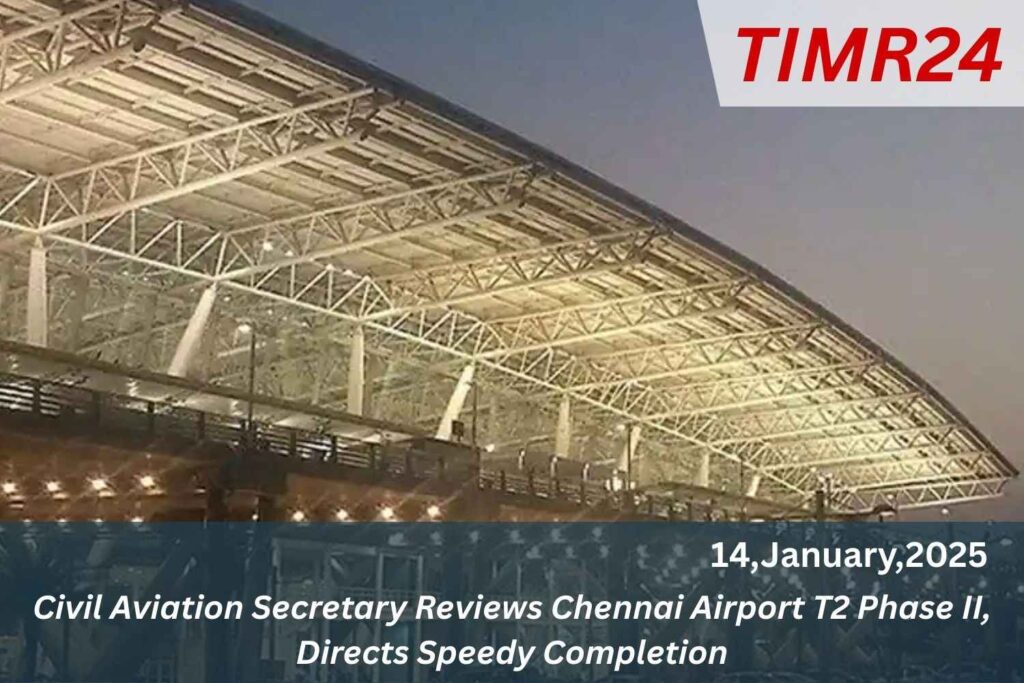
Secretary of the Ministry of Civil Aviation, Samir Kumar Sinha, led a review meeting on the New Integrated Terminal Building (T2 Phase II) at Chennai International Airport, urging the Airports Authority of India (AAI), L&T, and the Project Management Consultant (PMC) to (India) promptly resolve outstanding issues. The T2 Phase II expansion, covering 86,135 sq m, aims to boost passenger capacity to 35 million annually, enhancing the travel experience through improved accessibility and efficient passenger flow to meet increasing regional air traffic demands.
Construction New Terminal Area Spanning
The modernization of Chennai International Airport stands as a cornerstone of the Ministry of Civil Aviation’s strategy to transform India into a global aviation hub. The ongoing Phase II expansion is a massive undertaking that follows the successful inauguration of Phase I by Prime Minister Narendra Modi in 2023. This second stage involves the construction of a new terminal area spanning over 86,000 square meters on the site where the old terminals once stood the Secretary’s intervention was prompted by the need to synchronize the efforts of various contractors. The primary goal is to accommodate the explosive growth in passenger traffic, which is projected to.
Hit the 35 million mark annually by the end of 2026. This growth is not just a number but a reflection of Chennai’s rising status as a commercial and cultural magnet in South India The project has faced several hurdles in the past, including geological challenges like hard rock excavation and price escalations for raw materials. During the review, the Secretary made it clear that “National Importance” projects must adhere to strict timelines monitor the installation of state-of-the-art facilities. These facilities include an Automatic Tray Return System (ATRS), high-speed baggage conveyors, and a sophisticated terminal management system designed to reduce wait times during peak hours.
Maintaining Chennai’s Competitiveness
Furthermore, the integration of T1, T2, T3, and T4 terminals will provide a seamless transit experience, allowing passengers to move between domestic and international zones without leaving the secure perimeter. This connectivity is essential for maintaining Chennai’s competitiveness against other major hubs like Bengaluru and Hyderabad Technically, the Phase II terminal is designed to handle more than 500 aircraft movements daily. The architectural design incorporates traditional Tamil culture with modern sustainable building practices, aiming for a high GRIHA rating. The Secretary’s directive for “speedy completion” also focuses on the landside infrastructure.
Including the approach roads and multi-level car parking, which must be ready to handle the increased vehicle volume. As the project nears its March 2026 deadline, the focus has shifted from heavy civil engineering to internal fit-outs and systems integration. This phase is often (India) the most critical, as it involves testing the security protocols and passenger processing software that will define the terminal’s operational efficiency. The government remains committed to ensuring that the airport reflects the spirit of a modern, “Viksit Bharat,” providing world-class infrastructure for every traveler.
Q1. What is Terminal 2 Phase II at Chennai Airport?
Terminal 2 Phase II is an expansion project aimed at increasing international passenger handling capacity and improving overall airport infrastructure.
Q2. Why did the Civil Aviation Secretary review the project?
The review was conducted to assess progress, identify delays, and direct authorities to ensure speedy completion of the terminal.
Q3. How will T2 Phase II benefit passengers?
It will reduce congestion, improve passenger flow, and offer modern facilities such as faster immigration, baggage handling, and enhanced amenities.
Q4. When is the terminal expected to be completed?
Authorities have been directed to expedite work, though final commissioning will depend on construction and operational readiness milestones.
Q5. How does this project fit into India’s aviation growth plans?
It supports India’s broader strategy to expand airport capacity, enhance connectivity, and meet rising air travel demand.