

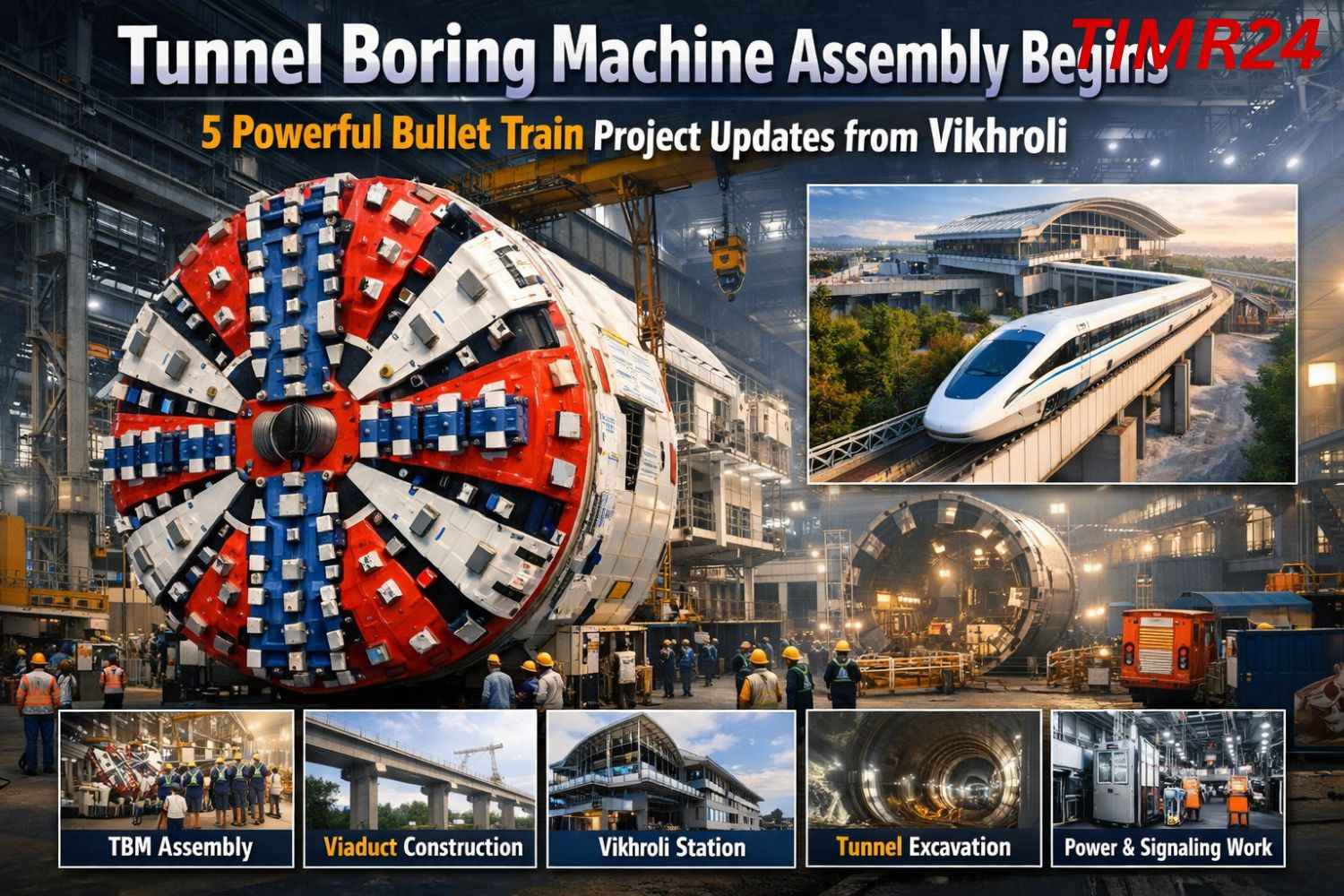













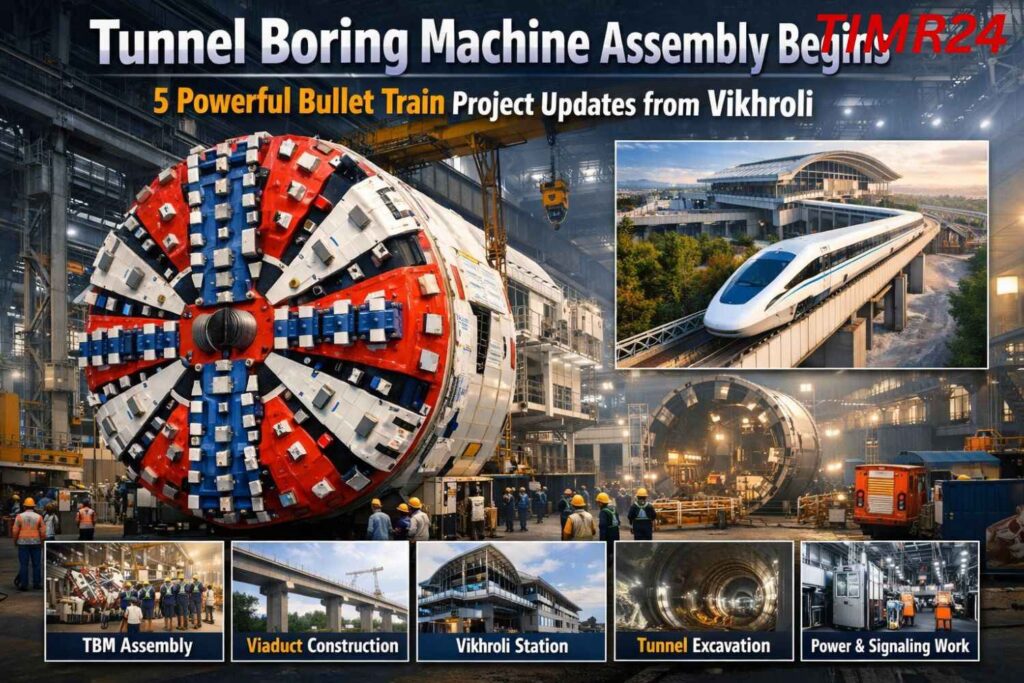
The construction of a 16 km tunnel for the Mumbai-Ahmedabad Bullet Train Project Assembly is underway, utilizing two advanced Tunnel Boring Machines (TBMs) based on Mix Shield/Slurry technology. The project includes India’s first 7 km undersea tunnel beneath Thane Creek. The tunnel features a single tube with a 13.1 m diameter and will reach depths of up to 114 m. The lowering of the TBM’s components has commenced, with TBM 1 starting from Vikhroli towards BKC and TBM 2 from Sawli towards Vikhroli. Each TBM weighs over 3,000 tons and is equipped for complex geological conditions. A dedicated casting yard in Mahape is operational for producing tunnel lining segments.
Development Marks A Significant Step Forward
Employing automated machinery for quality assurance. Monitoring instruments are in place to ensure safe excavation and structure integrity in the vicinity The Mumbai-Ahmedabad Bullet Train Project has achieved another major milestone as the assembly of Tunnel Boring Machines (TBMs) has officially begun at Vikhroli in Maharashtra. This development marks a significant step forward in the construction of India’s first high-speed rail corridor, which is set to revolutionize intercity transportation in the country. The TBMs will be deployed for excavation of the highly challenging underground tunnel section between Bandra-Kurla Complex (BKC) and Shilphata, one of the most technically.
Demanding stretches of the entire project The Mumbai-Ahmedabad High Speed Rail Corridor is India’s flagship bullet train initiative, spanning approximately 508 kilometers and connecting the financial capital Mumbai with Ahmedabad in Gujarat. Once completed, the corridor will dramatically reduce travel time between the two cities while introducing world-class Japanese Shinkansen technology to India. The latest progress at Vikhroli demonstrates the steady momentum being maintained by the National High Speed Rail Corporation Limited (NHSRCL), the implementing agency of the project The Tunnel Boring Machine assembly at Vikhroli is specifically linked to.
Tunnel Stretching Approximately 7 kilometers
The 21-kilometer underground tunnel package of the bullet train corridor. This underground section is considered the most complex engineering portion of the project because it includes India’s first-ever undersea bullet train tunnel stretching approximately 7 kilometers beneath Thane Creek. Out of the total 21-kilometer tunnel, 5 kilometers have already been excavated using the New Austrian Tunnelling Method (NATM), while the remaining 16 kilometers will be constructed using these advanced TBMs According to project officials, the TBMs being assembled are among the largest and most sophisticated tunnel excavation machines deployed in India.
Each machine weighs over 3,000 tonnes and measures around 95 meters in length. These giant machines use slurry-based mix shield technology, specially designed for difficult underground geological conditions such as soft soil, rock layers, and water-bearing strata. Their deployment is crucial because the bullet train tunnel alignment passes through densely populated urban areas and below critical infrastructure, requiring highly precise and safe excavation methods The assembly process itself is a highly technical operation. At Vikhroli, one of the six massive shield segments of the TBM, weighing approximately 170 metric tonnes, has already been lowered into.
TBM Will Begin Tunnelling From Vikhroli Towards
A shaft nearly 56 meters below ground level. This depth is equivalent to a 20-storey building underground. The machine will be assembled piece by piece within the shaft before full testing and commissioning take place. Once operational, the first TBM will begin tunnelling from Vikhroli towards BKC, while another TBM will excavate from Sawli near Ghansoli toward Vikhroli One of the most remarkable aspects of this project is the construction of India’s first undersea rail tunnel. The 7-kilometer undersea segment beneath Thane Creek will establish a new benchmark in Indian infrastructure engineering. Building tunnels below water bodies requires advanced waterproofing systems.
Precise pressure management, and continuous monitoring to ensure structural safety. The successful deployment of TBMs for this segment will showcase India’s growing capability in executing globally competitive infrastructure megaprojects The underground tunnel has been designed as a single-tube structure with a diameter of 13.1 meters, large enough to accommodate twin bullet train tracks. The tunnel depth will vary between 25 meters and 57 meters below ground level, with the deepest construction point reaching 114 meters below Parsik Hill. Such depth and scale highlight the enormous engineering complexity of the project. The use of cutting-edge.
TBMs In Addition, A Specialized Casting
TBMs is essential for maintaining safety, speed, and precision during excavation To support the TBM operations, NHSRCL has already developed dedicated shafts at BKC, Vikhroli, and Sawli. These shafts serve as launch and retrieval points for the TBMs. In addition, a specialized casting yard at Mahape in Thane district has been set up to manufacture tunnel lining segments for the 16-kilometer TBM-driven portion. Approximately 77,000 precast tunnel segments will be produced to form 7,700 tunnel rings, which will line the tunnel walls and provide structural reinforcement throughout the underground stretch The significance of the Mumbai-Ahmedabad Bullet Train Project extends beyond transportation.
It is expected to boost regional economic growth, generate employment, improve urban mobility, and enhance technological capability within India’s construction and railway sectors. The project has also led to the transfer of advanced Japanese high-speed (India) technology and engineering expertise, which could benefit future bullet train corridors planned across the country In recent months, the bullet train project has witnessed rapid progress across multiple construction fronts. More than 340 kilometers of viaduct work has been completed, several stations are under advanced construction, and track bed installation is progressing steadily in Gujarat.
Underground Tunnel Excavation Accelerate
The start of TBM assembly for the underground Mumbai section removes one of the biggest bottlenecks in the project timeline and signals that the most difficult part of the corridor is moving into execution phase Experts believe that once the underground tunnel excavation accelerates, the Mumbai-Ahmedabad Bullet Train Project will enter a transformative stage, bringing India much closer to launching its first bullet train operations. The underground and undersea sections were always expected to be the defining engineering challenge of the project. With TBM assembly now underway, confidence has increased regarding timely completion of this critical package.
Q1. What has started at Vikhroli for the Bullet Train Project?
Assembly of Tunnel Boring Machines (TBMs) has begun for the underground tunnel section of the Mumbai-Ahmedabad Bullet Train corridor.
Q2. Why are TBMs important in this project?
TBMs will excavate the 16-km underground tunnel stretch, including the undersea tunnel beneath Thane Creek.
Q3. How long is the total underground tunnel?
The total underground tunnel section is 21 km.
Q4. What is unique about this tunnel?
It includes India’s first 7-km undersea bullet train tunnel.
Q5. When will tunnelling begin?
Initial TBM drive is expected around July 2026 after assembly and testing.