










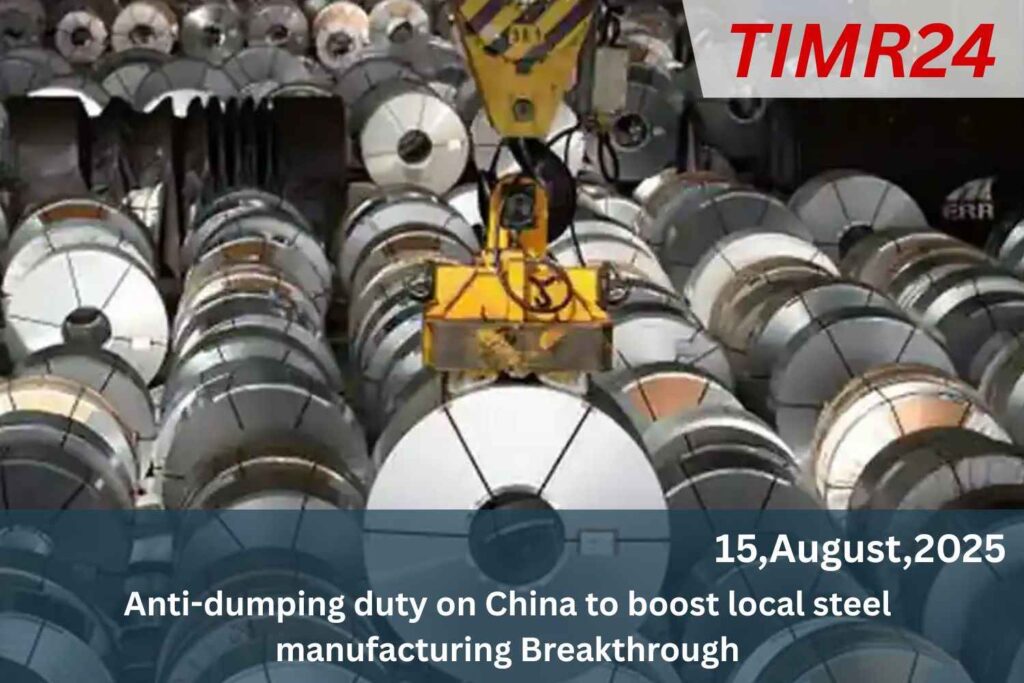
India’s steel producers anticipate a boost in manufacturing and price decrease following the Union government’s five-year anti-dumping duty on China’s wheels. China was the second-largest steel exporter to India, selling 0.6 million metric tons during April-July, up 62% from the previous year. As India navigates the increasingly complex global trade landscape, the imposition of anti-dumping duties on imports from China stands as a strategic intervention to rekindle and reinforce the resilience of local steel manufacturing. In a climate where cheap dumping particularly in segments like alloy wire rods used in auto, defence, and aerospace has sharply undercut domestic margins, producers spearheaded by the Alloy Producers Association of India filed a crucial petition in July 2025, urging regulators to act decisively
Earlier, in 2025, the government rolled out a 12 percent temporary safeguard duty on certain steel imports, largely targeting undervalued Chinese shipments, offering immediate relief to local mills by alleviating pressure on prices and allowing some to defer planned job This policy response goes further than short-term relief; it paves the way for reclaiming competitive advantage. With India’s steel sector having added 14 million (Steel) tonnes of new capacity since early 2024, the reduced import pressure could finally enable the country to transition from being a net importer back to a net exporter, a status last held in 2022 Executives, including those from JSW , view this approach as instrumental in securing a more level playing field for domestic producers.
Nonetheless, concerns persist industry leaders continue to call for vigilance against a potential resurgence of cheap imports, signaling that the current measures are a beginning rather than a comprehensive. Meanwhile, proposals to raise the safeguard duty ceiling from 12 percent to 24 percent are under active consideration, underscoring the government’s readiness to escalate protective measures if necessary The impacts of these duties ripple beyond the steel mills themselves into downstream industries. For instance, the levy on non-alloy and alloy steel flat products has translated into higher spot-market prices by around ₹4–₹5 per kg which, while offering relief to steelmakers, present cost challenges for MSMEs in the construction equipment sector.
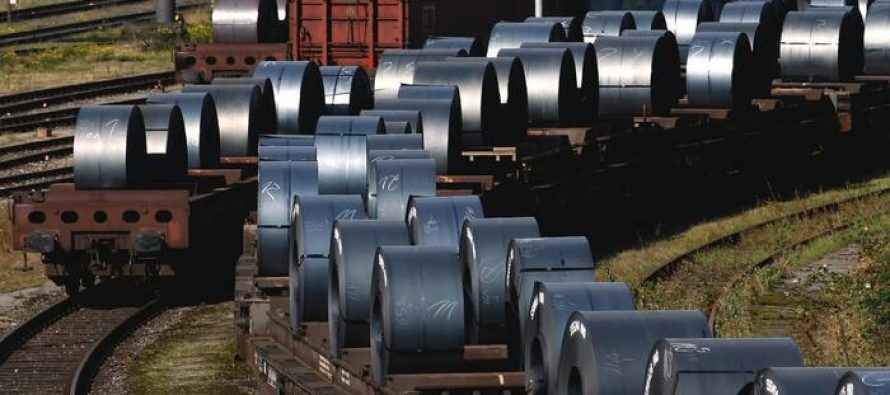
Yet this pricing shift also signals the pressure Chinese dumping had imposed, and the measure’s broader intent to restore fair competition. The sector’s trajectory also resonates with India’s long-term vision under the National Steel Policy, which seeks to dramatically boost both domestic capacity and per-capita consumption while cultivating advanced and high-value capabilities Embedded Manufacturing within this shift are broader strategic currents India’s demand for green innovation, its market diversification efforts via schemes like Rode, PLI incentives, and its push to engage more deeply with global trade frameworks all point toward a multi-pronged approach to bolstering self-reliant, sustainable domestic steel capacity
Yet underlying challenges like elevated energy costs, infrastructure gaps, and scale disadvantages remain. As echoed in industry discourse, such structural issues must be addressed alongside trade remedies if India is to fully break free from being a dumping ground for oversupplied markets In essence, India’s application of anti-dumping duty measures is more than a defence it is a deliberate catalyst for industrial rejuvenation intended to strengthen domestic manufacturing, encourage investment in modernization, and ultimately restore the sector’s global competitiveness. By coupling trade measures with forward-looking policy instruments, the government aims to transform protective action into a foundation for sustainable long-term growth.
Q1. What is anti-dumping duty on Chinese steel?
A trade measure to prevent under-priced Chinese steel from harming India’s domestic industry.
Q2. Why is it being implemented now?
To protect local steelmakers from price undercutting amid rising cheap imports.
Q3. How will it boost local steel manufacturing?
It reduces unfair competition, enabling domestic producers to stabilize prices and increase output.
Q4. Will steel prices rise for consumers?
Yes, slightly, but the increase supports long-term industry sustainability.
Q5. Is this duty permanent?
No, it will be reviewed periodically and adjusted based on market conditions.