















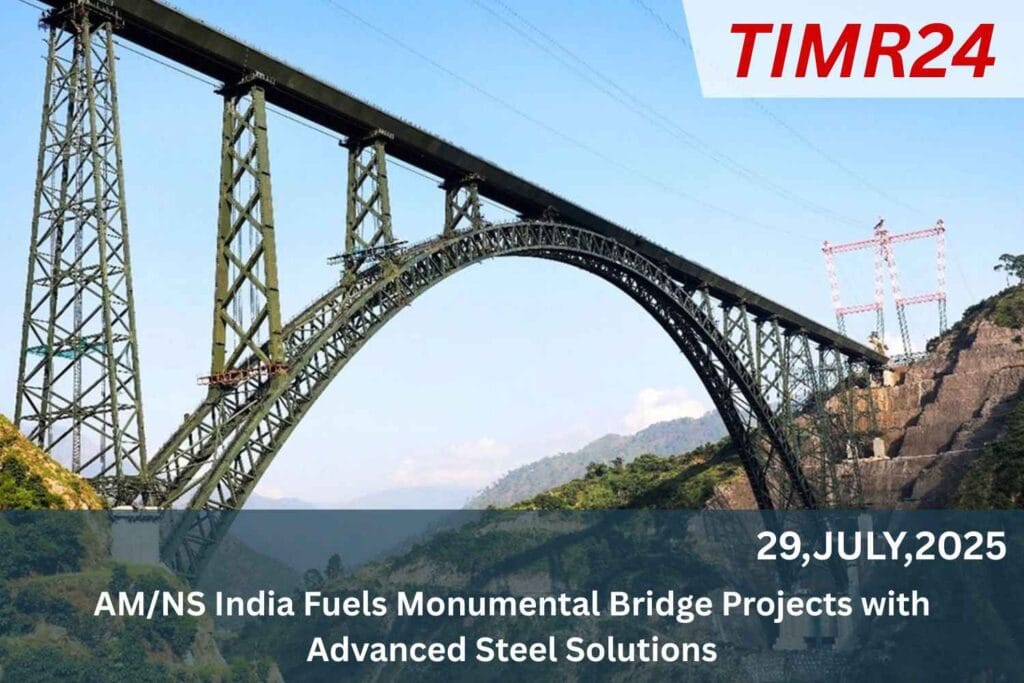
ArcelorMittal Nippon Steel India (AM/NS India) has contributed to India’s infrastructure development by providing high-quality steel for two of the country’s most iconic railway bridges, the Chenab Bridge and the Anji Khad Bridge. India supplied 70% of the flat steel used in the Chenab Bridge and 100% of the steel required for the Anji Khadr Bridge, demonstrating its commitment to powering national infrastructure projects with world-class materials.
The dedication of these engineering marvels by Hon’ble Prime Minister Shri Narendra Modi marks a historic milestone in the journey toward Viksit Bharat 2047. The steel was manufactured under tightly controlled parameters and subjected to rigorous quality checks by third-party agencies. The steel was also supplied approximately 7,000 metric tonnes of customised fabricated steel structures for the Anji Khad Bridge, meeting 100% of the bridge’s steel requirement.
Infrastructure Development in Jammu & Kashmir
The Chenab and Anji Khad bridges represent monumental infrastructure undertakings in Jammu & Kashmir, showcasing India’s engineering prowess in one of the country’s most challenging terrains. These bridges are part of the ambitious Udhampur-Srinagar-Baramulla Rail Link (USBRL) project, which aims to enhance connectivity across the Himalayan region. Notably, the Chenab Bridge, the world’s highest railway bridge, stands at a towering 359 meters above the riverbed, while the Anji Khad Bridge is India’s first cable-stayed railway bridge. These structures are vital for boosting regional connectivity, facilitating tourism, and enhancing logistical efficiency for both passengers and freight. (Infrastructure)
Role of AM/NS India in the Project
AM/NS India, a joint venture between ArcelorMittal and Nippon Steel, has supplied high-quality, specialized steel for both bridges. The company’s contribution includes corrosion-resistant, high-strength steel that can withstand extreme temperature variations, seismic activity, and high wind pressures—crucial characteristics for structures located in Himalayan seismic zones. This project demonstrates AM/NS India’s growing role in strategic infrastructure projects, complementing their previous supply to critical structures like metro rail systems and airport terminals.
Engineering & Design Excellence
The use of AM/NS India steel in the bridges also highlights advancements in structural design and material technology. The Chenab Bridge’s arch structure demanded customized steel sections for accuracy and load-bearing strength, while the Anji Khad Bridge required flexible yet robust steel cables for stability and long-term performance. The steel supplied met the specifications laid out by Indian Railways and international safety standards, ensuring durability and structural integrity.
Boost to the Steel Industry
This collaboration also symbolizes a broader transformation in India’s domestic steel sector. It underscores the shift from general-purpose steel to application-specific grades, aligning with the Make in India initiative. AM/NS India’s role in such high-stakes projects sets a benchmark for other steel manufacturers to diversify and cater to value-added markets. As infrastructure demand rises, India’s steel sector is evolving from a volume-based to a value-driven model.
Socio-Economic Impact
The completion of these bridges will not only reduce travel time and enhance trade in the region but also generate employment, stimulate tourism, and bridge the economic divide between rural and urban areas. AM/NS India’s involvement further reflects the integration of private sector capabilities in public infrastructure. By contributing to such high-profile national projects, the company is reinforcing its commitment to nation-building and sustainability. (Regional development).
Q1. What role did AM/NS India play in the Chenab and Anji Khad bridges?
AM/NS India supplied specialized, high-quality steel critical for the construction of both landmark railway bridges.
Q2. Why is the Chenab Bridge significant?
It is the world’s highest railway bridge, standing 359 meters above the Chenab River, part of the USBRL project.
Q3. What makes the Anji Khad Bridge unique?
It is India’s first cable-stayed railway bridge, designed to handle complex terrain and strong wind conditions.
Q4. What type of steel was used in these bridges?
India provided corrosion-resistant, high-strength steel engineered for extreme temperatures and seismic zones.
Q5. How do these bridges impact Jammu & Kashmir?
They improve regional connectivity, boost economic activity, and are crucial to integrating remote areas into the national rail network.