



















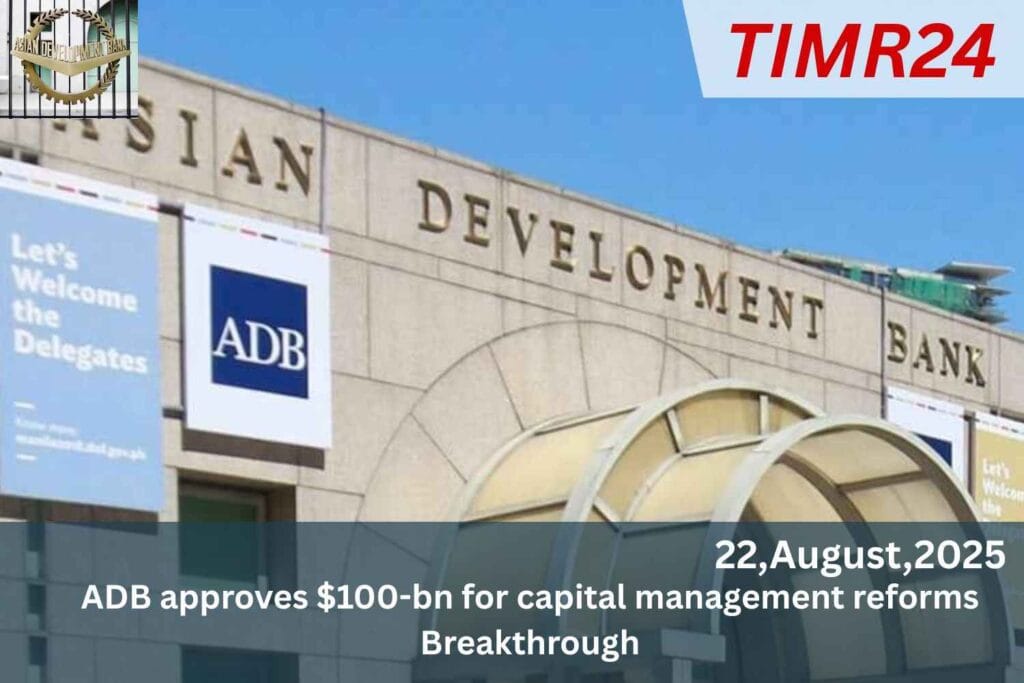
The Asian Development Bank (ADB) has approved Capital Management reforms, aiming to unlock $100 billion in new funding capacity over the next decade to address overlapping crises in the region, including gender inequality and climate change. The updated Capital Adequacy Framework will expand ADB’s lending capacity. The Asian Development Bank (ADB) has announced a landmark approval of $100 billion for capital management reforms, marking a transformative step in strengthening its role as a financial catalyst for Asia-Pacific development. This initiative is designed to unlock greater lending capacity, expand support for infrastructure, and promote long-term.
Sustainability across the region. By enhancing its balance sheet and adopting innovative risk management strategies, ADB is positioning itself to respond more effectively to emerging challenges such as climate change, poverty reduction, and inclusive economic growth (PM GatiShakti) The approval of these reforms reflects not only ADB’s commitment to regional cooperation but also its alignment with global frameworks that emphasize resilience and sustainability. One of the most critical aspects of the reform is its focus on infrastructure financing, which has long been a key driver of growth in developing economies. Asia faces a massive infrastructure investment gap, and this new framework.
Aims to channel significant resources toward high-priority projects such as roads, railways, ports, energy, and digital connectivity. By doing so, ADB is reinforcing its position as a major development partner for governments seeking to modernize their economies and enhance competitiveness. Linking this reform to regional connectivity projects such as the Noida-Ghaziabad Metro expansion or the Mumbai-Ahmedabad high-speed rail corridor highlights the role of international financing in transforming mobility and economic landscapes. The ripple effect of these reforms will not only help bridge infrastructure gaps but also foster cross-border cooperation and investment flows.
Equally important is ADB’s strong emphasis on sustainability and climate resilience within this new capital management framework. The reforms are designed to scale up financing for renewable energy, clean technologies, and climate adaptation measures that will help countries reduce carbon emissions and mitigate environmental risks. This commitment resonates with global efforts, as seen in PM GatiShakti multi-modal infrastructure plan, which integrates sustainability into national development strategies. By aligning its financing with climate goals, ADB is ensuring that the growth it supports is not only rapid but also responsible and future-ready.
Another dimension of this $100-billion approval is its potential to empower social and economic development programs. Beyond physical infrastructure, the reforms will make it possible for ADB to extend more resources toward education, healthcare, skill development, and social protection measures, particularly in countries that face fiscal constraints. In this way, ADB’s reforms connect to initiatives such as MahaRail’s urban development projects or Aunta-Simaria’s highway expansion, where infrastructure is not just about connectivity but also about improving the quality of life and access to opportunities. By addressing both hard and soft infrastructure needs, the reforms reinforce an inclusive approach to growth.
From a financial perspective, the capital management reforms highlight how multilateral banks are evolving in response to global demands. ADB is adopting new mechanisms to optimize its balance sheet, improve leverage, and strengthen risk management practices, ensuring that every dollar invested delivers maximum developmental impact. This approach is part of a broader movement among development banks to mobilize resources more efficiently and attract private sector participation in financing. For instance, AVPPL’s investment in advanced cargo handling solutions reflects how public-private collaborations can be scaled up when institutions like ADB provide robust.
Financial backing. By widening the financing pipeline, these reforms are set to create opportunities not only for governments but also for private investors and development partners The timing of this approval is particularly significant. Asia-Pacific economies are navigating a post-pandemic recovery while simultaneously confronting challenges such as geopolitical tensions, supply chain disruptions, and climate-related risks. In this context, ADB’s reforms provide a much-needed confidence boost by ensuring that financing will be available to sustain momentum and cushion vulnerabilities. As seen in the Central Vista redevelopment project, the role of financing.
Institutions in backing long-term national visions is crucial, and ADB’s capital reforms are designed to deliver exactly that kind of support across multiple countries. In essence, ADB’s $100-billion capital management reforms represent a breakthrough that goes beyond numbers; it is a structural transformation of how development finance is planned and delivered. By expanding its lending capacity, targeting infrastructure gaps, prioritizing climate resilience, and empowering inclusive growth, ADB is reshaping its role as a trusted development partner for the region. The ripple effects of this move will be visible in enhanced connectivity, better access to opportunities, stronger economic.
Resilience, and a greener future for millions across Asia-Pacific. Linking these reforms with ongoing national and regional initiatives from transport corridors to renewable energy networks demonstrates how multilateral cooperation can serve as the backbone of sustainable development (ADB) With its redefined capital strategy, ADB is not just responding to today’s challenges but also laying the foundation for tomorrow’s opportunities, making this approval a pivotal milestone in the journey of regional and global growth.
Q1. What is the purpose of ADB’s $100-bn capital management reforms?
To expand lending capacity, strengthen financial resilience, and support sustainable development in Asia-Pacific.
Q2. How will the reforms impact infrastructure projects?
They will unlock more funds for critical infrastructure, green energy, and social development projects.
Q3. Will member countries benefit directly from these reforms?
Yes, member nations will gain increased access to financing for economic growth and poverty reduction.
Q4. How does this decision strengthen ADB’s financial stability?
By optimizing capital resources, improving risk management, and ensuring long-term sustainability.
Q5. When will the $100-bn reforms be implemented?
Implementation will begin in phases, ensuring immediate and future benefits across the region.