


















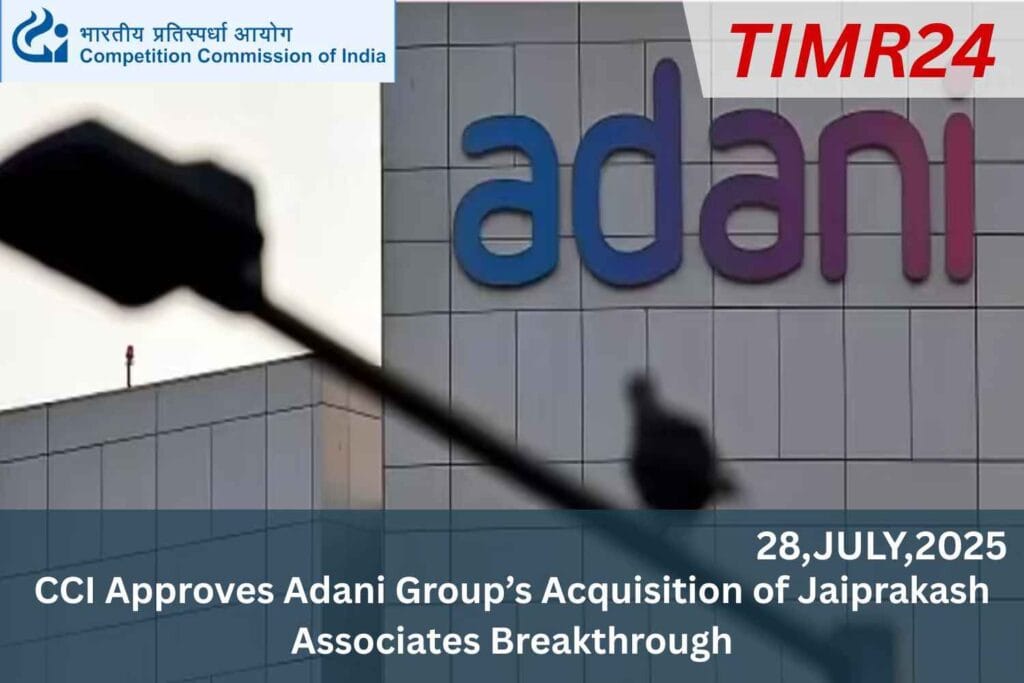
The Competition Commission of India (CCI) has approved the acquisition of Jaiprakash Associates Limited (JAL) by Adani Group entities, allowing them to acquire up to 100% shareholding. JAL is currently undergoing corporate insolvency resolution under the Insolvency and Bankruptcy Code, 2016. Adani Group operates in various sectors. The approval by the Competition Commission of India (Metro Project) for Adani Group’s acquisition of Jaiprakash Associates has emerged as one of the most significant corporate breakthroughs in India’s infrastructure and cement sector, not only because it marks a large-scale merger but also because it symbolizes the changing face of India’s business consolidation landscape where leading conglomerates are expanding into core industries to build stronger.
Foundations for long-term growth. The Adani Group, already known for its dominance in energy, logistics, and ports, has in recent years turned its attention toward cement and construction, sectors that are directly tied to India’s infrastructure push under government programs such as the National Infrastructure Pipeline (NIP) and the PM Gati Shakti masterplan, both of which are expected to fuel cement consumption in the coming decades. The entry into cement was initially marked by Adani’s acquisition of Ambuja Cements and ACC, and with the fresh approval to take over Jaiprakash Associates’ assets, Adani further strengthens its hold, positioning itself to compete head-to-head with industry leaders like UltraTech. For Jaiprakash Associates, once a household.
Name in construction and cement, the transaction is both a financial relief and a strategic exit from debt-heavy operations that had been burdening the company for years, as mounting liabilities and restructuring pressures had forced asset divestments to ensure survival. The deal is, therefore, not just about asset transfer but about the story of resilience, market consolidation, and the evolution of India’s corporate debt management. Looking closely at the impact on the cement sector, this acquisition enhances Adani’s production capacity significantly, which is particularly important as the demand for cement is closely tied to housing, highways, bridges, and industrial development.
regulatory and policy perspective
The Indian cement industry has historically been fragmented, but recent years have shown an aggressive wave of consolidation, with strong players expanding to capture growing demand The entry of Adani, backed by its financial strength and integrated infrastructure ecosystem, creates a scenario where supply chains can become more efficient and pricing can remain competitive. According to reports from institutions like ICRA, India’s cement sector is poised for steady growth despite short-term fluctuations, and players like Adani will play a vital role in stabilizing supply and maintaining the momentum of projects that are critical to the country’s infrastructure goals. Moreover, the deal.
Highlights the role of the as a regulator, ensuring that such acquisitions do not lead to monopolistic practices but rather encourage fair competition The CCI’s nod to this transaction demonstrates that the commission sees the deal as a way to strengthen industry resilience without harming market competitiveness, a crucial factor in a sector as essential as cement. For Adani Group, this acquisition is another step in aligning its cement strategy with its larger infrastructure portfolio, which includes ports, power plants, renewable energy parks, and logistics corridors. By integrating cement manufacturing with its infrastructure projects, Adani can reduce procurement costs, ensure timely material supply, and expand its influence across the entire construction ecosystem.
This integration also means that the group is better positioned to deliver large-scale projects such as metro networks. Smart cities, expressways, and renewable energy infrastructure, many of which have been highlighted in our previous coverage of projects like the and These developments underline how cement is not just a product but the backbone of infrastructure, and Adani’s ability to control production gives it a unique advantage in meeting deadlines and maintaining quality across projects. On the other side, Jaiprakash Associates, once a pioneer in highways, dams, and power projects, has faced financial stress for nearly a decade, largely due to over-leverage and delays in project execution. Selling its cement assets to.
Adani’s acquisition will likely trigger
Adani marks a crucial turning point, enabling the company to pare down debt and concentrate on stabilizing its remaining businesses This is part of a larger narrative in India where debt-ridden companies are increasingly offloading non-core or capital-intensive assets to stronger players, a trend that ensures continuity in industries vital to the economy. For instance, we recently saw similar moves in the energy and logistics sectors, where weaker firms merged or sold assets to larger conglomerates to ensure efficiency and growth. In the case of Jaiprakash Associates, the deal not only helps them achieve financial stability but also contributes to sectoral consolidation that benefits the economy at large.
From a regulatory and policy perspective, the CCI’s approval is also a message that India’s corporate environment encourages consolidation when it leads to efficiency, provided it does not harm consumers or restrict competition. By ensuring that the Adani-Jaiprakash deal does not distort market conditions, the CCI has balanced corporate ambition with market fairness. For policymakers, such decisions are in sync with India’s broader vision of achieving infrastructure-driven growth, where companies with strong financial and operational capabilities are entrusted with executing large-scale projects that require reliability and scale. This is especially relevant as India continues to invest in infrastructure, from highways like to massive transportation corridors and greenfield airport developments.
Looking at future implications, Adani’s acquisition will likely trigger further consolidation in the cement sector, as competitors attempt to strengthen their positions in response to Adani’s rapid expansion. For consumers and construction companies, this could translate into more reliable supply chains and stable pricing, as larger players can afford to absorb fluctuations in input costs like coal and energy. Additionally, the synergies between Adani’s logistics, ports, and cement businesses mean that the group can reduce transportation bottlenecks, an advantage that could eventually reduce costs for large-scale builders and even smaller housing developers. For India’s infrastructure ecosystem, this translates into smoother project execution and timely delivery.
Which has often been a challenge due to fragmented supply chains and high input volatility. The acquisition also demonstrates how conglomerates like Adani are positioning themselves as end-to-end infrastructure solution providers, integrating everything from energy supply to raw materials, logistics, and construction. This comprehensive approach reflects global trends where large corporations seek vertical integration to remain competitive and resilient in volatile markets. In India’s context, where infrastructure is a national priority, such integration ensures that the country’s ambitious growth plans are not hindered by fragmented supply chains or financial stress among mid-sized players. In fact, when viewed alongside our earlier coverage on
It becomes clear how critical cement and construction capacity is in every dimension of development, whether it is railways, airports, roads, or housing. the CCI’s approval of Adani Group’s acquisition of Jaiprakash Associates represents much more than a business transaction it is a reflection of India’s evolving corporate landscape, where consolidation, efficiency, and long-term strategy are shaping the future of infrastructure and construction. For Adani, it strengthens its journey to becoming a global leader in cement and infrastructure, for Jaiprakash Associates, it marks financial relief and a new beginning, and for India, it ensures that the cement sector is better prepared to meet.
Q1. What is the significance of CCI approving Adani Group’s acquisition of Jaiprakash Associates?
It allows Adani to expand in cement and infrastructure, strengthening its market presence.
Q2. How will this acquisition impact the cement sector in India?
It boosts Adani’s production capacity, enhancing competition in the Indian cement industry.
Q3. What does this deal mean for Jaiprakash Associates?
It provides financial relief and an exit from debt-heavy operations.
Q4. How does this acquisition align with Adani Group’s growth strategy?
It supports Adani’s ambition to become a leading cement producer alongside infrastructure expansion.
Q5. Will this acquisition affect consumers and construction costs?
In the long run, it could lead to stable supply and more competitive pricing.