



















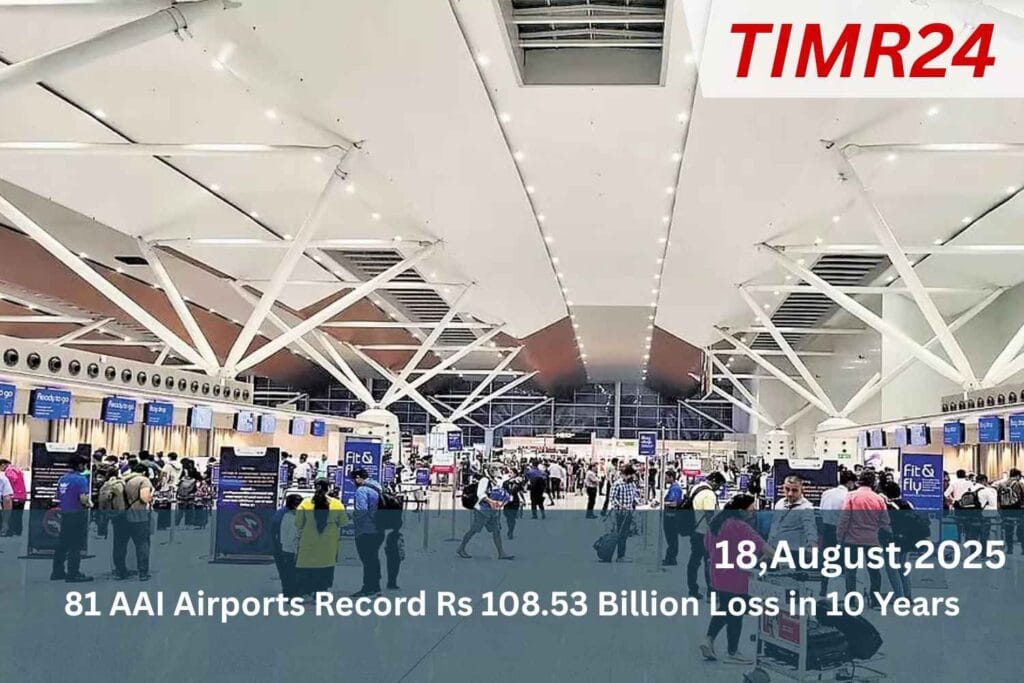
The Airports Authority of India (AAI) has reported losses of Rs 108.53 billion over the past decade, with 22 of these airports now non-operational. The highest losses were reported at Safdarjung Airport in Delhi, followed by Agartala, Hyderabad, Dehradun, and Vijayawada. Other major loss-making airports include Bhopal, Aurangabad, Tirupati, Khajuraho, and Imphal. The Regional Connectivity Scheme Due Desh Ka Aam Nargiz (RCS-UDAN) was launched in 2016 to improve air connectivity from unserved and underserved The Authority of India (AAI), which manages a majority of the country’s airports, has been grappling with financial challenges, as recent data reveals a cumulative loss of Rs 108.53 billion over the past decade. This staggering figure highlights not just the strain on
Government-managed airports but also the evolving landscape of India’s aviation industry. While air travel has surged significantly in metros and tier-1 cities, many regional airports under AAI continue to operate with underutilized capacity, limited revenue generation, and rising operational costs, leading to long-term financial distress. The financial losses are attributed largely to the mismatch between revenue collection and expenditure. On one hand, the under private-public partnership (PPP) models such as Delhi, Mumbai, Hyderabad, and Bengaluru have been thriving with strong passenger inflows and diversified non-aeronautical revenues.
On the other hand, AAI’s directly managed airports, especially in smaller cities, face reduced footfall, lower commercial income, and high infrastructure maintenance expenses. This imbalance creates a widening gap that impacts AAI’s financial stability. To understand the depth of the issue, it is important to look into how privatization has shifted the revenue dynamics. The losses are not uniform across the board; a handful of large and profitable airports managed by AAI continue to generate positive cash flows. However, the majority of smaller airports, particularly those in tier-2 and tier-3 cities, are unable to sustain operations at current cost levels. Despite heavy investment.
Under government initiatives like UDAN (Due Desh ka Aam Nagrik), which aimed to connect underserved regions through affordable flights, the return on investment has been slow. Airlines have either withdrawn services due to low demand or reduced frequency, which further erodes the financial base of these airports. This raises questions on how sustainable regional connectivity can be without a balanced (Airports Authority) financial model Another critical factor behind the Rs 108.53 billion loss is the limited scope of non-aeronautical revenues for AAI-managed airports. Unlike private, which leverage retail spaces, advertising, food courts, parking, and hospitality tie-ups, many
AAI are yet to fully exploit these opportunities. The reliance on aeronautical revenues alone, such as landing fees, parking charges, and passenger service fees, creates vulnerability, especially when passenger traffic fluctuates. In contrast, private players have demonstrated how commercial spaces within airports can become major revenue drivers. To bridge this gap, AAI must accelerate its focus on real estate development, partnerships with retail brands, and improved passenger amenities The financial strain also reflects broader challenges in infrastructure management. AAI has made significant capital investments in upgrading terminals, runways, and safety
Systems to meet international standards, but the expected returns have not materialized in all regions. For example, airports in remote areas, though critical for strategic and social reasons, may not achieve profitability in the short term. This creates a dual role for AAI: on one side, functioning as a commercial body expected to generate revenue, and on the other, serving as a national authority responsible for connectivity and accessibility. Balancing these roles requires careful financial restructuring and possibly more government support Looking ahead, recovery strategies for AAI are likely to focus on expanding the PPP model. The transfer of profitable to private operators
Under long-term lease agreements has been a contentious issue, as it reduces AAI’s revenue share while lowering its operating burden. However, proponents argue that this allows AAI to concentrate resources on unprofitable airports that need attention. For AAI to regain financial health, reforms such as innovative financing models, better integration of digital systems, and public-private collaborations in regional may be necessary It is also important to assess the implications of these losses on air travellers and the aviation ecosystem. While ticket fares are largely regulated by airlines, airports can impose higher user charges, which may eventually be passed on to passengers. This creates a cycle where affordability, one of the core visions of India’s aviation growth, might get.
Compromised. Additionally, if AAI continues to accumulate losses, the government may need to provide direct financial support, which could affect budgetary allocations for other infrastructure sectors. The impact of these decisions will ripple across the aviation supply chain, from airlines to service providers and passengers alike the Rs 108.53 billion loss recorded by AAI over ten years is a (Ministry of Civil Aviation) reflection of structural, operational, and policy-level challenges. While major thrive under privatization, regional airports continue to bleed financially, threatening the long-term sustainability of India’s airport network. The way forward lies in strategic reforms, innovative revenue models, and a stronger balance between commercial viability and social responsibility.
Q1. Why did AAI airports record a Rs 108.53 billion loss?
AAI’s losses stem from high operational costs, underutilized airports, and limited revenue sources.
Q2. Which airports contributed most to the losses?
Mainly smaller regional airports with low passenger traffic contributed heavily.
Q3. How is AAI planning to recover these losses?
AAI aims to boost non-aeronautical revenue, enhance PPP models, and increase efficiency.
Q4. Will these losses impact air travelers?
Passengers may face higher charges at certain airports to balance financial stress.
Q5. What role does privatization play in reducing AAI’s losses?
Privatization of major airports has reduced AAI’s revenue share but also eased its cost burden.