






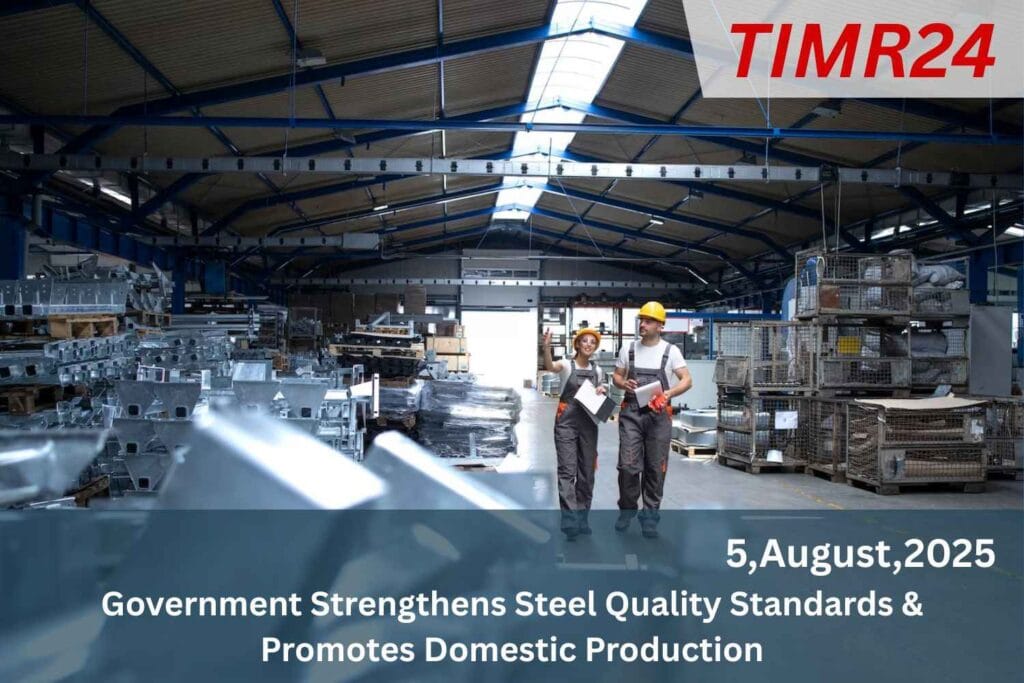
The Indian government has allocated ₹6,833.46 crore over five years to enhance infrastructure development along India’s National Waterways, aiming to promote sustainable transport and economic growth. Major allocations include the Jal Marg Vikas Project and the development of NW-2 in Assam. The Inland Waterways Authority of India is constructing 60 community jetties and constructing hybrid electric catamarans. The Government of India has taken a decisive step to fortify the nation’s steel ecosystem by tightening quality control measures and encouraging greater domestic production. These reforms, spearheaded by the Ministry of Steel, aim to improve the competitiveness of Indian steelmakers, reduce dependency on imports, and align Indian products with global standards.
Enhanced Quality Control Orders (QCOs)
The Ministry has issued revised Quality Control Orders (QCOs) that make it mandatory for various steel products—such as rebars, flat products, and alloy steels—to conform to Bureau of Indian Standards (BIS) specifications. These orders cover not just primary manufacturers but also secondary steel producers, ensuring uniformity in output quality across the sector The move is seen as a response to rising concerns over substandard imported steel entering the domestic market. By mandating strict compliance, the government aims to safeguard end-users and uphold India’s growing reputation in international infrastructure and construction markets. (Steel)
Focus on Self-Reliance and Make in India
Aligned with the Atmanirbhar Bharat initiative, the government’s emphasis on domestic steel production aims to stimulate local industries and reduce the country’s reliance on foreign suppliers. With India being the second-largest steel producer globally, there is significant potential to increase exports while meeting domestic demand sustainably. The Ministry of Steel has encouraged the use of Made-in-India steel in sectors like railways, defence, shipping, and infrastructure. Additionally, public procurement guidelines have been updated to give preference to domestically manufactured steel under the Public Procurement (Preference to Make in India), Order 2017.
Promoting Green and Value-Added Steel
Another key focus area is the promotion of value-added and green steel. The government is encouraging investments in clean technologies such as Electric Arc Furnaces (EAF) and Hydrogen-based steelmaking, which are less carbon-intensive than traditional blast furnaces. This aligns with India’s international climate commitments under the Paris Agreement and the roadmap toward net-zero emissions by 2070. Incentives and policy support are also being considered for companies that adopt green steel technologies, enhancing India’s position as a sustainable steel-producing nation. (Green Steel).
Implications for the Industry
These regulatory changes are expected to benefit integrated steel producers who have already adopted BIS standards. However, secondary and small-scale producers will need to invest in quality upgrades to remain compliant. In the long run, this could lead to industry consolidation and the emergence of stronger, more resilient domestic players. The move also opens up export opportunities, particularly in regions like the Middle East, Southeast Asia, and Africa, where demand for high-quality Indian steel is rising.
Conclusion
With the tightening of quality standards and the push for domestic production, the Indian government is laying a strong foundation for a modern, self-reliant, and globally competitive steel industry. These steps not only protect consumer interests but also position India as a key player in the global steel supply chain.
q1. What changes has the government made to steel quality standards?
The government has revised Quality Control Orders (QCOs) to mandate compliance with BIS standards for a wide range of steel products.
q2. Why is India strengthening steel quality norms?
To curb substandard imports, ensure safety, improve product reliability, and align domestic steel with global standards.
q3. How does this move support domestic steel producers?
By promoting the use of Made-in-India steel in key sectors and limiting the entry of low-grade foreign steel, it gives Indian manufacturers a competitive edge.
q4. Are these quality norms applicable to small-scale or secondary steel producers?
Yes, the revised QCOs apply to both primary and secondary steel producers, encouraging uniform quality across the industry.
q5. Is the government promoting sustainable steel production too?
Yes, policies are being framed to support green and value-added steel, with incentives for adopting clean technologies like Electric Arc Furnaces and hydrogen-based processes.