







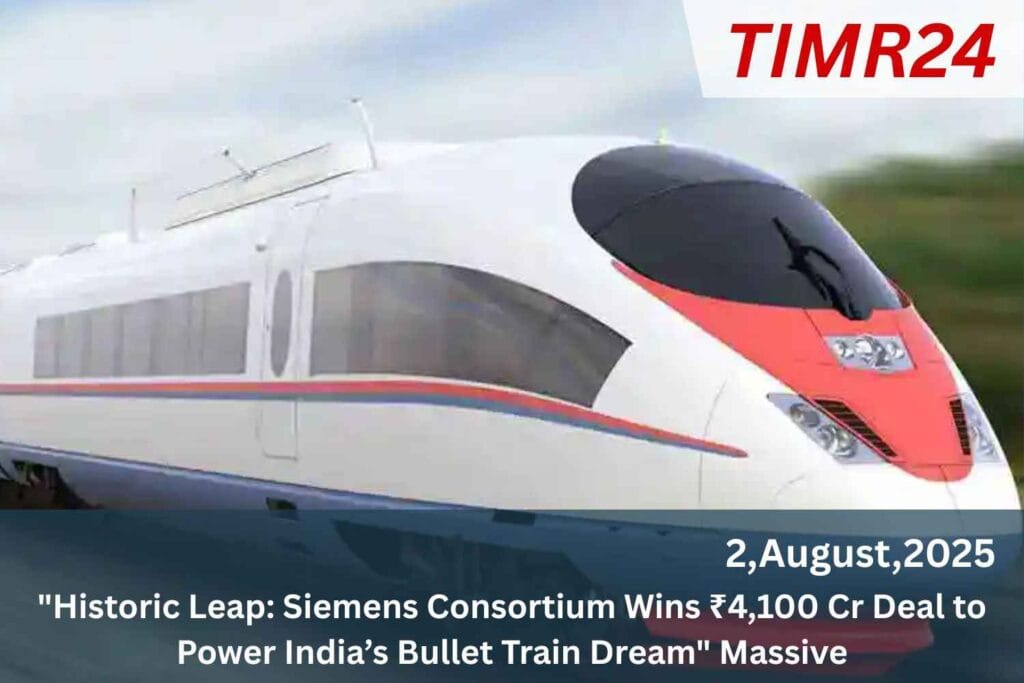
Siemens Ltd has secured a ₹4,100 crore contract from NHSRCL for the Mumbai-Ahmedabad bullet train project, covering design, installation, and maintenance of advanced signalling and telecommunication systems. The project will be executed over 54 months, with Siemens providing 15 years of maintenance support.
In a major boost to India’s high-speed rail ambitions, a consortium led by Siemens AG has secured a ₹4,100 crore contract for the Mumbai-Ahmedabad bullet train project. The project, implemented by the National High-Speed Rail Corporation Limited (NHSRCL), marks a significant step in advancing India’s transport infrastructure to global standards.
Scope of the Contract
The Siemens-led consortium—which includes Siemens India and other global technology partners—will be responsible for providing the 25 kV AC electrification system and power supply infrastructure for the bullet train route. This includes traction substations, switching stations, and the overhead equipment (OHE) essential for powering the 508-km high-speed corridor. The advanced technology is expected to ensure high operational reliability and energy efficiency. The contract involves designing, supplying, installing, and commissioning the 25 kV AC overhead electrification system along with traction substations, switching posts, and the entire power supply system for the 508-km corridor. Siemens, known for its expertise in rail electrification, will deliver energy-efficient and robust systems tailored for high-speed rail. (India’s Railway Technology)
Importance to India’s Rail Modernization
This deal is part of India’s efforts to modernize railway infrastructure, a vision supported by the Indian Railways’ mission to shift towards electrified and high-speed corridors. The Mumbai-Ahmedabad high-speed rail (MAHSR) line is India’s first bullet train project, modelled on Japan’s Shinkansen system, and is expected to cut travel time between the two financial hubs to around 2 hours from the current 6–7 hours.
Make in India and Localisation Push
Under the terms of the contract, Siemens and its consortium partners will also contribute to the Make in India initiative by localizing certain components of the electrification infrastructure. This includes sourcing materials, engaging domestic subcontractors, and facilitating knowledge transfer to Indian engineers and technicians.
Timeline and Progress
According to NHSRCL, the installation work is set to commence shortly and align with the ongoing civil construction of the MAHSR corridor, which is being developed in phases. The bullet train project is expected to begin partial operations by 2026, with full commissioning aimed for 2028, depending on land acquisition and other clearances.
Global Expertise Meets Indian Vision
Siemens’ involvement brings world-class engineering experience from high-speed rail projects across Europe, especially Germany and Spain. This collaboration is viewed as a positive sign of international confidence in India’s infrastructure rollout and ability to handle complex megaprojects with global standards. (Railways)
Conclusion
The ₹4,100 crore contract awarded to the Siemens-led consortium is a landmark development that accelerates India’s high-speed rail aspirations and sets a precedent for future transport innovations. With electrification and sustainability at its core, the Mumbai-Ahmedabad bullet train will not only revolutionize domestic travel but also elevate India’s global image as a forward-looking economy with robust infrastructure capabilities.
Q1. What is the value of the contract awarded to Siemens-led consortium?
The consortium has been awarded a contract worth ₹4,100 crore for the Mumbai-Ahmedabad bullet train project.
Q2. What will Siemens provide under this contract?
Siemens will deliver the electrification system, including 25 kV AC overhead equipment, traction substations, and power supply infrastructure.
Q3. Which project is this contract part of?
This is part of the Mumbai-Ahmedabad High-Speed Rail (MAHSR) project—India’s first bullet train corridor.
Q4. How does this support the Make in India initiative?
The contract includes local sourcing, domestic subcontracting, and skills transfer to promote Make in India.
Q5. When is the bullet train expected to begin operations?
The first phase of operations is expected by 2026, with full completion targeted for 2028.