













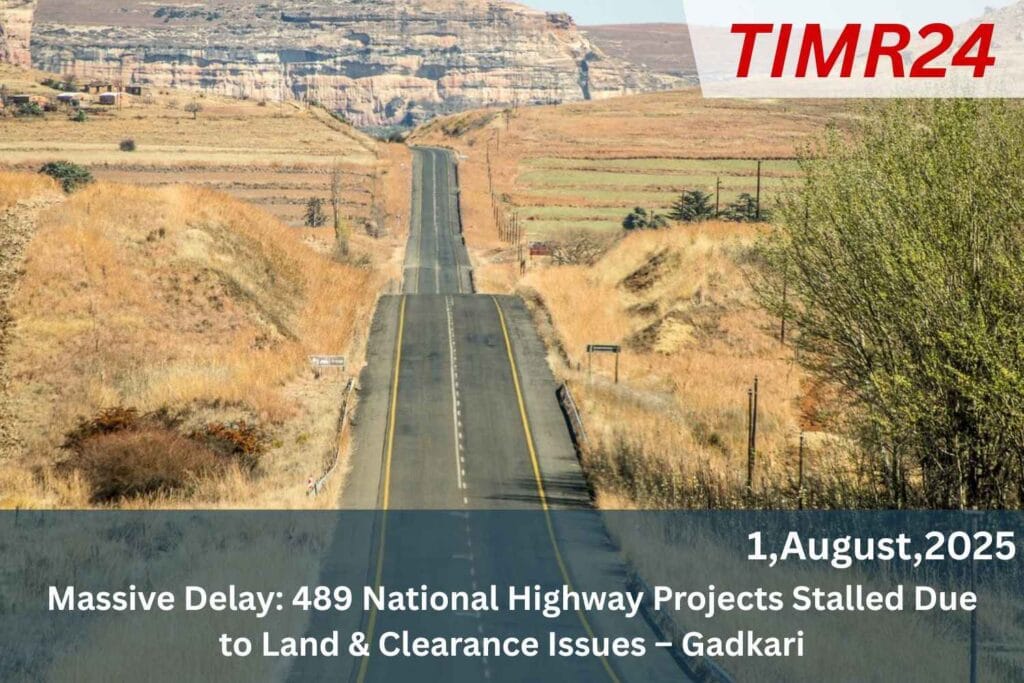
489 national highway projects, scheduled for completion by March 2025, are facing delays due to land acquisition, clearances, and railway approvals. Union Minister Nitin Gadkari said the government is working with state authorities to resolve the issues, which have led to cost overruns. If projects fail, contracts are terminated and re-awarded, sometimes with revised configurations.
Overview of the Issue
Union Minister for Road Transport and Highways, Nitin Gadkari, recently informed Parliament that 489 national highway projects across the country are currently delayed due to a range of implementation hurdles. Chief among these are issues related to land acquisition, forest and environmental clearances, and contractor performance. These projects form part of the government’s expansive highway development agenda under the Bharatmala Pariyojana, which aims to upgrade over 83,000 km of roads for seamless connectivity. (Highway)
Land Acquisition Bottlenecks
According to ministry data, a significant number of delays stem from land acquisition challenges at the state level. Differences in compensation, legal disputes, and resistance from local communities have stalled several packages, especially in densely populated or industrial zones. The Ministry is working with state governments and local authorities to expedite land transfer and resolve litigation.
Union Road Transport and Highways Minister Nitin Gadkari informed the Lok Sabha that 489 national highway projects are currently delayed across India, primarily due to challenges involving land acquisition, environmental clearances, and contractor inefficiencies. These projects are part of flagship initiatives like the Bharatmala Pariyojana, which seeks to enhance road connectivity nationwide. According to the (Lok Sabha unstarred) delays have wide-reaching implications for logistics and economic growth.
Clearance and Approval Delays
Another major cause of delay is the slow pace of forest and environmental clearances. Projects passing through ecologically sensitive zones, protected forest areas, or tribal regions often require multi-tiered approvals from both central and state agencies. In several cases, the absence of timely clearance has led to cost overruns and extended project timelines. The Ministry of Environment, Forest and Climate Change is reviewing clearance protocols to reduce red tape without compromising sustainability.
Contractor and Project Execution Issues
Beyond administrative hurdles, many projects are facing difficulties due to underperformance by contractors or disputes over contractual terms. Financial constraints, delays in mobilization, and technical challenges in hilly or remote terrain have led to execution failures. In some cases, arbitration or blacklisting measures are being initiated. The National Highways Authority of India (NHAI) is exploring alternative models of project management, including hybrid annuity and EPC contracts.
Steps Being Taken by the Government
To address these delays, the Ministry is taking a multi-pronged approach. Special project monitoring cells have been activated, and regular review meetings with states are being conducted. The Centre is also considering incentives for early land acquisition and fast-tracking clearances through digital portals like, which integrates environment-related approvals in one place. Furthermore, NHAI is developing a risk-allocation framework to minimize litigation and improve private sector participation.
Economic and Infrastructure Impact
The delay in highway projects has a ripple effect across the economy—slowing logistics efficiency, raising transportation costs, and affecting employment in the construction sector. Timely completion is crucial for improving rural connectivity, enhancing freight corridors, and reducing carbon emissions through shorter routes. Stakeholders are urging greater coordination between central and state agencies to ensure that highway development remains on track.
Conclusion
With 489 projects stalled, the challenge is immense—but so is the opportunity. Swift resolution of land, clearance, and execution issues will be key to reviving momentum in India’s road infrastructure sector and ensuring long-term economic benefits.
Q1. Why are 489 highway projects delayed in India?
Most delays are due to land acquisition problems, environmental clearances, and contractor issues.
Q2. Which ministry reported the project delays?
The Ministry of Road Transport and Highways, led by Nitin Gadkari, reported the delays in Parliament.
Q3. What are the economic impacts of these delays?
Delays increase project costs, affect job creation, and slow down logistics and infrastructure growth.
Q4. Which states are most affected by these project delays?
States with high infrastructure activity like Uttar Pradesh, Maharashtra, and Tamil Nadu are among the most affected.
Q5. What is Bharatmala Pariyojana, and how is it related?
Bharatmala Pariyojana is a flagship highway development program, under which many of the delayed projects fall.