













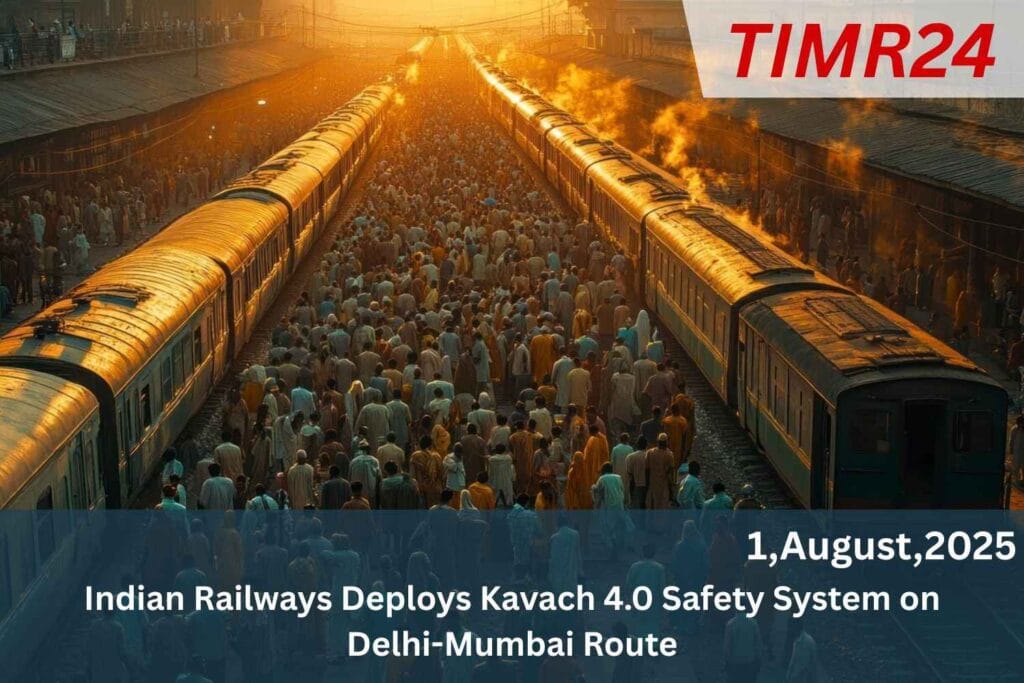
Indian Railways has commissioned the indigenous train safety system Kavach 4.0 on the Mathura-Kota section of the Delhi-Mumbai corridor, marking a significant step in modernizing India’s railway safety infrastructure. Kavach 4.0, developed domestically, is an advanced Automatic Train Protection system designed to prevent collisions by controlling train speed and ensuring automatic brake application when necessary. The system, which operates at Safety Integrity Level 4 (SIL 4), includes RFID tags, telecom towers, onboard Loco Kavach devices, Station Kavach units, and centralized signalling integration. The implementation is underway without disrupting ongoing passenger or freight train services.
In a major technological leap for railway safety, Indian Railways has successfully deployed the Kavach 4.0 system on the high-density Delhi–Mumbai route, one of the busiest and most economically vital corridors in the country. Kavach, which means “Armor” in Hindi, is India’s indigenously developed Automatic Train Protection (ATP) system designed to prevent signal passing at danger (SPAD), over speeding, and collisions, thus drastically improving operational safety. The latest upgrade, Kavach 4.0, introduces enhanced features like faster response times, improved fault diagnostics, and better integration with modern rolling stock. (Indian Railways)
Route Significance and Rollout
The Delhi–Mumbai route, stretching over 1,400 kilometres, serves as a strategic trunk line for both passenger and freight traffic, connecting political and financial capitals. With multiple high-speed trains, such as the Rajdhani Express and several premium freight services, the implementation of Kavach 4.0 is expected to reduce human error-related incidents significantly. Indian Railways had previously conducted successful trials of the technology on the South Central Railway zone and is now scaling it up nationally.
Technological Advancements in Kavach 4.0
Compared to its previous versions, Kavach 4.0 boasts of better communication interfaces, high-speed braking logic, and compatibility with both electric and diesel locomotives. It uses RFID tags, radio communication between loco and signal units, and centralized control monitoring systems. The system ensures that if a loco pilot fails to apply brakes in case of danger, Kavach will override and bring the train to a halt autonomously. This level of automation aligns India with global best practices like Europe’s ETCS Level 2 and Japan’s ATACS system. (Global Railway Safety Systems)
Impact on Passenger and Freight Safety
The deployment of Kavach 4.0 is expected to bring substantial benefits in accident prevention and real-time monitoring. On such busy corridors, even minor delays or signal violations can result in significant cascading impacts. With Kavach, incidents like head-on or rear-end collisions will be avoided, and loco pilots will be assisted with alert systems and automatic braking, thereby reducing stress and fatigue. It also helps ensure on-time performance, boosting overall network efficiency.
Future Expansion and Make-in-India Push
Indian Railways aims to expand Kavach across 35,000 km of its network in the next few years, focusing first on high-density and high-speed corridors. The technology is a result of the government’s Make in India initiative, developed by Indian firms in partnership with RDSO (Research Designs and Standards Organisation). It also aligns with the goal of Viksit Bharat@2047, where rail transport is envisioned to be smart, safe, and sustainable.
q1. What is Kavach 4.0?
Kavach 4.0 is an upgraded Automatic Train Protection (ATP) system developed by Indian Railways to prevent collisions, over speeding, and signal passing errors.
q2. Where has Kavach 4.0 been deployed?
It has been deployed on the high-density Delhi–Mumbai railway route, one of the busiest corridors in India.
q3. How does Kavach 4.0 improve train safety?
It automatically applies brakes in case of danger, prevents SPAD incidents, and ensures real-time alerts to loco pilots.
q4. Is Kavach 4.0 compatible with all trains?
Yes, it is compatible with both electric and diesel locomotives and integrates with modern rolling stock.
q5. Will Kavach be expanded across India?
Yes, Indian Railways plans to implement Kavach across 35,000 km of its network under the National Rail Plan.