












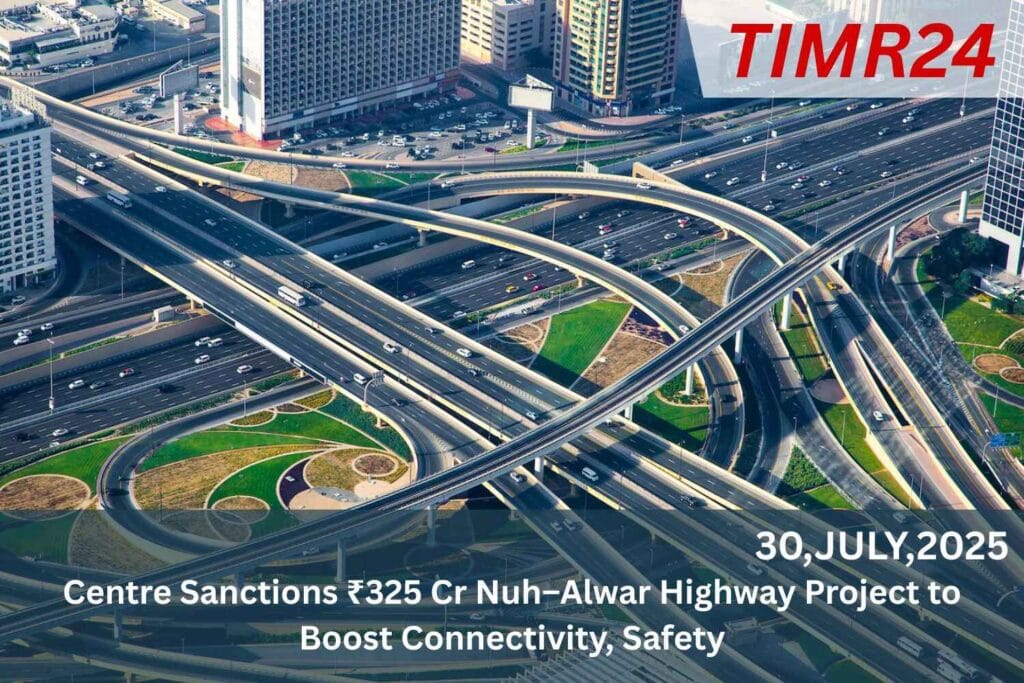
The Central Government has approved the development of a 45-km four-lane National Highway from Nuh to Ferozepur Jhirka and Alwar on the Rajasthan border, aiming to reduce travel time and improve road safety. The project, worth ₹325 crore, will feature nine flyovers, six underpasses, and bypasses.
Strategic Sanction to Bridge Regional Gaps
The Central Government has sanctioned ₹325 crore for the development of the Nuh–Alwar Highway, a key infrastructure project that aims to significantly enhance regional connectivity between southern Haryana and north-eastern Rajasthan. The highway, which will cover a critical corridor between Nuh (Mewat district, Haryana) and Alwar (Rajasthan), is expected to reduce travel time, improve logistics efficiency, and foster socio-economic development in both regions.
Enhancing Rural-Urban Mobility
This highway project is part of a broader national effort under the Baramulla Pariyojana, which focuses on optimizing road connectivity in underdeveloped and border areas. By linking remote towns and rural areas to major highways and economic hubs, the Nuh–Alwar road will improve access to services, education, markets, and healthcare. The (Road Transport Highway) (MoRTH) will oversee implementation, ensuring adherence to quality standards and completion targets.
Focus on Road Safety and Modern Design
One of the most critical aspects of this ₹325 crore investment is its focus on road safety. The highway will be built with features such as divided lanes, improved signage, modern crash barriers, service roads, pedestrian crossings, and better drainage systems. These upgrades aim to reduce accidents, particularly in accident-prone rural stretches. According to the improving highway infrastructure is a key method of reducing fatalities and injuries on Indian roads.
Economic and Industrial Impact
This corridor has strategic economic value as it connects Haryana’s backward Nuh district to Alwar, a key industrial center of Rajasthan. The improved connectivity is expected to facilitate smoother transport of goods, support local (MoRTH) will oversee implementation, ensuring adherence agricultural economies, and attract small and medium enterprises (SMEs). This complements initiatives like which integrates infrastructure planning for smoother multimodal connectivity across India.
Employment and Construction Benefits
The highway development will generate short-term and long-term employment opportunities in the region, especially in construction, raw material supply, and road maintenance. In alignment with the National Infrastructure Pipeline (NIP) goals, this investment is part of India’s long-term strategy to create jobs through infrastructure-led growth. You can read more about NIP’s roadmap on the (Highway).
Environmental and Sustainability Measures
The project is expected to follow environmental norms, with provisions for afforestation, noise reduction, and eco-friendly construction materials. Additionally, regular audits and monitoring will be done to minimize ecological disruption in sensitive areas along the route.
Conclusion
The ₹325 crore sanctioned for the Nuh–Alwar Highway is a transformative step toward inclusive infrastructure development in northern India. With its focus on connectivity, road safety, economic empowerment, and environmental sustainability, the project is set to improve quality of life and mobility in this underdeveloped belt by 2026.
Q1. What is the purpose of the Nuh–Alwar highway project?
The project aims to enhance road safety and improve regional connectivity between Nuh (Haryana) and Alwar (Rajasthan).
Q2. How much is being invested in the project?
The Central Government has sanctioned ₹325 crore for the highway’s redevelopment.
Q3. What key infrastructure features are included?
The project includes 4-laning, 9 flyovers, 6 underpasses, and 2 bypasses to ease congestion and reduce accidents.
Q4. Why is this stretch called the ‘killer highway’?
This 45-km section of NH‑248A has witnessed over 2,500 road fatalities in the last 12 years due to poor road conditions.
Q5. When is the project expected to be completed?
The project has a construction timeline of 24 months, with an additional 60-month maintenance period.