
















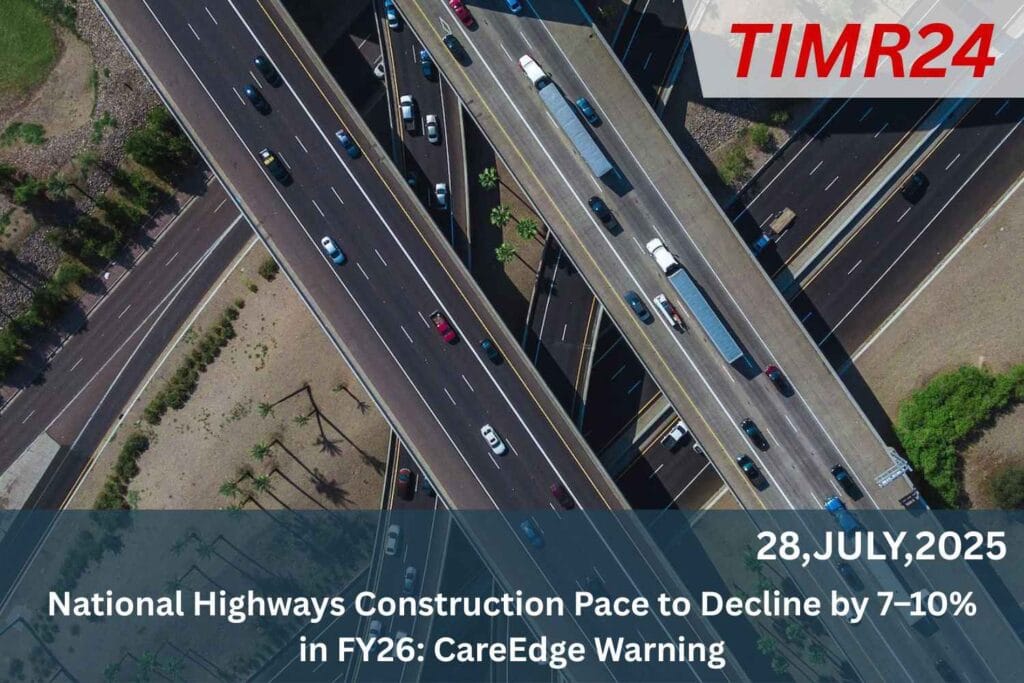
National Highway (NH) construction and awarding activity in India has been slowing down, according to a report by CareEdge Ratings. Project awarding declined by 30% in FY24 and remained stagnant in 11MFY25 at 4,874 km. The execution pace dropped by 8% during 11MFY25, averaging 25 km/day versus 27 km/day in 11MFY24. The pace is expected to decline by 7-10% in FY26 on a year-on-year basis, reaching 26-28 km/day. The deceleration is attributed to persistent execution hurdles such as prolonged delays in appointed date issuance, land acquisition challenges, lack of hindrance-free Right of Way, uniform two-year construction periods, and unprecedented monsoons in FY25.
The pace of national highways construction in India is expected to decline by 7–10% in FY26, according to a recent report by Care Edge Ratings. This projected slowdown comes after a robust performance in recent years, where highway development was at a record high. However, a combination of factors—ranging from funding constraints to election-related disruptions—is likely to weigh on execution in the upcoming fiscal.
Funding and Budgetary Constraints
The Centre’s budgetary allocation for the Ministry of Road Transport and Highways (MoRTH) plays a key role in highway development. While the FY25 Union Budget has increased allocations marginally, a significant portion has been diverted toward repayment obligations and maintenance costs. As per the Care Edge report, private sector interest via PPP (Public-Private Partnership) has also not picked up pace as expected, further adding to the funding shortfall. (Construction )
Impact of General Elections
The upcoming General Elections in 2026 are anticipated to have a short-term dampening effect on construction activities. Historically, during election periods, the pace of tender approvals and disbursements slows down. According to Care Edge, administrative delays and the enforcement of the Model Code of Conduct could restrict progress during critical months, especially in Q1 and Q2 of FY26. (MoRTH)
Shift in Focus Towards Asset Monetisation
The government’s emphasis is now shifting towards asset monetisation rather than launching fresh construction projects. Under the National Monetisation Pipeline (NMP), several operational highway stretches have been earmarked for leasing to private players, aiming to generate upfront revenue. While this helps in reducing fiscal pressure, it also means fewer greenfield highway projects are being launched in the short term.
Project Execution Challenges
Land acquisition remains a persistent hurdle in many states including Uttar Pradesh, Maharashtra, and Tamil Nadu. Legal clearances, compensation disputes, and rehabilitation issues continue to cause delays. Furthermore, rising input costs—particularly for bitumen, cement, and labour—have made many contractors cautious about taking on new projects.
Hope for FY27 Rebound
Despite the projected decline in FY26, industry experts remain optimistic about a rebound in FY27. The completion of ongoing expressway projects like the Delhi–Amritsar–Karta Expressway, Mumbai–Nagpur Zamudio Mahamari, and portions of the Baramulla Phase 1 are expected to drive growth once the political climate stabilizes. Moreover, with India’s goal of expanding its highway network to 2 lakh km by 2030, long-term prospects remain strong.
The government’s emphasis is now shifting towards asset monetisation rather than launching fresh construction projects. Under the National Monetisation Pipeline (NMP), several operational highway stretches have been earmarked for leasing to private players, aiming to generate upfront revenue. While this helps in reducing fiscal pressure, it also means fewer greenfield highway projects are being launched in the short term.
Q1. Why is the national highway construction pace expected to decline in FY26?
Due to funding constraints, slower project awards, and high pending land acquisition.
Q2. What is the expected percentage decline in construction?
Care Edge projects a decline of 7–10% in FY26 compared to the previous year.
Q3. How much highway length was constructed in FY25?
Around 12,349 km of national highways were built in FY25, the second-highest ever.
Q4. What is the government’s construction target for FY26?
The Ministry of Road Transport aims to build approximately 11,500–11,900 km in FY26.
Q5. Will this slowdown impact infrastructure growth?
Yes, it could delay key connectivity projects and affect economic momentum temporarily.