



















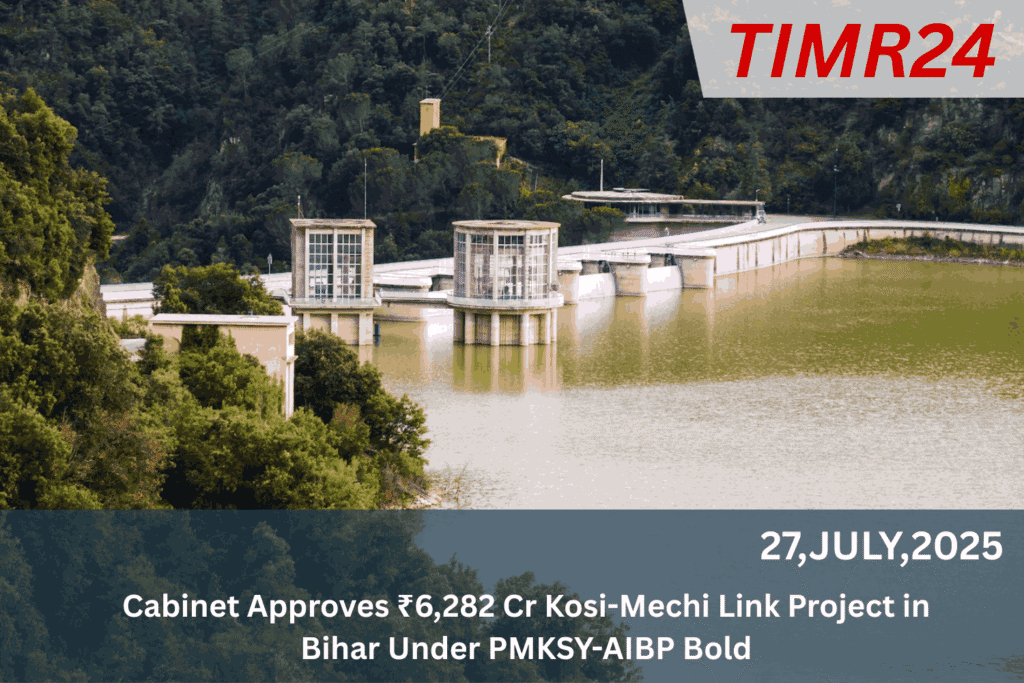
The CCEA approved the Kiamichi Intra-State Link Project in Bihar under PMKSY-AIBP on March 28, 2025. It involves remodelling the EKMC and extending it to the Mekhi River, with completion set for March 2029. The project’s estimated cost is ₹6,282.32 crore, with a central share of ₹3,652.56 crore. Once finished, it will provide irrigation to 2.15 lakh hectares and aid in flood mitigation in several districts. Question: 1. What was recently approved by the Cabinet Committee on Economic Affairs for inclusion.
The Union Cabinet, chaired by Prime Minister Narendra Modi, has approved the ₹6,282 crore Kiamichi Link in Bihar under the Pradhan Mantri Krishi Sinkhole Yojana – Accelerated Irrigation Benefits Programme (PMKSY-AIBP). The aims to boost irrigation potential, strengthen water resources, and transform agricultural output in Bihar’s water-deficient districts. This project marks a major milestone in India’s river interlinking programme. It is aligned with the national vision for water security and doubling farmers’ income…(Ministry of Jal Shakti)
Project Overview
The Kiamichi Link is a significant step in enhancing irrigation infrastructure in Bihar, particularly for the drought-prone regions. With a total cost of ₹6,282 crore, expected to be completed by 2028. It involves interlinking rivers and constructing diversion structures, canals, and water storage systems to facilitate year-round irrigation. The project will harness the surplus water from the Kosi River and redirect it through a new canal system to irrigate more than 2.5 lakh hectares in the districts of Auraria, Purina, Katihar, and Kishanganj. (Construction)
Objectives and Benefits
The main objectives of include:
- Expanding irrigation coverage under “Har Khet Ko Pain”
- Ensuring sustainable water use in water-scarce areas
- Promoting crop diversification and increasing agricultural productivity
- Strengthening the rural economy and reducing farmer distress
This initiative is expected to benefit over 10 lakh farmers and bring a substantial boost to agricultural income, especially in eastern Bihar, where irrigation infrastructure has long been underdeveloped.
Funding and Implementation
The project falls under the PMKSY-AIBP framework, with central and state governments sharing the funding. The Centre will contribute approximately 60% of the cost, while the remaining 40% will be borne by the Bihar government. Implementation will be overseen by the Water Resources Department of Bihar, with technical support from the Central Water Commission (CWC). This approval marks one of the largest irrigation-linked investments in Bihar in recent decades.
Environmental and Social Impact
To minimize the ecological footprint, the project will include:
- Afforestation measures along canal routes
- Eco-sensitive planning for water diversion structures
- Resettlement and rehabilitation packages for displaced families
Environmental clearances have already been initiated, ensuring minimal disruption to local biodiversity and communities.
Strategic Significance for Bihar
The Kiamichi Link is part of the larger strategy to bridge the water availability gap in North Bihar, which has historically faced flood-drought cycles. By channelling excess water from the Kosi basin during floods to drought-prone areas, the project is a game-changer for climate-resilient agriculture.
Future Outlook
The Kiamichi Link aligns with the Government’s vision of doubling farmers’ income and improving rural livelihoods. It also paves the way for more inter-basin river linkages, as envisioned in India’s National Perspective Plan for Water Resources. With this approval, Bihar takes a major leap toward water security, agricultural self-reliance, and sustainable development.
q1. What is the Kosi-Mechi Link Project?
It is a river interlinking project that diverts surplus water from the Kosi River to the Mechi River to enhance irrigation in North Bihar.
q2. How much does the project cost?
The total approved cost of the project is ₹6,282 crore.
q3. Which areas will benefit from this project?
Districts like Auraria, Kishanganj, Purina, and Katihar in Bihar will benefit, covering over 2.14 lakh hectares of farmland.
q4. Under which scheme is the project being implemented?
It is being implemented under the Pradhan Mantri Krishi Sinkhole Yojana – Accelerated Irrigation Benefits Programme (PMKSY-AIBP).
q5. What are the main benefits of the project?
The project aims to improve irrigation, reduce flood impact, boost agricultural productivity, and benefit over 10 lakh farmers.