












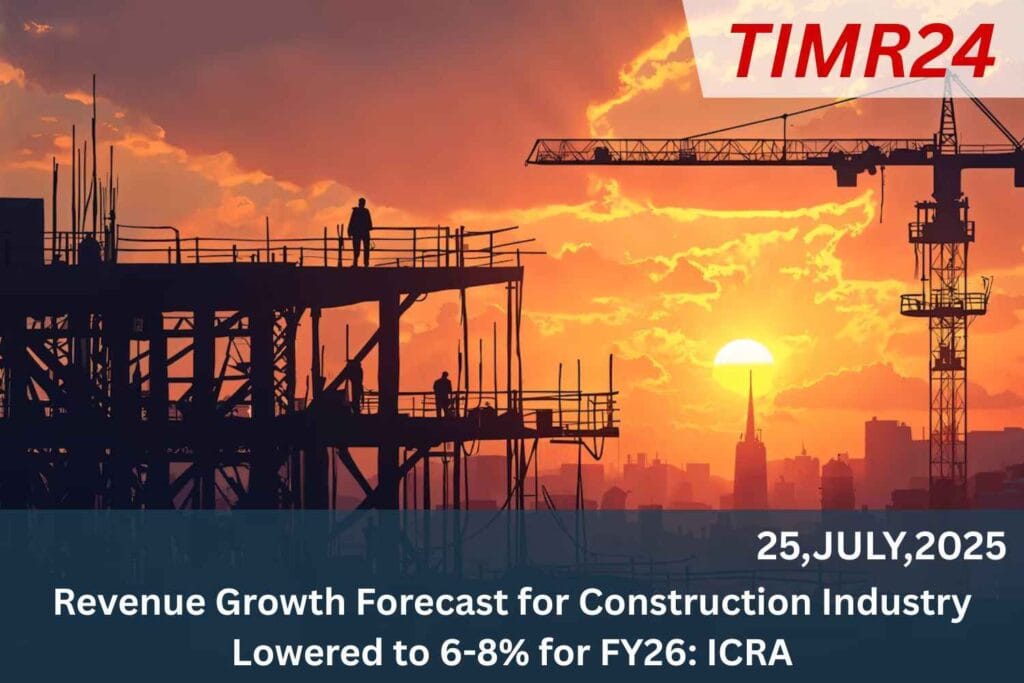
India’s Corporate Ratings Agency (ICRA) has reduced its revenue growth forecast for India’s construction industry in FY2026 to 6-8%, down from 8-10%, due to delays in road project awards and a slowdown in Jal Jeevan Mission execution. However, a pickup in urban infrastructure and irrigation projects is expected to support moderate growth. The order book-to-operating income ratio remains strong at 3.5x, offering healthy revenue visibility.
Operating margins are projected to stay stable at 10.25-10.75%, down from peak levels of 13-14% in FY2021. ICRA expects the operating margin of players to remain under check due to aggressive competition, but stable commodity prices and operating leverage benefits should support profitability. Construction activities, to…(ICRA’s official report) ,particularly road projects, have been notably affected due to lower fresh order inflows following the enforcement of the Model Code of Conduct in Q1 FY2025.
Introduction: Revised Outlook by ICRA
Leading rating agency ICRA has revised its growth forecast for India’s construction industry for FY26, lowering the projected revenue expansion from the earlier 9–11% range to 6–8%. The revision is attributed to multiple challenges including sluggish private sector participation, high input costs, and delays in project execution.
Sectoral Performance Analysis
According to ICRA, the moderation is more pronounced in segments such as urban infrastructure and industrial construction, where private capex is lagging behind. On the other hand, segments supported by public expenditure—such as roads and railways—are likely to remain stable. For comparison, review
Key Challenges Impacting Growth
A slowdown in project tendering, geopolitical uncertainties, rising raw material prices, and difficulties in financial closures have weakened momentum. These have particularly affected medium-sized EPC contractors. To understand similar patterns, visit…(Construction).
Government-Led Capex as a Buffer
Despite the lowered outlook, the central government’s continued infrastructure push under initiatives like PM Gati Shakti and National Infrastructure Pipeline (NIP) offers a cushion. However, their benefits may be partially offset by delays in state-level fund utilization and coordination.
Private Sector Slowdown
Private investment, particularly in commercial and industrial projects, remains subdued. While real estate is witnessing a rebound in metros, it has not translated into substantial EPC order flows. For deeper insight, refer to.
Input Cost Volatility
Fluctuating prices of key inputs such as cement, steel, and fuel are impacting project viability and profitability. Contractors are demanding more flexible contracts to absorb such volatilities. To understand this trend, Despite the slowdown, a positive takeaway is the increasing adoption of digital tools like Building Information Modelling (BIM), project management software, and drone-based site monitoring. These technologies are helping companies track delays, optimize cost, and increase overall efficiency—factors that could support long-term stabilization of the sector.
Policy and Reforms Needed
Experts emphasize the need for quicker clearances, faster dispute resolution, and reform in payment cycles from public bodies to ensure sustained growth. The government’s initiatives on digitizing procurement and introducing single-window clearance systems are steps in the right direction. In addition to financial and material constraints, the industry is grappling with labour shortages in specific zones, particularly in fast-urbanizing Tier-2 and Tier-3 cities. Regulatory delays in land acquisition and environmental clearances are further compounding execution challenges. Many developers are forced to re-negotiate deadlines or restructure project timelines to stay aligned with financial feasibility.
Conclusion: Navigating a Cautious Path Forward
While the ICRA’s revised projection signals a more cautious outlook, the Indian construction sector still holds long-term promise. Sustained public investment, financial discipline, and timely execution will be key to overcoming short-term challenges and maintaining investor confidence.
q1. Why has ICRA lowered the growth forecast for FY26?
ICRA cites slower project execution, high input costs, and reduced private capex as key reasons.
q2. What was the previous growth estimate for the construction industry?
Earlier, ICRA had projected a revenue growth of 9–11% for FY26.
q3. Which construction segments are most impacted?
Earlier, ICRA had projected a revenue growth of 9–11% for FY26.
q4. Will government projects continue to support growth?
Yes, public infrastructure spending—especially in roads and railways—is expected to cushion the impact.
q5. How are companies responding to this forecast?
Firms are focusing on operational efficiency, technology adoption, and selective bidding to stay profitable.