










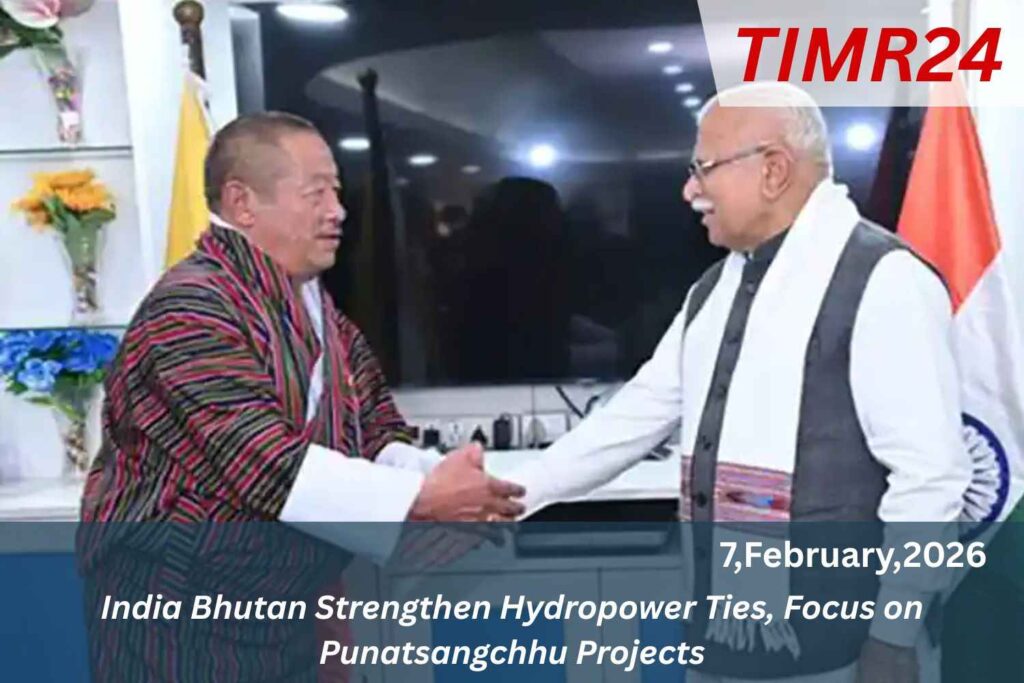
Bhutan’s Energy and Natural Resources Minister, Lyonpo Gem Tshering, met with Indian officials to enhance bilateral cooperation in the power sector, particularly in hydropower. Their collaboration began in 1961 and was formalized in 2006. Key discussion points included optimizing power generation from the 1020 MW Punatsangchhu-II project and expediting the commissioning of the 1200 MW Punatsangchhu-I project. They also reviewed the future plan for the Sankosh Hydropower Project and assessed cross-border transmission links until 2040, emphasizing the need for streamlined approvals for power scheduling during Bhutan’s low generation months to ensure stable electricity exchange.
Sustainable Development, Regional
India and Bhutan have once again reinforced their long-standing partnership in the hydropower sector, with renewed focus on the strategically important Punatsangchhu hydropower projects. The collaboration reflects a shared vision of sustainable development, regional energy security, and economic interdependence. Hydropower cooperation has historically been a cornerstone of India–Bhutan relations, and the latest engagement signals continuity as well as future-oriented planning in clean energy generation Hydropower development in Bhutan has played a transformative role in the country’s economic growth, with India acting as both a development partner and primary power purchaser.
Over the years, projects such as Chukha, Tala, and Mangdechhu have demonstrated how cross-border energy collaboration can be mutually beneficial. The current emphasis on Punatsangchhu-I and Punatsangchhu-II underlines the importance of completing large-scale projects that are critical for Bhutan’s revenue generation and India’s renewable energy targets The Punatsangchhu projects, located on the Punatsangchhu river in Bhutan, are among the largest hydropower initiatives undertaken jointly by the two countries. While these projects have faced geological and technical challenges in the past, renewed coordination, improved engineering solutions, and strengthened institutional.
Significantly Enhance Bhutan’s Export
Mechanisms are now driving them toward completion. India’s technical and financial support continues to play a key role, ensuring that From an economic perspective, the successful completion of the Punatsangchhu projects is expected to significantly enhance Bhutan’s export revenues, as surplus electricity will be sold to India under long-term power purchase agreements. This revenue stream supports Bhutan’s social development programs while reinforcing India’s access to reliable, clean power. At a time when India is aggressively expanding its renewable energy portfolio, hydropower imports from Bhutan complement domestic solar and wind generation by providing stable baseload power.
Beyond economics, the hydropower partnership also strengthens diplomatic ties between the two neighbours. Regular high-level dialogues, joint project review mechanisms, and institutional cooperation frameworks ensure transparency and trust. These engagements reaffirm India’s commitment to Bhutan’s development priorities while respecting Bhutan’s environmental and social considerations. The partnership serves as a model for regional cooperation in South Asia, particularly in the context of climate change mitigation and sustainable infrastructure development Environmental sustainability remains a key consideration in the Punatsangchhu projects.
Fossil Fuels Contributing
Both governments have emphasised the adoption of advanced environmental management practices to minimise ecological impact and protect riverine ecosystems. Hydropower, when responsibly developed, offers a low-carbon alternative to fossil fuels, contributing to climate (India) goals under international frameworks The strategic importance of India–Bhutan hydropower cooperation also extends to regional energy integration. Cross-border electricity trade supports grid stability and opens pathways for future multilateral energy exchanges in South Asia. As regional power markets evolve, Bhutan’s hydropower assets, developed in partnership with India, could play a pivotal role in balancing energy demand across neighbouring countries.
India’s support for the Punatsangchhu projects aligns with its broader commitment to strengthening neighbourhood ties through infrastructure and development assistance. Hydropower cooperation exemplifies a development-centric approach that prioritises long-term benefits over short-term gains. It also reinforces India’s image as a reliable partner in sustainable development, particularly in the Himalayan region where environmental sensitivity is paramount From Bhutan’s perspective, the renewed focus on Punatsangchhu projects signals confidence in overcoming past challenges and unlocking the full potential of its hydropower resources.
Hydropower Revenues Provide
The projects are expected to create employment opportunities, enhance technical capacity, and contribute to national self-reliance. As Bhutan continues to pursue a development model rooted in Gross National Happiness, hydropower revenues provide the financial backbone (India) for social welfare and environmental conservation The strengthening of India–Bhutan hydropower ties with emphasis on the Punatsangchhu projects represents more than just an energy partnership. It reflects shared values of sustainability, mutual growth, and regional stability. As the projects move closer to completion, they are poised to deliver long-term benefits for both nations while setting benchmarks for cross-border renewable energy cooperation.
Q1. What are the Punatsangchhu hydropower projects?
The Punatsangchhu-I and II projects are large hydropower initiatives in Bhutan developed with India’s support to generate clean electricity for domestic use and export.
Q2. Why are these projects important for India?
They provide India with stable, renewable power and support its clean energy and climate commitments.
Q3. How do the projects benefit Bhutan’s economy?
Electricity exports generate significant revenue, supporting Bhutan’s social development and economic stability.
Q4. Have the projects faced challenges?
Yes, geological and technical challenges caused delays, but renewed cooperation and improved solutions are addressing these issues.
Q5. What is the long-term significance of this partnership?
It strengthens bilateral relations, promotes sustainable energy, and supports regional power integration in South Asia.