

















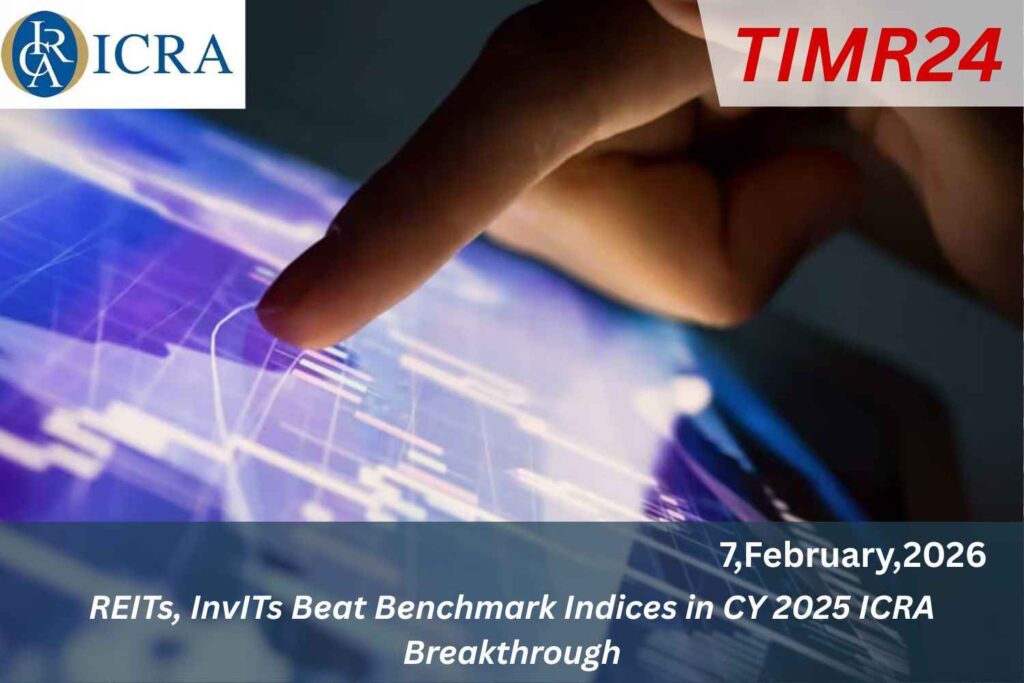
India’s listed Real Estate Investment Trusts (REITs) and Infrastructure Investment Trusts (InvITs) have shown a strong performance in CY 2025, achieving a return of 19.55%, surpassing traditional benchmarks like the Nifty50 TRI (11.42%) and G Sec Index (6.81%). REITs led with a notable 29.68% return due to robust leasing and stable yields, while Power InvITs reported 20.22%. In contrast, Road InvITs faced a decline with a return of 6.55%. Year-on-year trends showed REITs nearly doubled their returns from 16.81% to 29.68%, but Road InvITs dipped from 9.49% to 6.55%. The interest rate environment favored equity-linked investments, impacting G-Sec performance, but trusts.
Real Estate Investment Trusts
Maintained strong interest with stable cash flows and competitive yields. Performance figures are based on equal weight calculations across listed entities, including pending December 2025 distribution credits In calendar year 2025, Real Estate Investment Trusts (REITs) and Infrastructure Investment Trusts (InvITs) have delivered a standout performance, surpassing traditional benchmark indices such as the Nifty 50 and Sensex, according to analysis by ICRA Analytics. This development marks a significant shift in investor preference as market participants increasingly seek stable income-generating assets amid global volatility, moderating equity returns, and persistent macroeconomic uncertainties.
The outperformance highlights the growing maturity of India’s listed alternative investment ecosystem and reinforces the role of REITs and InvITs as long-term portfolio stabilizers rather than niche investment instruments REITs and InvITs are structured to distribute a large portion of their cash flows to unitholders, making them particularly attractive during periods when equity markets experience fluctuating growth and valuation pressures. In CY 2025, benchmark indices have shown uneven momentum due to global interest rate sensitivity, geopolitical developments, and sector-specific slowdowns. Against this backdrop, the predictable yield profile of REITs and InvITs has helped them.
Oriented Assets Gain Prominence
Deliver superior risk-adjusted returns, as highlighted in ICRA Analytics’ comparative performance assessment. This trend also underscores the increasing alignment of Indian capital markets with global investment patterns where yield-oriented assets gain prominence during transitional economic phases A key driver behind the strong performance of REITs in 2025 has been the resilience of India’s commercial real estate sector. Office assets held by listed REITs continue to benefit from high occupancy levels, stable lease structures, and built-in rental escalations. Despite concerns around remote work models, demand for Grade-A office spaces in major business hubs has remained robust.
Supported by IT services, global capability centers, and flexible workspace operators. These fundamentals have translated into steady net operating income growth, enabling REITs to maintain consistent distributions while also supporting unit price appreciation InvITs, on (India) the other hand, have emerged as a cornerstone of infrastructure financing in India’s capital markets. Assets such as highways, power transmission lines, renewable energy projects, and gas pipelines provide long-term contracted cash flows with limited demand risk. In CY 2025, InvITs benefited from stable toll collections, improved traffic volumes, and regulatory support for infrastructure monetisation.
Pressured Yield Assets Globally
ICRA Analytics notes that the predictable revenue model of InvITs, combined with lower operational volatility, has allowed them to outperform equity indices that are more sensitive to earnings cycles and market sentiment While rate hikes in previous years had pressured yield assets globally, CY 2025 has seen relative stability in borrowing costs. This has improved the valuation outlook for REITs and InvITs, as their long-term cash flows become more attractive when discount rate volatility reduces. Additionally, many listed trusts have proactively refinanced debt, extended maturities, and reduced overall cost of capital, strengthening balance sheets and improving distributable cash flows.
This disciplined financial management has further enhanced investor confidence, especially among institutional participants such as pension funds and insurance companies From a portfolio construction perspective, REITs and InvITs have increasingly been viewed as defensive assets that provide diversification benefits. Their low correlation with traditional equities has helped investors manage downside risk while still participating in income generation. ICRA Analytics’ data indicates that during periods of equity market consolidation in 2025, REITs and InvITs demonstrated lower drawdowns and quicker recovery, reinforcing their role as stabilising instruments.
Governance Frameworks, Improving
Regulatory support has also played a meaningful role in strengthening the REIT and InvIT ecosystem. The Securities and Exchange Board of India (SEBI) has continued to refine disclosure norms, distribution policies, and governance frameworks, improving transparency and investor protection. These measures have increased retail participation while also attracting global investors seeking exposure to India’s growth story through structured, income-oriented vehicles ICRA Analytics expects the relative outperformance of REITs and InvITs to remain sustainable, provided underlying asset quality and cash flow visibility remain strong. While equity markets may regain momentum with improved.
Earnings visibility, yield-focused assets are likely to continue attracting capital from investors prioritising income stability and capital preservation. Planned infrastructure expansions, ongoing asset monetisation by government entities, and rising institutional allocations are expected to support the long-term growth trajectory of InvITs, while REITs stand to benefit from India’s expanding commercial real estate footprint The outperformance of REITs and InvITs over traditional benchmark indices in CY 2025 reflects a broader shift in investment behaviour toward.
Stability, predictability, and income generation. As highlighted by ICRA Analytics, these instruments have moved beyond being alternative options and are (India) now integral components of diversified investment portfolios. For investors seeking consistent returns amid evolving market conditions, REITs and InvITs offer a compelling balance between yield and growth, underpinned by real assets and regulatory clarity.
Q1. Why did REITs and InvITs outperform benchmark indices in CY 2025?
REITs and InvITs benefited from stable cash flows, predictable distributions, and lower volatility compared to equities, helping them outperform traditional indices.
Q2. Are REITs and InvITs suitable for long-term investors?
Yes, they are well-suited for long-term investors seeking regular income, diversification, and exposure to real assets.
Q3. How do interest rates impact REIT and InvIT performance?
Stable or declining interest rates improve valuations and enhance the attractiveness of their long-term cash flows.
Q4. What types of assets do InvITs typically hold?
InvITs usually invest in infrastructure assets such as highways, power transmission lines, renewable energy projects, and pipelines.
Q5. What role does regulation play in REIT and InvIT growth?
Strong regulatory oversight improves transparency, governance, and investor confidence, supporting sustainable growth.