






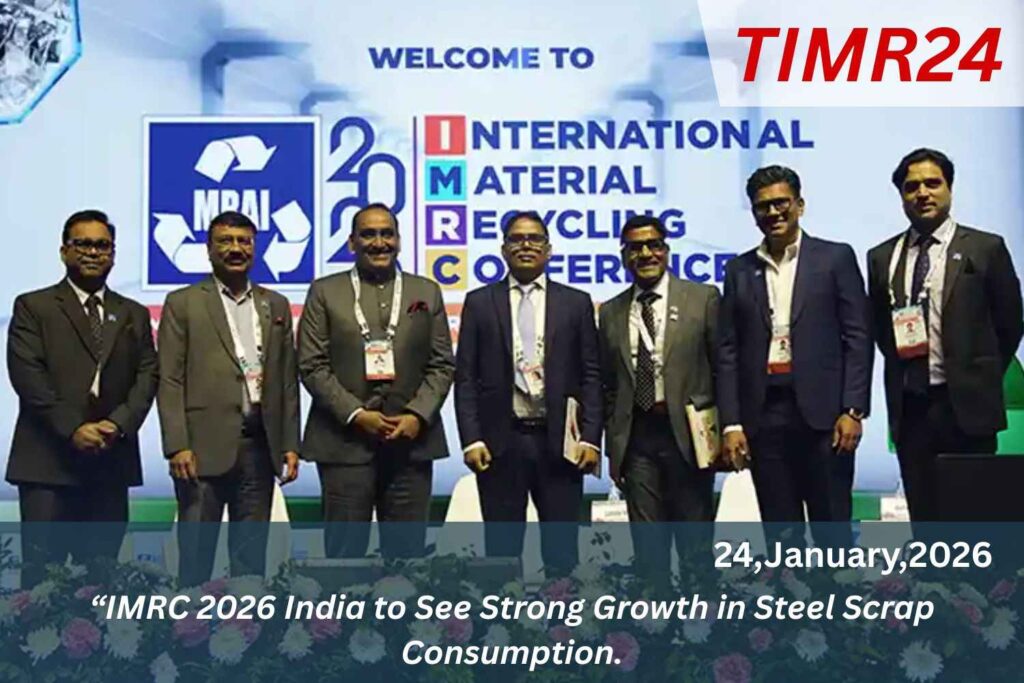
IMRC Scrap contributes approximately 21% to India’s crude steel production, contrasting with a global average of one-third. Shri Daya Nidhan Pandey highlighted the expected rise to 36 million tonnes of scrap availability and emphasized the importance of scrap for India’s steel capacity goals, aiming for 300 million tonnes by 2030. Policy efforts like the Steel Scrap Recycling Policy 2019 and Extended Producer Responsibility (EPR) are aimed at enhancing scrap recycling. Addressing operational challenges, Shri Sanjay Mehta advocated for lower GST on scrap and improved enforcement of EPR in various waste sectors. The recycling industry has shifted from CSR to.
Aiming To Position India’s Recycling
Core business, with over 1400 start-ups in waste management. The conference focuses on sustainability and regulatory clarity, aiming to position India’s recycling industry as a key player in the circular economy and climate efforts India’s steel industry is entering a decisive phase of transformation as capacity expansion plans gather momentum and sustainability becomes central to production strategies. At the India Metal Recycling Conference (IMRC) 2026, Shri Daya Nidhan Pandey from the Ministry of Steel highlighted that India’s demand for steel scrap is expected to increase sharply in the coming years, driven by rapid growth in steelmaking capacity, increased.
Adoption of electric arc furnaces, and a national push toward circular economy practices. His remarks underline a structural shift in how India will source raw materials for steel production in the next decade India has set an ambitious target of achieving more than 300 million tonnes of steel production capacity by 2030, as outlined in the National Steel Policy. This expansion is not only meant to meet domestic infrastructure, housing, automotive, and manufacturing demand, but also to position India as a major global steel supplier. As production volumes rise, the traditional dependence on iron ore-based blast furnace routes is gradually being complemented by scrap-based steelmaking routes.
Increasing Share Of Electric Are
Which are more energy-efficient and environmentally sustainable. This change is making steel scrap a strategic raw material for the future of India’s metallurgical industry One of the most important drivers of rising scrap demand is the increasing share of electric arc furnaces (EAFs) and induction furnaces (IFs) in India’s steel production mix. These technologies primarily use steel scrap as their main feedstock, unlike blast furnaces that rely on iron ore and coking coal. As India seeks to reduce its carbon intensity and align with global decarbonisation goals, scrap-based steelmaking is emerging as a preferred route. According to the Ministry of Steel, every tonne of steel produced.
Using scrap can reduce carbon dioxide emissions by up to 60 percent compared to conventional methods. This environmental advantage is making scrap an essential component of India’s green steel roadmap Policy initiatives are also playing a crucial role in shaping this transition. The Vehicle Scrappage Policy, introduced to phase out old and polluting vehicles, is expected to generate millions of tonnes of additional ferrous scrap annually. This policy not only improves road safety and air quality but also creates a steady domestic supply of recyclable steel. At the same time, the government is encouraging the formalisation of the scrap collection and processing sector to.
Working Closely With Industry Bodies
Improve quality, traceability, and efficiency. These measures are gradually reducing India’s dependence on imported scrap, which currently accounts for a significant portion of total consumption The Ministry of Steel has also been working closely with industry bodies and recyclers to develop a robust scrap ecosystem. Investments are being made in organised shredding facilities, automated sorting plants, and modern recycling hubs across major industrial corridors. These facilities are expected to improve recovery rates, reduce contamination, and ensure consistent supply to steelmakers. Over time, this infrastructure development will help stabilise scrap prices and improve.
The competitiveness of scrap-based steel production in India From an economic perspective, rising scrap demand is creating new opportunities across the value chain. Scrap processors, logistics companies, equipment manufacturers, and technology providers are all set to benefit from the expansion of the recycling industry. Large integrated steel producers are also entering into long-term (India) partnerships with recyclers to secure reliable scrap supplies. This integration is expected to bring greater transparency and efficiency to the market, while reducing supply chain risks However, the sharp rise in scrap demand also presents challenges that must be addressed carefully.
Medium Term, India May Continue
One of the key concerns is the availability of sufficient domestic scrap to meet future requirements. As India’s per capita steel consumption is still lower than that of developed economies, the generation of obsolete scrap is currently limited. This means that in the short to medium term, India may continue to rely on imported scrap to bridge the supply gap. Managing this transition while protecting domestic recyclers and ensuring quality standards will be a critical policy task Quality control is another important issue highlighted by industry experts at IMRC 2026. Contaminated or mixed scrap can reduce furnace efficiency, increase energy consumption, and affect product quality.
To address this, the Bureau of Indian Standards and the Ministry of Steel are working on strengthening scrap quality standards and certification systems. Digital tracking, grading protocols, and standardised testing are being introduced to improve confidence among steel producers and buyers The growing importance of scrap is also closely linked to India’s broader climate commitments. As the country moves toward its net-zero targets, the steel sector will be under increasing pressure to reduce emissions. Scrap-based production offers one of the fastest and most cost-effective ways to achieve this. Many leading steelmakers have already announced plans to increase.
Deeper Strategic Shift In India’s Industrial
The share of scrap in their charge mix and invest in low-carbon technologies such as hydrogen-ready furnaces and renewable energy integration In this context, the remarks by Shri Daya Nidhan Pandey at IMRC 2026 reflect not just a projection of rising demand, but a deeper strategic shift in India’s industrial policy. Steel scrap is no longer seen as a secondary raw material, but as a core input for sustainable growth. The success of this transition will depend on coordinated action between policymakers, steel producers, recyclers, and technology providers India’s scrap demand is expected to grow at a compound annual rate of 8 to 10 percent over the next decade.
This growth will reshape trade flows, investment patterns, and technology adoption across the sector. If managed well, it can reduce import dependence, improve resource (India) efficiency, and position India as a global leader in sustainable steel production. The message from 2026 is clear: steel scrap will be at the heart of India’s next phase of industrial expansion.