












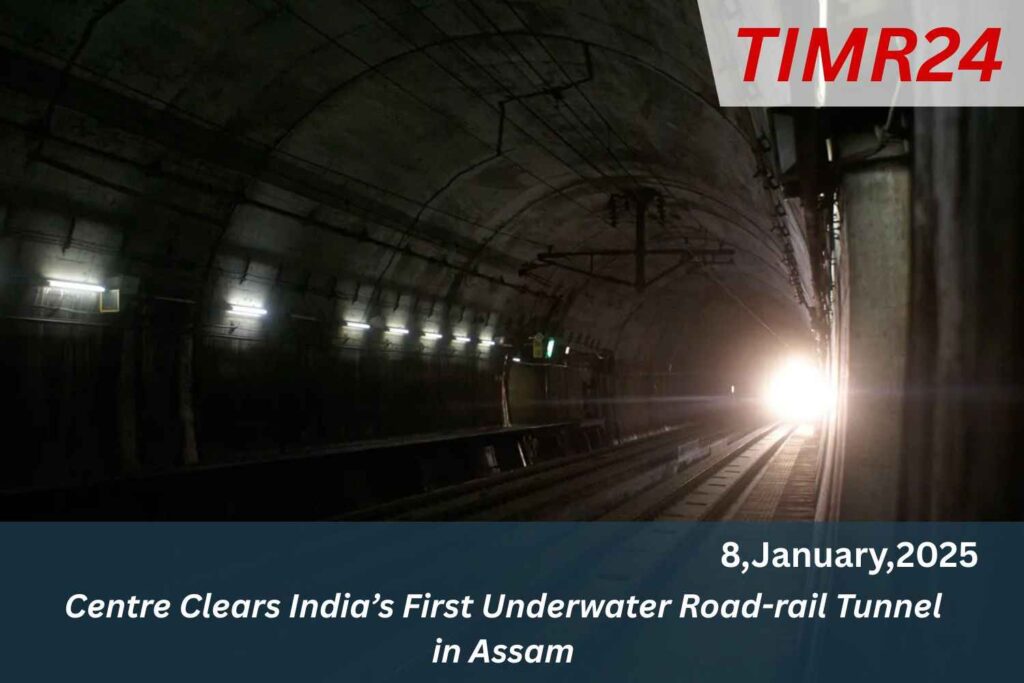
India is set to construct its first Clears underwater road-rail tunnel across the Brahmaputra river in Assam, with a length of 15.8 km. Approved by an inter-ministerial panel, the tunnel will feature a railway track in one tube and is designed to enhance strategic and civilian connectivity in the Northeast. The project aims to ensure rapid mobilization of security forces and reduce travel time between Gohpur and Numaligarh from six and a half hours to approximately 30 minutes. It also lowers the travel distance from 240 km to 34 km. The comprehensive project, estimated at Rs 18,600 crore, will include approach roads and railway infrastructure, totaling 33.7 km. The project is expected to be completed within five years.
Union Government’s Clearance India’s
This approval, the proposal will be submitted to the Union Cabinet for final sanction, anticipated before the Assam Assembly elections The Union Government’s clearance of India’s first underwater road-rail tunnel in Assam marks a historic milestone in the country’s infrastructure journey and signals a transformative phase for the Northeast. Designed to pass beneath the mighty Brahmaputra River, the ambitious project integrates both road and railway connectivity within a single underwater corridor. This engineering feat not only reflects India’s growing technical capabilities but also underscores the Centre’s commitment to bridging long-standing connectivity gaps in strategically important regions.
With this approval, Assam is set to become a national symbol of modern infrastructure innovation and regional integration The Brahmaputra River has historically posed logistical challenges for surface transportation, particularly during monsoons when ferry services are disrupted and bridges face capacity stress. The proposed underwater tunnel addresses these challenges by providing uninterrupted, all-weather connectivity between critical economic and population hubs on either side of the river. By enabling faster movement of goods and passengers, the project aligns seamlessly with national initiatives such as PM Gati Shakti, which aims to create a unified and efficient transport network across India.
Infrastructure Essential National Security Clears
From a strategic standpoint, the underwater road-rail tunnel holds immense importance beyond civilian transport. Assam’s proximity to international borders and its role as a gateway to the broader Northeast make robust infrastructure essential for national security and disaster response. The tunnel will significantly reduce travel time for defence logistics and emergency services, ensuring rapid deployment during critical situations. This aspect closely complements India’s broader border infrastructure development strategy, which has been consistently highlighted in official policy updates from agencies such as the Press Information Bureau (PIB).
Technologically, the project represents a leap forward for Indian civil engineering. Underwater tunnels demand advanced construction techniques such as immersed tube technology or tunnel boring machines specifically designed for subaqueous conditions. These methods require meticulous planning to ensure structural stability, water tightness, and long-term safety. By undertaking such a project domestically, India joins a select group of nations that have successfully executed underwater transport tunnels, including Japan, China, and several European countries. This expertise will not only benefit future river-crossing projects but may also open opportunities for.
Catalyst For Growth Across Assam
Indian engineering firms in global infrastructure markets. To understand India’s growing engineering capabilities, readers can explore our internal article on next-generation transport engineering in India Economically, the tunnel is expected to act as a catalyst for growth across Assam and neighbouring states. Reduced travel time and logistics costs will enhance supply chain efficiency for industries such as agriculture, tea exports, oil and gas, and small-scale manufacturing. Improved connectivity often leads to increased private investment, industrial clustering, and employment generation. Local businesses, especially in semi-urban and rural areas, are likely to gain improved access to national markets.
This aligns with the Centre’s long-term objective of balanced regional development, ensuring that economic growth is not confined to metropolitan centres alone Tourism is another sector poised to benefit significantly from the project. Assam’s rich cultural heritage, wildlife sanctuaries like Kaziranga, and scenic river landscapes attract both domestic and international tourists. However, transportation bottlenecks have historically limited tourism potential. The underwater tunnel will provide seamless access between key destinations, encouraging circuit tourism across the Northeast. Enhanced rail-road integration will also support eco-tourism initiatives by reducing dependence on slower, less reliable transport options.
Incorporating Sustainable Construction
Environmental considerations have been a crucial aspect of the project’s planning process. Large infrastructure developments under major rivers require strict adherence to environmental safeguards to protect aquatic ecosystems and water flow patterns. The project is expected to follow comprehensive environmental impact assessment norms, incorporating sustainable construction practices and continuous monitoring. International case studies show that well-designed underwater tunnels can coexist with river ecosystems when executed responsibly. Institutions such as the National Highways & Infrastructure Development Corporation Limited (NHIDCL) .
Indian Railways play a key role in ensuring compliance with environmental and safety standards. More information on sustainable transport infrastructure can be accessed The integration of road and rail within a single underwater structure is particularly significant in terms of multimodal transport efficiency. Traditionally, separate bridges or tunnels are constructed for different transport modes, increasing costs and land acquisition challenges. A combined tunnel optimises space, reduces surface-level disruptions, and maximises return on investment. This model supports India’s vision of multimodal logistics parks and integrated freight corridors.
Regulatory Hurdles Inter-Departmental
From a governance perspective, the clearance of this project reflects improved coordination between central ministries, state governments, and executing agencies. Large infrastructure projects often face delays due to regulatory hurdles and inter-departmental approvals. The (Solar) relatively swift clearance process signals a maturing project management framework, supported by digital monitoring tools and policy reforms. This approach is increasingly visible across sectors, from highways to railways and ports, reinforcing investor confidence in India’s infrastructure pipeline As India continues to urbanise and expand its transport networks, landmark projects like.
The Assam underwater road-rail tunnel serve as benchmarks for future development. They demonstrate how infrastructure can be both transformative and inclusive, addressing regional disparities while advancing national capabilities. The project also sends a strong message about India’s readiness to undertake complex engineering challenges that were once considered beyond its scope. For continued updates on similar mega projects.
Opportunities Enhancing
The Centre’s approval of India’s first underwater road-rail tunnel in Assam is more than just a construction greenlight; it is a strategic investment in connectivity, security, and sustainable growth. By unlocking new economic opportunities, enhancing mobility, and (India) showcasing engineering excellence, the project is set to redefine how infrastructure shapes regional development. As execution progresses, it will be closely watched not only as a transport solution but as a symbol of India’s evolving infrastructure ambition.
Q1. Where will India’s first underwater road-rail tunnel be built?
It will be built in Assam under the Brahmaputra River.
Q2. What makes this project unique?
It is India’s first combined underwater road and rail tunnel.
Q3. Who approved the project?
The project has been cleared by the Union Government of India.
Q4. How will it benefit Assam and the Northeast?
It will improve connectivity, trade, tourism, and strategic mobility.
Q5. Is this tunnel inspired by global models?
Yes, it follows global best practices used in Europe and East Asia.