













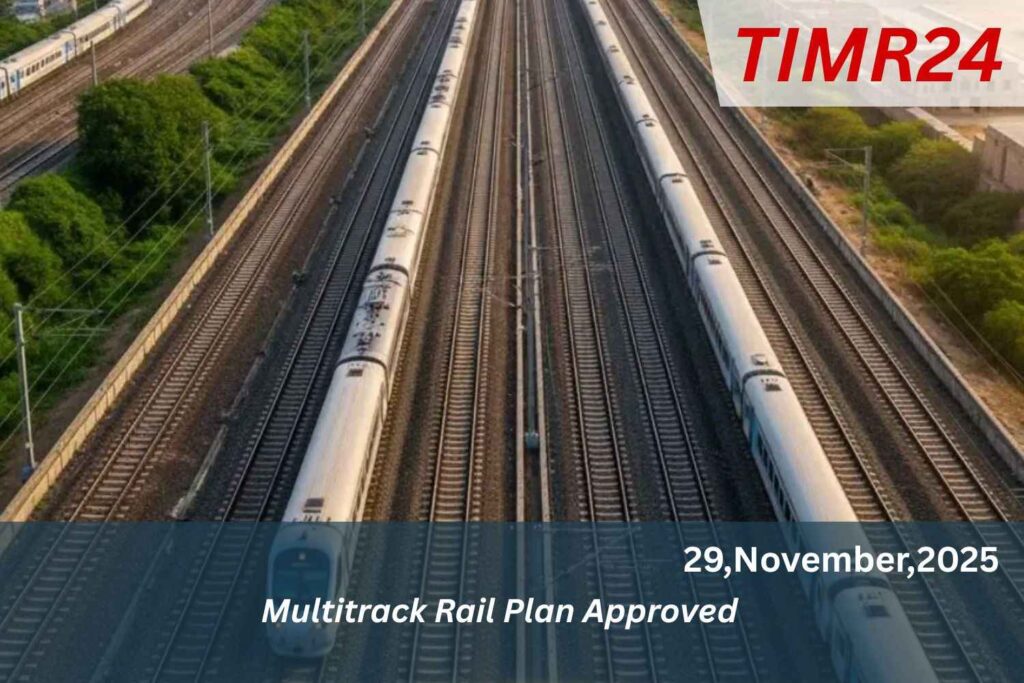
The Cabinet Committee on Economic Affairs, chaired by Prime Minister Narendra Modi, has approved two railway multitracking projects with an estimated cost of Rs 27.81 billion. These projects involve doubling the 141-km Devbhumi Dwarka (Okha)–Kanalus section and adding the 3rd and 4th lines to the 32-km Badlapur–Karjat section. This capacity expansion aims to enhance mobility, operational efficiency, and service reliability, supporting the Prime Minister’s vision of a more connected and economically vibrant New India. The projects will enhance multimodal connectivity and logistics efficiency, benefiting nearly 585 villages with a population of around 3.2 million. million.
Union Cabinet’s Approval of Railway
The Kanalus–Okha project will improve access to the Dwarkadhish Temple, while the Badlapur–Karjat route strengthens the Mumbai suburban corridor. Both routes are vital for freight traffic, expected to support an additional 18 MTPA. The initiatives also align with climate goals, reducing logistics costs and CO2 emissions significantly. The Union Cabinet’s approval of railway (Railways) multitracking projects in Maharashtra and Gujarat marks a strategic milestone in India’s journey toward transport modernisation and logistics transformation. In a rapidly expanding economy where industrial production, exports, and domestic trade are growing at a record pace.
Railway infrastructure remains a decisive factor in sustaining development. By allowing the expansion of existing railway routes through additional tracks, the government has set the direction for long-term economic mobility, reduced congestion, and improved network efficiency. These clearance decisions are not only engineering upgrades but represent a wider policy push to build resilient infrastructure that strengthens industrial zones, ports, and logistics clusters. The move directly aligns with broader national initiatives such as the PM Gati Shakti initiative and National Logistics Policy, which aim to synchronise infrastructure across sectors.
India’s Maritime Economy
Maharashtra and Gujarat play a dominant role in India’s manufacturing and export ecosystem, and therefore were natural candidates for multitracking investments. Gujarat, with its extensive coastline and thriving port infrastructure, is central to India’s maritime economy, while Maharashtra remains the financial and commercial engine with dense industrial corridors. Cargo movement on existing rail lines in these states often exceeds optimal capacity, leading to delays, congestion, and inventory build-up. With new tracks in place, the additional capacity will enable continuous traffic flow and better timetable management, reducing dependency on road transport.
This shift helps reduce logistics costs for industries, improves turnaround time for goods, and reduces environmental pressure by minimising fuel consumption per ton of transport. For passenger services, the impact of multitracking is equally significant. Clearance bottlenecks on existing routes are one of the primary reasons behind train delays. With parallel tracks in operation, express and freight trains will operate independently in many segments, improving punctuality and overall commuter experience. Faster movement also allows better route planning, enabling new services and increased frequency without altering current schedules drastically.
Scale Create Sustained Opportunities
Regions currently struggling with overcrowded services will benefit as capacity expands to meet demand organically rather than reactively. This government action also serves as a bold statement of India’s commitment to infrastructure-led economic growth. The rail sector alone provides direct and indirect employment to millions, and projects of this scale create sustained opportunities across construction, manufacturing, logistics, and service industries. From track laying to station upgrades, from steel production to signalling systems, the multiplier effect is considerable. Local economies benefit from contractor involvement and workforce accommodation.
Leading to growth even in semi-urban and rural regions along the project corridors, Export-driven industries such as textiles, chemicals, automobiles, and electronics will see immediate long-term gains due to smoother movement of raw materials and finished goods. Reduced congestion improves reliability in supply chains, making Indian exports more competitive internationally. The linkage between industrial freight corridors and ports is of special importance here, as exporters will be able to dispatch goods quickly, reducing port congestion and dwell time. This connectivity feeds directly into sectors boosted by programs like Make in India and Invest India.
Helping India Move Closer To Its Sustainable
Environmental implications must also be emphasised. Rail transportation remains one of the least energy-intensive freight systems globally. By attracting traffic away from highways, multitracking projects indirectly contribute to reduced fuel usage and lower carbon emissions. With freight trains replacing trucks in large volumes, air pollution and road maintenance expenses decline simultaneously. This makes the decision climate-sensitive as well as economically sound, helping India move closer to its sustainable development goals. From an execution perspective, bringing multitracking into reality requires coordination across land acquisition, engineering surveys.
Environmental approvals and financing strategies. Digital monitoring platforms, public-private partnerships, and transparent bidding processes will be critical to ensuring timely implementation. Efficient governance will determine how quickly citizens and industries experience real benefits. The Indian government has increasingly adopted digital tracking tools and transparent tender systems to ensure accountability and avoid delays that historically plagued large projects. On a policy level, railway expansion connects directly with reforms in national transportation systems. It complements developments such as dedicated freight corridors, metro rail expansions.
And expressway construction. Rather than building in isolation, modern infrastructure planning emphasises compatibility across networks. The goal is not merely faster transport, but integrated mobility. highways, and highways to cities, ensuring seamless movement across regions. India’s logistics cost as a percentage of GDP has historically been higher than developed economies. Multitracking contributes to reversing that trend by enhancing efficiency and lowering operational expenses for businesses. Reduced transportation time translates into faster inventory cycles and better market.
Responsiveness. Over time, cost competitiveness attracts both domestic and foreign investment, strengthening India’s position as a global manufacturing destination. What makes this Cabinet decision particularly important is its forward-looking design. Rather than reacting to existing capacity constraints, the policy anticipates future needs. Industrial hubs are expanding, coastal shipping volumes are growing, and export demand is rising. Infrastructure built today must support tomorrow’s economy. Multitracking ensures that railways remain a reliable backbone rather than becoming a bottleneck in the larger narrative of Indian development.
Global Manufacturing Destination
Connectivity has always been the catalyst for growth. Regions with better transport attract more investment, while isolated districts struggle despite having resources. Railway expansion in Maharashtra and Gujarat will improve accessibility to smaller towns and industrial belts, enabling balanced growth beyond metropolitan areas. This distributed development reduces migration pressure on cities and brings prosperity to emerging districts. The Cabinet’s clearance of railway multitracking projects in Maharashtra and Gujarat is not just an infrastructure announcement; it is an economic statement.
It reflects national ambition, regional empowerment, and long-term vision. As these projects roll out, the benefits will be measured not merely in kilometres of track laid, (India) but in increased trade, better job creation, cleaner transport solutions, and faster economic integration. For India’s journey toward becoming a manufacturing and logistics powerhouse, railway expansion remains one of the strongest pillars, and this decision reinforces its importance decisively.
Q1 What are railway multitracking projects?
They involve adding additional railway tracks to existing routes to manage higher traffic and improve train movement efficiency.
Q2 Why are Maharashtra and Gujarat prioritised?
These states are key industrial hubs with heavy freight traffic and require capacity expansion to avoid congestion.
Q3 How will this impact passengers?
More tracks mean fewer delays, improved punctuality, and smoother train operations.
Q4: Will this help freight transport?
Yes, it will significantly increase freight movement efficiency and reduce logistics costs.
Q5 When will the projects be completed?
Execution timelines depend on land acquisition, approvals, and construction phases, but are planned in phases.