







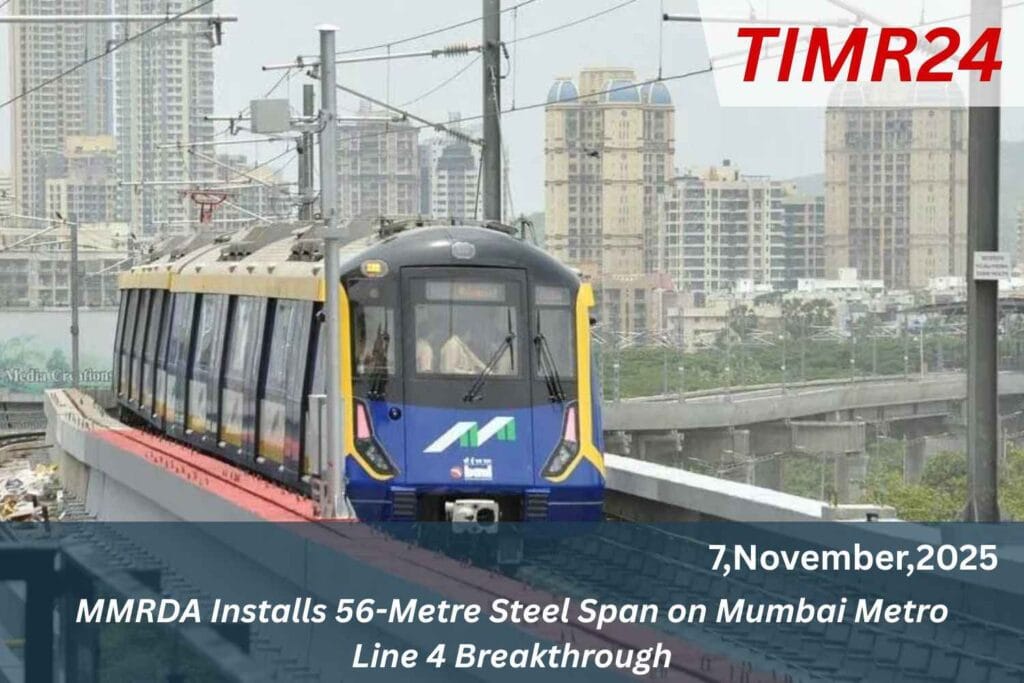
The Mumbai Metropolitan Region Development Authority (MMRDA) has reached a significant milestone in the Mumbai Metro Line 4 project by successfully installing a 56-metre, 450-ton steel span at the GMLR (Bhandup–Sonapur) Junction. This achievement marks the completion of over 84.5% of the project’s construction. The operation involved over 100 skilled workers and utilized nine high-capacity cranes, executed without disrupting traffic despite adverse weather conditions. The elevated Green Line will span 32.32 kilometres, connecting Wadala to Kasarvadavali with 30 stations, and will include a further extension to Gaimukh.
The project is being developed in three phases, with a completion goal set for 2027. This reflects MMRDA’s commitment to enhancing infrastructure and connectivity in Mumbai The urban landscape of Mumbai is on the cusp of transformation with the ambitious 32.32 km corridor of Mumbai Metro Line 4 stretching from Wadala to Kasarvadavli rapidly advancing toward completion under the stewardship of the Mumbai Metropolitan Region Development Authority (MMRDA). One of the most compelling recent milestones is the installation of a truly monumental steel span, measuring approximately 56–58 metres in length and weighing in the realm of 400-500 tonnes, depending on location and configuration.
Engineering Feat Amidst Urban Constraints
At the heart of this accomplishment lies a formidable engineering challenge: positioning the span above the crowded bus station at Pantnagar-Ghatkopar in Ghatkopar East, where the bustling Andheri-Ghatkopar Link Road and the adjacent Somaiya Nullah leave little margin for error. The span, standing around 3.1 metres high in that installation, was made of five steel girders and hoisted into place during the intervening nights to minimise disruption Heavy-lifting equipment played a starring role. Cranes with lifting capacities of 700 metric-tonnes and 500 metric-tonnes were deployed, supported by additional 500-tonne and 80-tonne cranes. More than 100 workers including engineers.
Safety staff and 50 traffic wardens managed the operation Every metro corridor has its critical segments, and for Metro Line 4, the steel span installations represent a turning point. These spans allow the elevated tracks to bridge major junctions, bypass congested roadways, and integrate seamlessly into the metro network. With this installation, the project edge closer to being fully operational. Reportedly, the line now stands at approximately 84.5 % completion For commuters, the implications are substantial: the readying of Line 4 means improved east-west connectivity across Mumbai’s suburbs areas such as Ghatkopar, Mulund, Thane and beyond and the potential to significantly reduce travel times.
Logistics, Coordination & Traffic Management
The elevated corridor is expected to relieve pressure on road traffic and existing mass transit systems. Executing a task of this magnitude in a live urban environment demanded meticulous planning. The decision to perform the installation overnight was strategic: it curtailed traffic impact while enabling longer uninterrupted work windows. Agencies such as traffic police, municipal authorities, crane (Railways) operators, and construction teams coordinated closely to ensure safety and continuity of flow one location near Kapurbawdi Junction saw the installation of a 48-metre-long, 14-metre-high span comprising four steel girders weighing 325 tonnes. That installation too was conducted overnight to navigate the high-traffic.
Grounder Road corridor Metro Line 4 is not a standalone venture: it integrates with key existing and planned corridors, acting as a spine for the city’s transit future. As the steel spans are put in place, stations, tracks, signalling and system integrations move closer to completion. The completed spans essentially unlock segments for track work, overhead line equipment, and eventual train trials. Moreover, landmark installations like this build public confidence in the project timeline and the MMRDA’s ability to deliver Once operational, the line is expected to change the daily commute narrative for thousands of residents: suburbs previously disconnected or underserved will gain central Mumbai.
Employment zones, and other transit systems. In areas where east-west travel has been particularly arduous, the new corridor promises relief from longstanding congestion the project has faced its share of hurdles. Delayed land acquisition, pandemic-related supply disruptions, and dense site conditions (especially near nullahs and interchange zones) have at times slowed pace. Yet the recent span installation underscores how mobility infrastructure projects can surge forward with disciplined logistics and multi-agency collaboration The readout from this milestone also signals that major civil works are largely done, with remaining tasks likely to focus on.
Signalling Electrification Integration
System installation, testing, station finishing and commissioning activities. In many ways, installing the steel span is a visible, tangible marker of the corridor entering its final phase With the steel span in place, attention naturally shifts to the next steps: track laying, signalling, electrification, integration with station architecture and eventual trial runs. The MMRDA has indicated that with such installations complete, the path to opening the corridor for public use is now clearer. As one article noted, “phase 1 commissioning” is on the horizon once the special steel spans are complete In practical terms, residents in Ghatkopar, Mulund, Bhandup, Thane and other connected zones should anticipate further traffic diversions.
Overnight closures for final works, and test train runs in the months ahead. The authorities’ ability to deliver the promise of faster connectivity will hinge on how smoothly these next phases roll out In the tapestry of Mumbai’s urban transit evolution, the installation of the massive steel span by MMRDA on Metro Line 4 stands out as a landmark sing-post. It exemplifies the blend of engineering (MMRC) ingenuity and urban planning required to steer a megacity’s infrastructure forward. As the elevated corridor inches toward readiness, the promise of more seamless, efficient commuting across the eastern suburbs draws closer. For Mumbai’s tens of thousands of daily travellers, the convenience of a smoother journey may soon become a reality.
Q1. What did MMRDA install on Metro Line 4?
The MMRDA installed a massive steel span measuring around 56 to 58 metres in length and weighing several hundred tonnes on the Metro Line 4 corridor.
Q2. Where exactly is the installation done?
The installation occurred at critical points along the Wadala-Kasarvadavli corridor of Metro Line 4. One key location is over the Pantnagar-Ghatkopar bus station in Ghatkopar East.
Q3. Why is the span installation important?
It’s a structural milestone that enables the elevated metro corridor to carry tracks over busy junctions and constrained spaces. It also moves the project closer to commissioning, enhancing east-west connectivity.
Q4. How was the work carried out amid traffic and other constraints?
The MMRDA executed the work during night hours, with heavy-duty cranes and coordinated traffic management, to minimise disruption on busy roads.
Q5. What is the current completion status of Metro Line 4?
Following this span installation, Metro Line 4 has been reported to be around 84.5 % complete.