















IST - Saturday, April 11, 2026 7:09 pm
Hot News

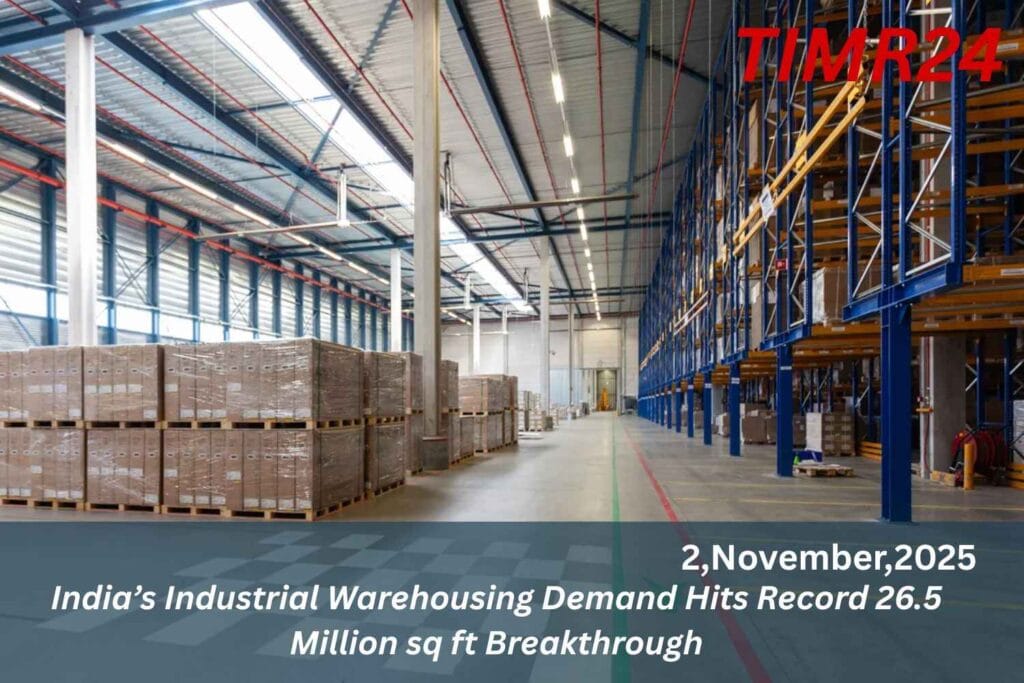
India’s Industrial Warehousing Demand Hits Record 26.5 Million sq ft Breakthrough

Soniya Gupta

Updated on:

Warehousing

India’s industrial and warehousing sector saw a record demand with 26.5 million sq ft leased in the first nine months of 2025, marking a 22% year-on-year increase. Bengaluru, Delhi-NCR, and Pune contributed over 60% of this leasing, while Chennai and Hyderabad also showed notable growth. Increased Grade A warehousing, enhanced multimodal connectivity, and a shift towards sustainability and automation have attracted occupiers. The sector is projected to exceed 35 million sq ft in total leasing by the end of 2025, bolstering India’s role as a global supply chain hub.

India’s industrial-warehousing sector has entered a transformative phase marked most notably by the news that leasing of grade-A warehouse space across the country’s top markets hit 26.5 million sq ft in the first nine months of 2025, up roughly 11 % year-on-year This milestone offers (Nepal) a lens through which to view the broader dynamics reshaping logistics real estate: from macro-economic shifts, to supply chain redesigns, to locational winners and structural headwinds At the heart of this growth lies the increasing integration of India into global supply chains and the deepening of its domestic consumption ecosystem. The strong tally of space absorption in 2025 underscores that occupiers are choosing.

Sustainability Features

To scale their Warehousing Infrastructure here not just in a reactionary manner, but as a strategic decision. The fact that so much of that leasing is in grade-A space signals that companies are placing a premium on quality: robust infrastructure, connectivity, automation and sustainability features From a demand-side perspective, the big drivers are clear. The third-party logistics (3PL) players continue to dominate occupier demand, accounting for nearly a third of leasing during the E-commerce and engineering/manufacturing segments are gaining relative traction e-commerce for its last-mile fulfilment and urban-proximate hubs, engineering and manufacturing.

For their supply-chain relocations and domestic production pushes. According to one major report, in Q1 2025 engineering alone contributed about 25 % of uptake across India’s top eight cities On the supply side, the response has been active: new completions across major markets in the first nine months of 2025 stood at around 28.8 million sq ft, a 6 % increase year-on-year, though this still slightly outpaced demand, pushing vacancy levels up by some 160 basis points That dynamic supply slightly ahead of demand raises important strategic questions for developers and investors around timing and quality of delivery Geographically, the lion’s share of activity is clustered.

The combined contribution of the Delhi NCR, Chennai and Mumbai markets accounted for over 60 % of leasing in the nine-month period Within those, micro-markets such as Luhari and Farukh Nagar (in Delhi NCR), Oragadam (in Chennai) and Bhiwandi (in Mumbai) remain high-momentum hubs thanks to their locational advantages (network connectivity, industrial hinterland Yet beneath the headline of “record absorption” lie a number of nuanced trends and caveats. For one, while the overall 9-month figure is up 11% year-on-year, the third quarter alone (Q3 2025) saw a moderation in take-up about 7.0 million sq ft, down 23% year-on-year. That pull-back signals that while momentum remains strong.

Occupiers are showing caution in the face of global trade uncertainty, cost pressures and evolving supply-chain strategies Another point: the surge in leasing is disproportionately in high-specification (“Grade A”) space. The occupier preference for best-in-class buildings is manifest. This means that not all new supply will carry equal value and some lower-end stock may find it tougher to secure tenants or justify rental growth. Indeed, rentals in prime micro-markets are firming up, even as vacancies tick up because of supply addition From a strategic-investment standpoint, there are several implications to consider. Developers and investors should assess not just.

Where to build or lease, but what quality and how connected. Logistics parks that offer multi-modal connectivity, scalability, automation, green features and are close to labour/consumption clusters will likely command premium occupancy and rental growth. The clustering of demand in Delhi NCR, Chennai and Mumbai underscores the “winner-take-most” nature of this market, at least for now At the same time, the fact that supply is outpacing demand somewhat means that timing matters. For those entering now, the risk is of leasing being delayed or incentives being higher, especially for less-preferred product or locations. But for those with premium positioning.

Growing Steadily Manufacturing

The benefits of scale and operational readiness may underpin strong returns Broader macro-factors lend further support: India’s domestic consumption is growing steadily manufacturing policies are stimulating investment; global firms are increasingly looking to diversify away from China and pivot toward India and Southeast Asia; and government infrastructure investment roads, ports, logistics parks continues apace. All of these translate into long-term tailwinds for warehousing and logistics real estate. Various reports indicate that manufacturing, engineering and e-commerce segments will continue to drive demand

Looking ahead, the remainder of 2025 and beyond appear promising but not without the need for caution and selectivity. The uptick in demand during the festive season and rising electronics sales are expected to boost Q4 leasing Meanwhile, markets beyond the top three mega-cities locations may emerge over time as occupier strategies evolve but for now the lion’s share remains in the established hubs. For investors, tracking rent trajectories, vacancy trends, logistics–industrial clustering, and the strength of occupier demand.

In summary, the milestone of 26.5 million sq ft leased across India’s major industrial and warehousing hubs in the first nine months of 2025 signals a robust and maturing sector driven (NTPC) by strong fundamentals, occupier upgrades and structural change. Yet the story isn’t purely one of “build everywhere” but rather one of targeted development, quality positioning and timing. For those paying attention, this sector offers compelling opportunities; for those less attuned, the risk of oversupply or sub-optimal location looms large.

Q1. What is India’s total industrial warehousing demand in 2025?
India’s industrial warehousing demand reached 26.5 million sq ft, the highest ever recorded.

Q2. Which cities are leading in warehousing development?
Major cities include Mumbai, Delhi-NCR, Pune, Chennai, and Bengaluru.

Q3. What sectors are driving warehousing growth?
E-commerce, manufacturing, and logistics are the top contributors.

Q4. How are government initiatives impacting warehousing?
Schemes like Make in India, Gati Shakti, and Logistics Policy have improved infrastructure and reduced logistics costs.

Q5. What is the future of India’s warehousing sector?
It’s expected to surpass 30 million sq ft by 2026, with increased automation and green warehousing solutions.