









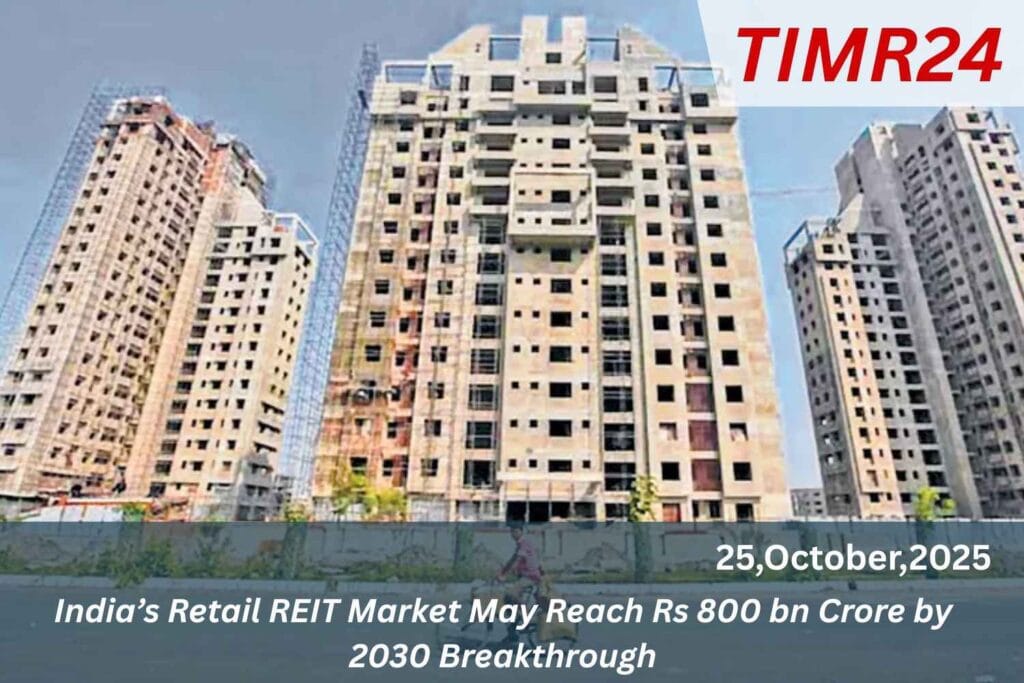
India’s retail Real Estate Investment Trust (REIT) market is expected to reach Rs 800 billion by 2030, driven by growing institutional interest, robust consumer demand, and increased retail space supply. With 110 million sq ft of organized mall space REITs are seen as a growth frontier for investors seeking stable returns. Cities like Delhi-NCR, Mumbai, Bengaluru, and Hyderabad are expected to lead the next phase The Indian real estate investment trust (REIT) landscape is undergoing a meaningful evolution, and the retail segment within it is attracting increasing attention. According to research by ANAROCK Research, India’s retail REIT market could grow to.
The order of ₹60,000-80,000 crore by 2030, roughly 30–40 % of the broader REIT universe. Some sources even suggest a potential of around ₹600-800 billion (₹60,000-80,000 crore) by 2030 This anticipated expansion reflects not just asset growth but a structural shift in how real estate is being packaged, offered and funded Until recently, India’s REITs have been dominated by commercial office assets. The listed REIT vehicles have largely comprised office parks and technology-office campuses, and only one of the five listed REITs is truly retail-focused However, several developments are converging that make the retail segment attractive:
- Grade A shopping malls and high-quality retail centres are maturing into stable, income-generating assets. ANAROCK notes that as these assets become more institutionalised, they become suitable for REIT structuring.
- Consumer spending is rising, urban incomes are increasing, and the experience-based retail segment (entertainment, food & beverage, lifestyle) is gaining traction.
- Developers and institutional players are looking to unlock value by listing or partially listing assets via REIT structures; the retail pipeline offers a new front for such listings.
- The growth of retail and mixed‐use developments outside the traditional top metros in Tier II and III cities is creating new supply and new demand, thereby making the retail REIT proposition broader geographically.
Market Size, Forecasts and the Opportunity
According to ANAROCK, by 2030 the total Indian REIT market may reach around USD 25 billion (≈ ₹2 lakh crore), and retail REITs could form about 30–40% of that. The ₹60,000–80,000 crore figure (₹600-800 billion) represents this 30-40% share. Other commentary uses the term “₹800 billion” (₹80,000 crore) as a ceiling for the retail REIT market by 2030 In more tangible terms, this means the retail REIT segment could become large enough to be a major asset class in Indian real estate, attracting institutional capital, offering liquidity, and providing investors access to large-scale, high-quality retail real estate without individually owning or managing properties.
Important Enablers of Growth
a) Maturing Assets: Many retail malls and shopping centres are now operating on stable tenancy, with anchor tenants, strong footfall, and reliable lease structures. This stability is key for REIT viability. For instance, new mall projects of around 1-1.2 million sq. ft. are being planned with entertainment, F&B and lifestyle retail alone accounting for nearly half of the new space.
b) Institutional Investment & Listing Pipeline The data suggest that 2-3 new REITs may launch in the next 3-5 years, as institutional portfolios of retail assets are partially listed. As the number of retail-REIT vehicles increases, the market structure becomes more robust, offering scale, transparency and investor access.
c) Demand from Tier-II & III Cities: Growth away from the top tier metros is notable. Cities such as Indore, Coimbatore, Surat, Bhubaneswar, and Chandigarh are emerging as consumption hubs and growth centres. Institutional players are targeting these markets, increasing the catchment and growth potential of retail real estate.
d) Changing Tenant Mix & Experience: Modern real estate is shifting from purely shopping to an experience-driven model where dining, entertainment, lifestyle, wellness and leisure co-exist with retail shopping. This helps increase footfall, dwell time and tenant diversity important for yield stability in a REIT structure.
Risks and Considerations
While the outlook is promising, several risks must be borne in mind. First, real estate is inherently dependent on footfall, consumer sentiment and spending power. Economic downturns, shifts to e-commerce, or lower footfalls could impact leasing and incomes. Second, the REIT market structure in India is still nascent for only one major REIT is listed, and investor familiarity may be lower than for office-REITs. Third, asset valuations, lease escalations, occupancy levels, and governance practices will matter strongly for success. Fourth, competition from alternative asset classes logistics, data-centres, residential/serviced-homes may divert capital.
For developers, the opportunity is clear converting or developing large-scale mixed-use assets with stable tenancy into institutional-grade portfolios enhances value, unlocks capital via REIT listings or co-investment vehicles, and improves asset liquidity. The anticipation of multiple REIT launches suggests that developers may increasingly package assets accordingly For investors, retail REITs provide a way to participate in India’s consumption story through a relatively asset-backed, yield-oriented vehicle. As one commentary notes, such REITs offer steady rental yields from long-term leases, inflation-linked rent escalations, portfolio diversification and trading.
The Broader Ecosystem and the Way Ahead
liquidity Equally, investors must undertake due diligence understand the lease terms, occupancy, location, tenant mix, and the underlying asset strength The coming decade therefore looks set to host a structural transition in India’s real estate investment ecosystem: from office-heavy REIT portfolios to a more diversified mix that includes retail, mixed-use, and even logistics segments. The move toward REIT institutionalisation will mean more transparent lease data, standardised asset management practices and more publicly traded vehicles.
For readers of this website interested in exploring other real-estate investment opportunities, you may wish to read our articles on (Real Estate) India’s REIT market is at a cusp. From an ecosystem dominated by office assets, the shift to leveraging retail and mixed-use portfolios via REIT structures signals both maturation.
Q1. What is a REIT?
A REIT (Real Estate Investment Trust) invests in income-generating retail properties like malls and shopping complexes.
Q2. How big is India’s retail REIT market expected to become?
By 2030, India’s REIT market could reach Rs 800 billion crore, backed by strong consumer demand and investment inflows.
Q3. Which cities are leading in REIT development?
Mumbai, Bengaluru, Delhi-NCR, Pune, and Hyderabad are leading due to rapid urbanisation and consumer spending.
Q4. Are REITs a safe investment option?
Yes, REITs provide stable rental income and portfolio diversification, though returns depend on occupancy and market demand.
Q5. What government policies support REITs in India?
SEBI’s simplified REIT regulations, tax benefits, and infrastructure initiatives like Smart Cities support the sector’s growth.