



















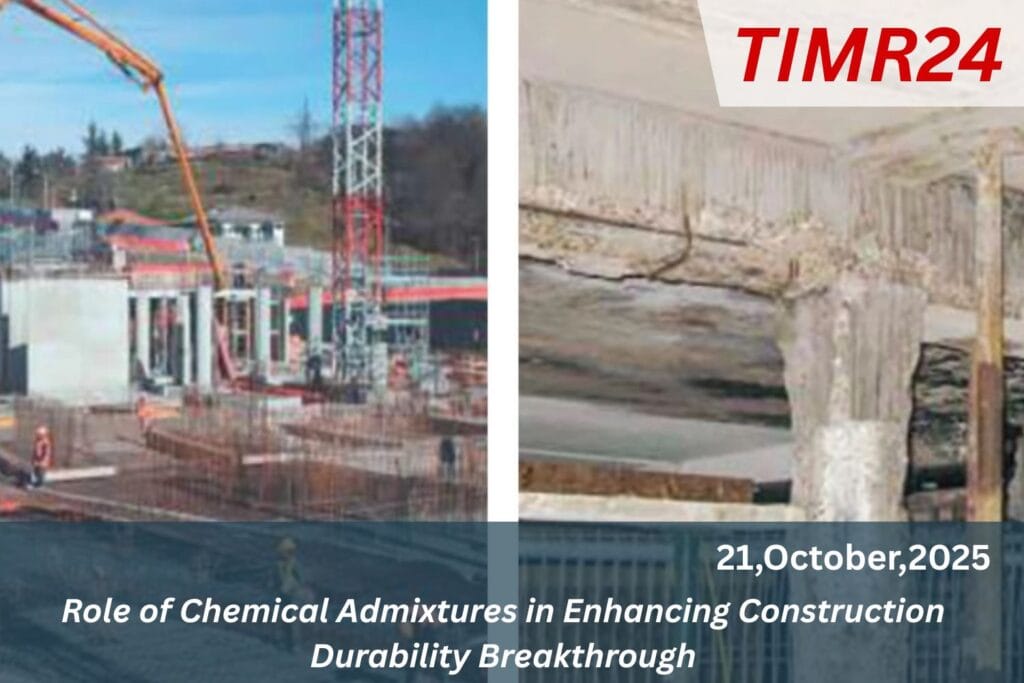
Chemical admixtures are essential in modern construction to enhance the performance, durability, and sustainability of concrete structures. These additives, introduced during the mixing process, modify concrete properties to meet specific engineering requirements, addressing challenges posed by complex designs and environmental conditions. Common types include plasticizers, superplasticizers, air-entraining agents, retarders, accelerators, and corrosion inhibitors The construction chemicals sector is at the forefront of developing advanced admixture solutions, reducing the carbon footprint of concrete production and improving concrete’s mechanical properties.
Companies are developing tailored admixtures for specific construction needs, such as high-performance concrete for infrastructure projects and self-compacting concrete for complex architectural designs Graphene-Enhanced Concrete is an emerging innovation in the admixture domain, incorporating carbon atoms into concrete mixes to improve compressive, tensile, and flexural strength. This advancement enables comparable or greater performance in concrete design mixes while using less cement, contributing to sustainability efforts The strategic use of admixtures has become indispensable in modern construction, offering solutions that enhance performance, ensure durability, and promote sustainability.
The construction industry has witnessed a remarkable transformation in material science over the past few decades, with chemical admixtures emerging as one of the most revolutionary innovations for enhancing concrete durability. Concrete, though one of the most versatile and widely used materials, is inherently porous and susceptible to environmental attacks such as corrosion, sulfate damage, and freeze-thaw cycles. These factors often reduce the lifespan of structures and increase maintenance costs. To counter these issues, chemical admixtures have been developed to modify the properties of fresh and hardened concrete, thereby improving performance.
Workability, and longevity chemical admixtures are integral in achieving desired concrete quality under diverse climatic and site conditions This advancement complements the modern trend toward sustainable and performance-based construction, which prioritizes long-term structural stability and minimal environmental impact. A detailed discussion on sustainability can be found in our related article, (Sustainability of Hardened) where the link between material innovation and eco-efficiency is further explored.
Understanding Chemical Admixtures and Their Role
Chemical admixtures are ingredients other than cement, aggregates, and water that are added to concrete before or during mixing to achieve specific properties. Their role extends far beyond improving the appearance or strength; they fundamentally enhance durability by modifying microstructures and reducing the pathways through which aggressive agents penetrate the concrete matrix. Admixtures such as water reducers, superplasticizers, and corrosion inhibitors play a pivotal role in creating dense, impermeable, and high-strength concrete suitable for aggressive environmental exposure When properly selected and dosed, admixtures can increase resistance to.
Chemical attack, minimize shrinkage, reduce water demand, and control setting times instance superplasticizers can reduce water content by up to 30%, leading to denser concrete and lower permeability. Air-entraining agents, on the other hand, improve freeze-thaw resistance by creating microscopic air voids that act as pressure relief chambers. For a deeper understanding of such applications in advanced construction, you can refer to our article on highlights the synergy between admixtures and high-performance concrete systems Durability, in the context of construction materials, refers to the ability of a structure to resist deterioration due to physical or chemical effects.
From the environment. One of the key contributions of chemical admixtures is in reducing permeability, thereby preventing the ingress of harmful ions like chlorides and sulphates that lead to corrosion and spalling. A denser microstructure also ensures less moisture movement, which is vital for extending service life Corrosion inhibitors form a protective layer around reinforcing steel, preventing oxidation even in chloride-rich environments such as coastal regions. Similarly, pozzolanic admixtures like fly ash and silica fume react with calcium hydroxide to form additional calcium silicate hydrate (C-S-H), which enhances density and strength.
These chemical interactions drastically improve the durability of concrete by refining pore structure and reducing chemical reactivity. The effect of water quality on durability is also significant, as highlighted in our post which explains how even seemingly clean water can impact concrete’s long-term strength and stability if not properly tested Furthermore, shrinkage-reducing admixtures mitigate cracking, which is one of the primary causes of durability failure. Cracks act as open doors for water and aggressive chemicals, accelerating degradation. By minimizing shrinkage, admixtures maintain the integrity of concrete structures, especially in large slabs and pavements where dimensional stability is crucial.
Chemical Admixtures and Sustainable Construction
The environmental aspect of chemical admixtures cannot be overlooked. Modern construction is moving toward sustainability, and admixtures contribute significantly by reducing the cement content required to achieve target strength and durability. Since cement production is a major source of CO₂ emissions, admixtures indirectly reduce the carbon footprint of construction water reducers and superplasticizers enable the design of high-strength concrete mixes with less cement and water, making them both economical and eco-friendly.
Additionally, the improved durability means fewer repairs and longer service life, leading to reduced consumption of construction materials and energy over time. This concept aligns closely with the government’s vision of sustainable infrastructure, as emphasized in our article (Awas Yojana and Pradhan Mantri Gram Sadak Yojana) where material optimization and life-cycle cost efficiency are key sustainability measures The performance of admixtures depends on several factors such as type of cement, aggregate quality, temperature, and mixing conditions. Admixtures must be compatible with the mix design and used within prescribed limits as per IS 9103:2019, which provides guidelines.
For their usage in concrete. Excessive or incompatible use can lead to issues like segregation, delayed setting, or strength reduction. Hence, scientific proportioning and quality control are essential to ensure the desired outcome Field applications have shown that using a combination of admixtures tailored to site conditions can provide exceptional durability results. For instance, in hot climates, retarders are often used to delay setting time, allowing sufficient placement and compaction, whereas in cold regions, accelerators promote early strength gain to prevent frost damage. These custom formulations enable engineers to achieve a balance between workability, strength, and durability, even under challenging environments.
Admixtures in Modern Infrastructure Projects
The use of admixtures is now common in mega projects such as high-rise buildings, bridges, tunnels, and marine structures. The demand for long-lasting concrete capable of resisting corrosion and cracking has made admixtures a standard component of mix design. In coastal infrastructure, where saltwater exposure is unavoidable corrosion inhibitors and pozzolanic admixtures are indispensable. In high-traffic urban zones, air-entraining agents and plasticizers improve flexibility and fatigue resistance To understand the role of industrial partnerships in promoting material innovation, you can refer to our analysis of which showcases how collaboration between.
Industries can drive sustainable growth and material technology advancements relevant to the construction sector The future of admixture technology is moving toward nanotechnology and smart materials. Nanoadmixtures, which utilize nanoparticles like nano-silica or carbon nanotubes, are expected to revolutionize concrete by enhancing self-healing, strength, and sustainability. Self-healing concrete incorporating chemical agents that activate upon crack formation could further extend the service life of structures with minimal maintenance. The integration of such advanced admixtures into the Indian construction ecosystem represents a major leap toward durable, resilient, and smart infrastructure.
Conclusion
The role of chemical admixtures in enhancing construction durability cannot be overstated. They are the unsung heroes behind every long-lasting, weather-resistant, and sustainable structure. By altering the concrete’s internal chemistry, admixtures improve strength, reduce permeability, control setting, and ensure corrosion protection factors that directly contribute to long-term durability. Their integration into construction practices reflects a paradigm shift from traditional material use to performance-based engineering. With growing emphasis on sustainability and life-cycle cost efficiency, chemical admixtures stand as a cornerstone for the future of durable, eco-friendly, and high-performance concrete structures.
Q1. What are chemical admixtures in concrete?
They are materials added in small quantities to modify concrete’s physical and chemical properties for better performance and durability.
Q2. How do admixtures enhance concrete durability?
By reducing permeability, improving workability, and preventing corrosion, admixtures increase concrete’s lifespan.
Q3. Which admixtures improve resistance to cracking?
Shrinkage-reducing and superplasticizer admixtures help minimize cracking during curing.
Q4. Are chemical admixtures environmentally friendly?
Yes, because they reduce cement usage, thereby lowering carbon emissions and enhancing sustainability.
Q5. What standards regulate admixture use in India?
IS 9103:2019 specifies the guidelines for chemical admixtures in concrete.