














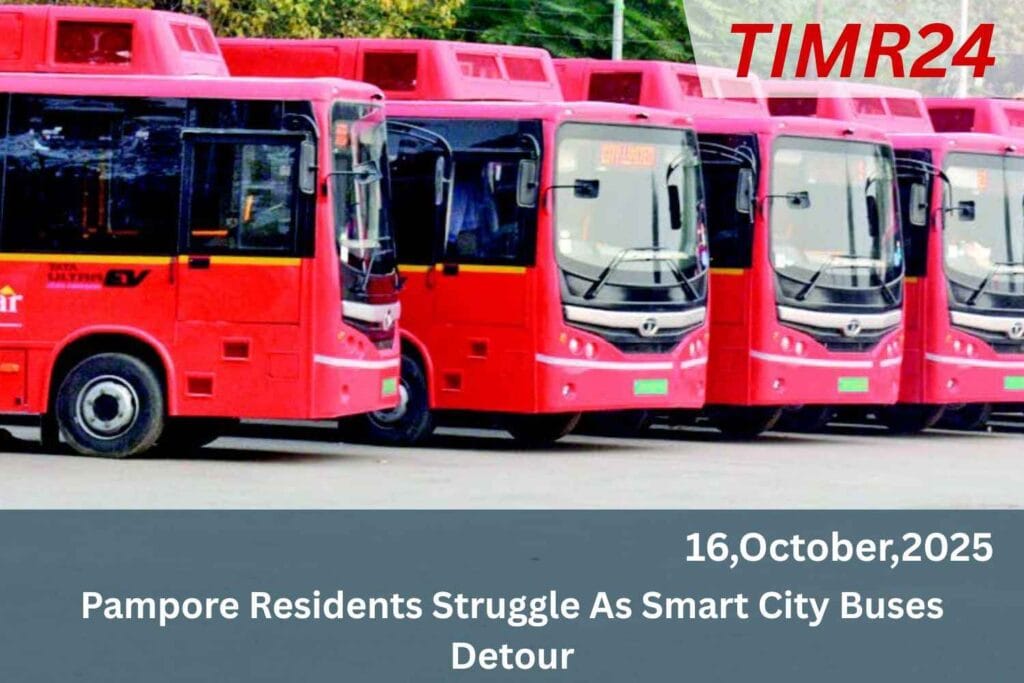
Pampore residents are experiencing severe inconvenience as the Smart City bus service on route 7A bypasses the town, forcing commuters to seek alternative transport. The service, which connects Jahangir Chowk in Srinagar to Pahoo via Pampore Road, was suspended due to heavy rainfall and Jhelum river overflowing. Students, employees, laborers, and patients are most affected. Authorities have assured drivers that the original route will resume tomorrow. Pampore, famously known as the “Saffron Town” of Jammu and Kashmir, has recently been grappling with significant challenges in daily commuting due to Smart City bus detours. The town, which has always relied heavily.
On public transport for its residents’ day-to-day movement, is now experiencing disruptions that affect not only the convenience of commuters but also the rhythm of local businesses and community activities. The Smart City initiative, aimed at modernizing urban transport and enhancing overall mobility, has necessitated temporary route changes as part of road maintenance and city planning interventions. While the long-term vision promises improved traffic management and streamlined connectivity, the immediate impact has left residents frustrated and uncertain about their travel schedules. The Jammu & Kashmir Transport Department’s highlights that.
These detours are part of a broader strategy to integrate technological solutions and urban planning measures, yet the on-ground reality reflects the challenges of implementing such large-scale changes in a town with historically narrow lanes and dense residential clusters The detours have brought everyday travel challenges to the forefront, particularly for commuters who rely on Smart City buses for reaching offices, schools, and medical facilities. Many residents have reported increased travel times and a lack of timely notifications about schedule changes. For working professionals, this has resulted in delayed arrivals and logistical adjustments, while students are facing.
Difficulties reaching educational institutions on time. Some elderly commuters have expressed concerns regarding the inconvenience caused by the altered routes, as longer walking distances and unfamiliar stops create additional strain. Local media outlets, such as have covered stories highlighting commuter grievances, emphasizing the need for better communication channels and contingency plans to reduce disruption during infrastructure upgrades The impact extends beyond daily travel and touches the economic life of the town. Shops, restaurants, and small businesses situated along the traditional bus routes are experiencing decreased footfall, affecting.
Revenue and daily operations. Local vendors, who rely on commuter traffic, are particularly vulnerable to the sudden changes in transit patterns. In response, authorities have proposed temporary measures such as shuttle services and alternative transport arrangements. The (Smart City) provides residents with real-time updates on route modifications, enabling commuters to plan their journeys more effectively. Yet, the community’s feedback suggests that more proactive communication through social media, local forums, and on-site notifications could significantly ease the challenges faced by residents during this transitional period.
The necessity for detours arises from ongoing efforts to modernize Pampore’s transportation framework. Urban planners and transport authorities are implementing road widening, resurfacing, and traffic management strategies to ensure long-term efficiency and sustainability. The Smart City initiative seeks to integrate technology with urban mobility, including real-time GPS tracking of buses, digital route maps, and centralized control systems. These advancements aim to reduce congestion, enhance passenger safety, and streamline citywide travel. However, in towns like Pampore, where historical road layouts and dense residential structures present logistical constraints.
Temporary detours are unavoidable The balance between immediate inconvenience and long-term benefits is delicate, requiring authorities to prioritize both infrastructural upgrades and commuter satisfaction Community engagement emerges as a critical factor in addressing these challenges. Residents have voiced the importance of being informed ahead of route changes and having accessible alternatives to maintain mobility. Local governance bodies have initiated public consultations and feedback collection mechanisms, encouraging commuters to share their experiences and suggest improvements. Online discussion forums, WhatsApp groups, and social media.
Platforms have become essential tools for residents to stay updated, exchange tips, and voice concerns. Experts in urban planning highlight that including community input not only enhances project acceptance but also ensures that practical solutions, such as temporary stops and shuttle services, align with actual commuter needs. By fostering active dialogue between authorities and residents, Pampore can navigate the transitional period more smoothly while minimizing disruption Another significant aspect of the detours is their effect on emergency services and healthcare access. Residents needing immediate medical attention or transport to hospitals have expressed concerns about.
The altered bus routes. While private transport remains an alternative, it is not always accessible or affordable for all sections of society. Authorities are exploring strategies to maintain emergency accessibility by coordinating with local ambulance services, implementing temporary priority lanes, and ensuring that bus scheduling does not impede critical transport. Health and safety considerations remain central to planning, especially in a town where public transport is the lifeline for many families Despite the immediate difficulties, some residents recognize the potential benefits of these infrastructural adjustments. Once completed, the Smart City improvements are expected to provide.
More reliable and faster public transport, better traffic flow, and enhanced urban mobility. Roads are being upgraded to accommodate increased bus frequency, pedestrian safety is being prioritized, and digital systems promise to offer commuters accurate, real-time updates. The integration of technology, such as GPS-enabled tracking and mobile notifications, is expected to revolutionize daily travel, making Pampore a model for similar towns in Jammu and Kashmir. By investing in modern transport infrastructure now, the town is positioning itself for a more connected, efficient, and sustainable future Local authorities are also mindful of the broader environmental and societal benefits.
Of streamlined public transport. Reducing reliance on private vehicles can lower traffic congestion, decrease carbon emissions, and improve air quality. Encouraging the use of Smart City buses, even amid temporary detours, aligns with global trends in sustainable urban planning. Educational campaigns and awareness initiatives are being rolled out to help residents adapt to new systems, understand route adjustments, and appreciate the long-term advantages of an upgraded public transport network In the interim, commuters are encouraged to plan their journeys proactively, monitor official and utilize alternative local transit options. Coordination between residents, local.
Businesses, and authorities can help mitigate the challenges of temporary detours. Civic engagement, patience, and effective communication will be essential as Pampore transitions toward a more modern, efficient urban mobility ecosystem. The ongoing efforts to modernize public transport underscore a larger commitment to enhancing the quality of life in the town while balancing the demands of infrastructure development and community needs while Pampore residents face temporary inconvenience due to Smart City bus detours, these challenges are part of a larger initiative aimed at improving urban mobility, traffic management, and commuter experience.
By actively engaging the community, leveraging digital tools, and implementing flexible transport solutions, the town can minimize disruption and pave the way for a more (Jammu & Kashmir Transport Department) efficient and sustainable future. Residents, businesses, and authorities must navigate this transitional phase together, ensuring that short-term difficulties give way to long-term benefits, making Pampore a successful example of Smart City integration in smaller towns.
Q1. Why are Smart City buses in Pampore being rerouted?
The detours are due to ongoing road maintenance, infrastructure upgrades, and city planning adjustments to improve traffic flow.
Q2. How long will the bus detours last?
Detours may continue until road work or city planning projects are completed; residents are advised to check official Smart City updates for timelines.
Q3. Are alternative transport options available for Pampore commuters?
Yes, temporary shuttle services and nearby public transport options have been suggested by the authorities to ease commuter inconvenience.
Q4. Where can I find the latest updates on Smart City bus routes?
Updates are shared via the official Smart City website and social media pages, including real-time schedule changes.
Q5. How are local businesses impacted by the bus detours?
Reduced commuter traffic has affected footfall and revenue for businesses along detoured routes, prompting authorities to consider alternative access solutions.