


















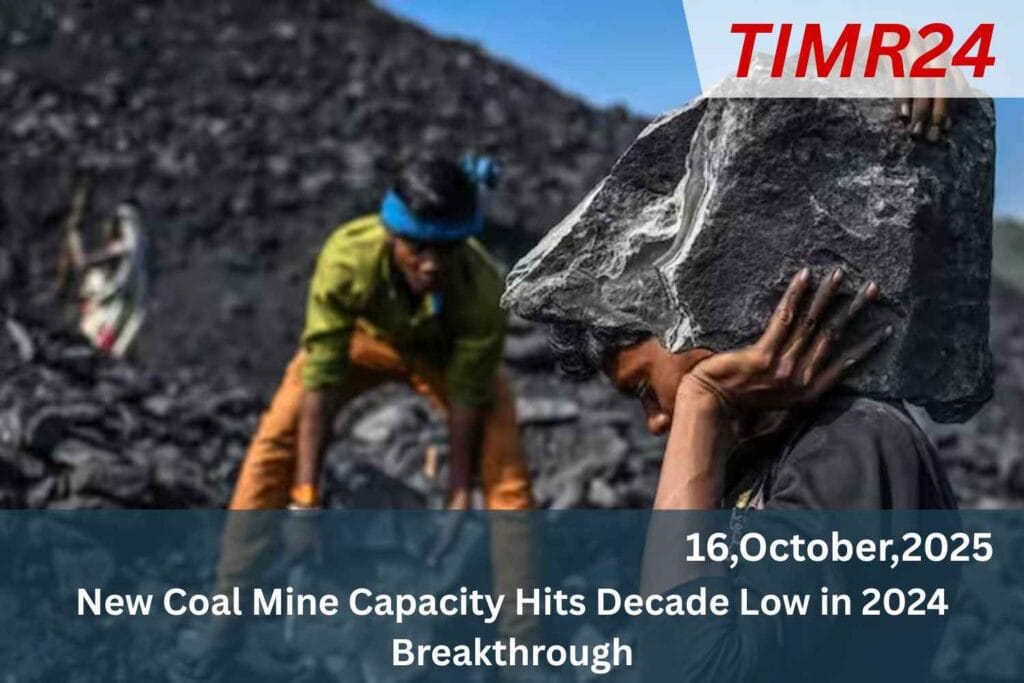
Global Energy Monitor (GEM) reports that the global capacity of newly opened coal mines in 2024 has fallen to its lowest level in a decade, with 105 million tonnes. This is a 46% drop from 193 Mt in 2023 and the lowest level since 2014. However, GEM warns that over 2,270 million tonnes per annum of mine capacity is currently under development worldwide, threatening efforts to curb greenhouse gas emissions. The International Energy Agency and United Nations recommend production cuts of 39 to 75% by 2030 compared to 2020 levels. In 2024, India’s mining sector experienced a remarkable slowdown, with new mine capacity reaching its lowest point in a.
Decade. This decline is significant, given the critical role coal plays in India’s energy infrastructure. continues to fuel over 70% of the country’s electricity generation, and any slowdown in new capacity can have far-reaching implications for both energy security and industrial growth. The contraction in new mine projects is the result of a combination of regulatory, environmental, and investment challenges, highlighting a complex intersection between economic development and sustainable practices One of the primary factors behind this decline is the increasingly stringent regulatory environment governing coal mining. Over the past decade, India has tightened environmental.
Regulations to reduce the ecological impact of mining activities. Approval processes for new mines now involve extensive environmental impact assessments, social audits, and compliance with land acquisition laws. While these measures are essential for sustainable development, they have inevitably slowed down the pace at which new mines are being approved. In addition, local communities and environmental activists have become more vocal, advocating for the protection of forests, water bodies, and wildlife habitats affected by mining. This push for sustainability has delayed the operationalization of several proposed coal projects, particularly in states like Jharkhand, Chhattisgarh.
Odisha, and West Bengal, which are traditionally responsible for a significant portion of India’s coal output. For further insights into regional coal production, readers can refer to our (Coal) page Investment patterns in the coal sector also play a critical role in explaining the reduction in new mine capacity. Private sector players are increasingly cautious about committing large sums to new coal mining projects due to policy uncertainties, rising operational costs, and the global shift toward renewable energy. Investors are increasingly evaluating the long-term viability of coal mining in a world that is steadily moving toward net-zero emissions. At the same time.
The Indian government has been actively promoting renewable energy initiatives, such as solar, wind, and green hydrogen projects, which are receiving significant financial and infrastructural support. As a result while still essential, is gradually receiving less focus from private investors. Readers interested in India’s renewable energy initiatives can explore (India Renewable Energy) for a deeper understanding of the ongoing shift.
The implications of this decline are far-reaching for the energy sector. With new mines being commissioned at a slower pace, electricity producers may face potential supply constraints -fired power plants, which account for a substantial share of India’s power generation, could encounter fuel shortages if older mines are depleted and new capacities are not brought online. This scenario could lead to increased electricity costs and may necessitate the import of coal from countries such as Australia and Indonesia, impacting India’s trade balance. The government and energy planners are, however, taking proactive measures to mitigate these risks, including stockpiling coal reserves.
And diversifying the energy mix to include more renewables. Our article on discusses these mitigation strategies in detail The slowdown in new coal mine capacity, while presenting challenges, also provides an opportunity for India to accelerate its transition toward cleaner energy mining is associated with high carbon emissions, land degradation, and air pollution. By reducing reliance on new coal projects, India can make significant strides toward meeting its climate goals and improving air quality. The shift toward renewable energy, including solar, wind, and emerging technologies like green hydrogen and energy storage solutions, is gaining momentum.
These technologies not only provide cleaner energy but also contribute to long-term sustainability and economic growth. For a comprehensive overview, readers can consult our section, which outlines the latest projects and government programs supporting renewable adoption Industry experts also point out that the slowdown could foster innovation within the coal sector itself. Technologies such as carbon capture and storage (CCS), improved coal washing techniques, and enhanced mechanization are being explored to make existing coal operations more efficient and environmentally friendly. By integrating such technologies -fired plants can reduce emissions.
While maintaining operational efficiency. Internal studies and reports indicate that modernization of existing mines may offset some of the shortfall from new capacity, ensuring that the sector continues to meet the country’s energy demands. For insights into technological advancements in mining State-specific dynamics are also critical to understanding the overall decline. In coal-rich regions like Jharkhand, Odisha, Chhattisgarh, and West Bengal, mining activities face unique challenges related to land rights, labor issues, and environmental clearances. These factors, combined with policy uncertainty, have slowed down project approvals and mine development.
Local communities are increasingly involved in decision-making processes, demanding compensation, rehabilitation, and employment opportunities. This participatory approach, while socially responsible, has contributed to longer timelines for new coal projects. To learn more about regional coal challenges The economic dimension of declining coal mine capacity is equally important mining supports millions of jobs directly and indirectly, and slower expansion could affect employment, local economies, and industrial output. While renewable energy projects are generating new job opportunities, the transition requires skill development and reskilling of workers previously.
Employed in coal-intensive sectors. Government initiatives aimed at skill enhancement and workforce development are crucial to ensuring that the shift from coal does not negatively impact livelihoods. Readers can explore more on workforce adaptation On the policy front, the government is balancing the need for energy security with environmental sustainability. Strategic measures such as maintaining coal stockpiles, incentivizing private investment in mine development, and promoting clean energy technologies are being implemented to ensure a smooth energy transition. Policies are also focusing on improving the efficiency of existing coal-fired power plants, thereby reducing.
The dependence on new mines while meeting demand. Comprehensive policy analyses and updates can be accessed through 2024 marks a pivotal year for India’s sector, with new mine capacity at a decade low. While this slowdown presents immediate challenges for energy supply, it also aligns with the broader goal of transitioning toward sustainable energy. Effective policy implementation, investment in modern technologies, and a balanced approach toward renewable adoption will determine India’s ability to navigate this critical period. By focusing on energy security, environmental responsibility, and technological innovation, India can ensure that its energy.
Landscape remains robust, sustainable, and aligned with global climate commitments. Internal resources like provide additional insights for stakeholders and readers keen on understanding the evolving dynamics of India’s energy sector.
Q1. Why has new coal mine capacity fallen in 2024?
Regulatory challenges, environmental concerns, and reduced investment have slowed the commissioning of new coal mines.
Q2 How does this impact India’s energy sector?
Lower coal capacity could lead to higher electricity costs and increased reliance on imports or alternative energy sources
Q3 What are the alternatives to coal amid declining capacity?
Renewable energy sources like solar, wind, and green hydrogen are being explored to bridge the energy gap.
Q4 Which states are most affected by this slowdown?
Coal-heavy states such as Jharkhand, Chhattisgarh, Odisha, and West Bengal are directly impacted.
Q5 Will coal demand decrease in the coming years?
Demand may remain stable in the short term but is expected to gradually decline as India shifts toward renewables.