



















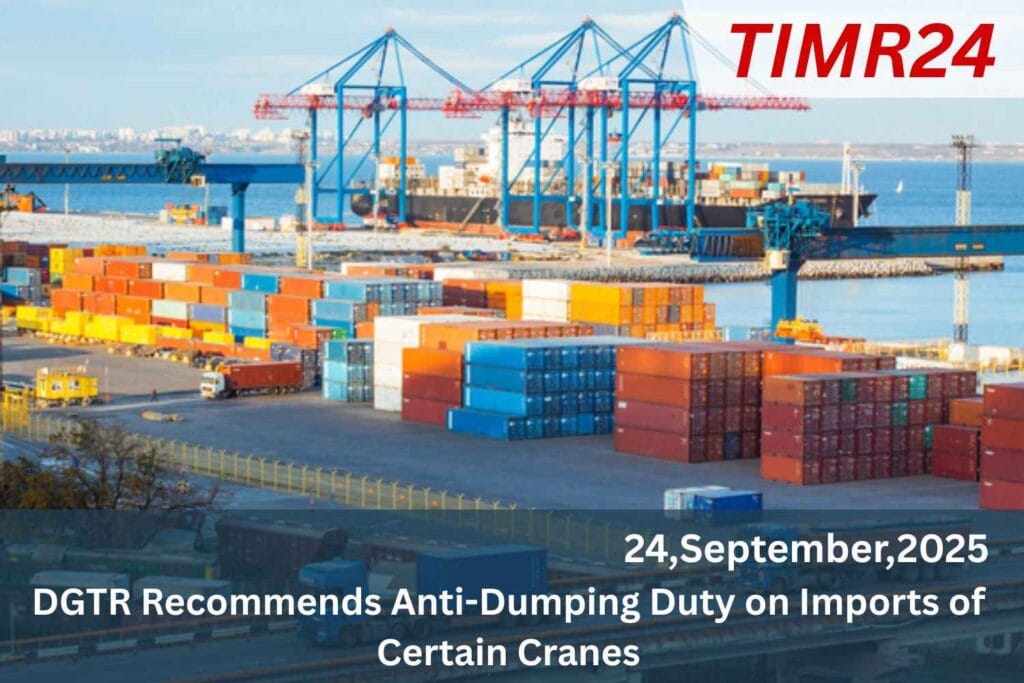
The Indian Ministry of Commerce & Industry’s Directorate General of Trade Remedies (DGTR) has recommended definitive anti-dumping duties for five years, ad-valorem on the CIF value. The investigation found that imports from low-cost supply regions were priced below fair value, causing significant harm to the Indian industry. The duties range from 25% to over 52%. The DGTR has recommended measures to restore fair trade practices and ensure a level playing field for domestic producers. The Ministry of Finance is awaiting final notification. The move could strengthen domestic manufacturers and encourage multinational players to consider local manufacturing for India’s.
Infrastructure demand However, experts warn of potential second-hand equipment filling the gap The Directorate General of Trade Remedies (DGTR), India’s apex trade remedial authority under the Ministry of Commerce and Industry, has recently recommended the imposition of anti-dumping duties on the import of certain categories of cranes. This development is a landmark decision for the domestic heavy machinery industry, particularly the manufacturers of crawler and truck cranes, who have long complained about unfair trade practices undermining their growth. Anti-dumping duties are corrective measures that ensure foreign exporters do not flood the Indian market.
Background of the Anti-Dumping Investigation
With under-priced goods, thereby creating a level playing field for local producers. The case of crane imports reflects how trade remedies are increasingly becoming an essential tool of India’s industrial policy, aligning with broader national initiatives like and infrastructure expansion programs that rely heavily on construction equipment The issue of crane imports has been building over the past few years, as Indian companies raised concerns that imported crawler cranes in the 40 to 260 metric ton range, and truck cranes of 25 to 160 metric tons, were being sold at prices far below their normal value in the exporting country. This practice, known as dumping, not only distorted fair.
Competition but also led to injury in the form of declining sales, suppressed margins, and under-utilization of domestic.
Production capacities. DGTR, as per its mandate, initiated a formal investigation covering the period between April 2023 and March 2024, with earlier years also reviewed to establish trends. After analyzing pricing data, cost structures, and injury claims, the authority confirmed that there was sufficient evidence of dumping and its harmful effects on Indian manufacturers. It is noteworthy that certain categories such as rough terrain cranes and all-terrain cranes above 160 metric tons were excluded from the scope, ensuring that only the most directly impacted product segments were addressed The DGTR concluded that material injury had indeed occurred due to low-priced imports.
Eroding the competitiveness of the Indian crane sector. To remedy this, the authority proposed definitive anti-dumping duties for a duration of five years. The duties are structured on an ad-valorem basis, meaning they are calculated as a percentage of the import value. Interestingly, DGTR has recommended a differentiated duty structure: certain identified exporters would face lower duties, while others would be subject to higher levies, with the rates ranging from around 25 percent to more than 52 percent. This system acknowledges that some foreign producers may have cooperated with the investigation or demonstrated more transparent pricing, while others may not have.
The Legal and Policy Context
The recommendation now awaits approval and formal notification by the Ministry of Finance, after which it will become enforceable under India’s customs law. Anti-dumping actions are not new to India, which has been among the most active users of such measures globally. Governed by the Customs Tariff Act and Anti-Dumping Rules aligned with World Trade Organization (WTO) disciplines, the DGTR plays a critical role in balancing trade openness with the need to safeguard domestic industries. The present crane case adds to earlier actions in sectors such as steel, chemicals, and solar equipment. For readers interested in broader trade policy trends, our detailed coverage.
The (National Progress) or the highlights how India is simultaneously protecting local industries and expanding its trade and infrastructure footprint. The crane duty fits within this policy matrix, protecting strategic capital goods that are vital for large-scale projects across ports, highways, and energy infrastructure For Indian manufacturers, this recommendation is likely to provide much-needed relief. Companies like Action Construction Equipment (ACE) and Escorts Kubota have faced stiff competition from imports that were priced unfairly. With anti-dumping duties in place, domestic producers may regain lost market share, improve capacity utilization, and even consider scaling up.
Production to meet rising demand from India’s ambitious infrastructure push. This aligns with the government’s long-term vision of promoting self-reliance in critical equipment manufacturing, thereby reducing dependence on external suppliers. Importers, however, may initially feel the pinch as procurement costs rise, but DGTR has maintained that the overall impact on project costs will be moderate. This is because cranes typically account for a relatively small portion of the total cost of large infrastructure projects, such as metro rail construction or highway bridges.
Reactions from Importers and International Stakeholders
While domestic manufacturers have welcomed the move, foreign exporters and their Indian import partners may not be as enthusiastic. Some may argue that the duties restrict competition or lead to higher equipment costs. Others may seek to challenge the recommendation legally or lobby for lower rates. In some cases, international producers may respond by setting up local assembly or manufacturing units in India, a strategy that not only bypasses the duties but also aligns with India’s industrial policy. This phenomenon was also seen in other industries where trade remedies encouraged foreign firms to localize production. For example, in our coverage of (Real Estate) and we noted how policy changes.
Often push global players to re-evaluate their India strategy, leading to stronger local ecosystems As with any trade remedial measure, risks and criticisms abound. One potential challenge is circumvention, where exporters reroute products through third countries to avoid duties. The DGTR and customs authorities will need to remain vigilant to ensure compliance and prevent loopholes. Another criticism is that duties, if too high, could restrict access to advanced technologies or specialized cranes that domestic manufacturers may not yet be able to produce at scale. Infrastructure developers worry that this could slow project execution if equipment availability is constrained.
Moreover, duties sometimes invite retaliatory measures from trade partners, though in this case the risk is relatively contained given the specific product focus Beyond the immediate effects on the crane sector, the DGTR’s recommendation underscores India’s growing willingness to deploy trade remedies strategically. The government has been balancing the twin goals of promoting industrial self-reliance while maintaining integration with global trade systems. Anti-dumping measures are not about shutting out imports but about ensuring that they enter on fair terms. For infrastructure, which remains a core driver of India’s growth story, the availability of competitively priced.
Domestically manufactured equipment strengthens long-term sustainability. This approach mirrors similar actions in other critical infrastructure domains, from where domestic participation is being encouraged through policy and regulatory frameworks The DGTR’s recommendation to impose anti-dumping duties on certain crane imports is a decisive step in protecting India’s heavy equipment industry from unfair trade practices. By targeting only those product categories most affected, the authority has taken a calibrated approach that minimizes downstream disruption while maximizing relief for domestic producers. Once notified by the Ministry of Finance.
The duties are expected to remain in place for five years, giving local manufacturers a crucial window to consolidate their market position, invest in capacity, and strengthen competitiveness. As India continues to expand its infrastructure footprint, from highways and metro networks to ports and industrial corridors, the availability of robust domestic crane manufacturing capacity will be invaluable. The crane anti-dumping case thus serves as both a reminder of the challenges posed by global trade imbalances and a testament to the role of strong regulatory institutions like the DGTR in shaping a fairer and more resilient industrial ecosystem.