



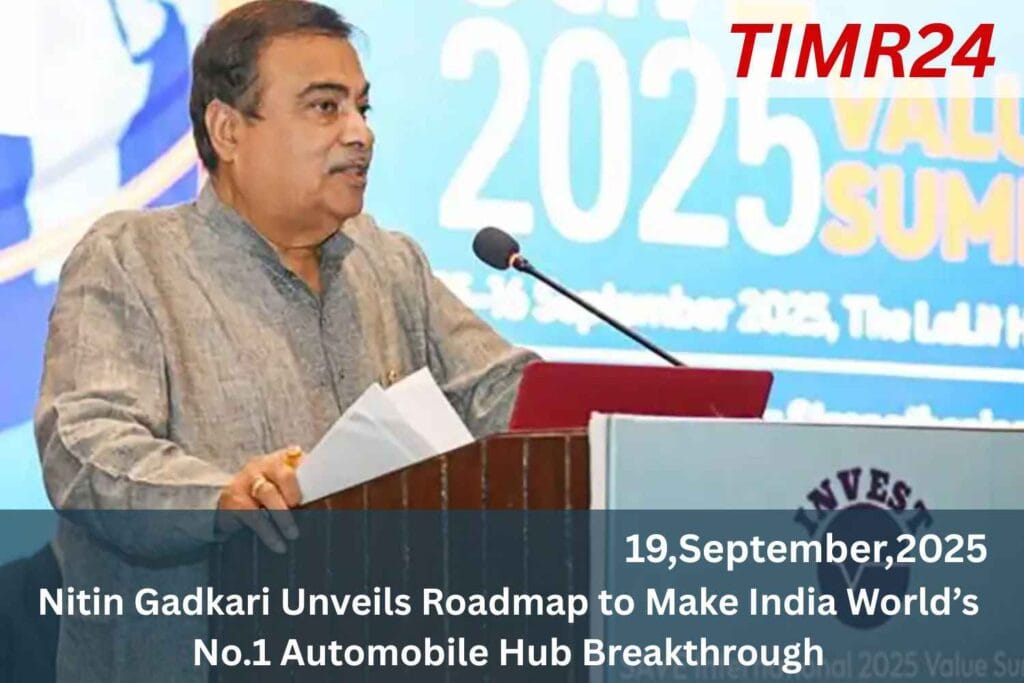
India’s Union Minister for Road Transport and Highways, Shri Nitin Gadkari, has announced plans to position the country as the global leader in automobile manufacturing, green mobility, and infrastructure innovation. The country has surpassed Japan as the world’s third-largest automobile market and aims to become the No. 1 position within five years. Gadkari highlighted India’s leadership in electric vehicles, hydrogen fuel, and alternative fuels, and announced that the government has provided ₹600 crore in grants to fast-track hydrogen infrastructure. road infrastructure has seen transformative progress, with the second-largest road network in the world and significant.
Progress in sustainability. Gadkari also called for global partnerships in key innovation areas, such as precast road Construction, Tunnel Engineering, hydrogen transport systems, and circular economy solutions. Union Minister for Road Transport and Highways, Nitin Gadkari, has the (FAME India) unveiled an ambitious roadmap that aims to position India as the world’s leading automobile hub. This bold vision comes at a time when the global automobile industry is undergoing massive transformations driven by sustainability, electrification, and technological innovations. India, with its strong manufacturing base, growing demand, and supportive government policies, is poised to leverage.
This transition and carve out a leadership position in the global market. Gadkari’s announcement is not just about expanding India’s automobile production but also about setting new standards in green mobility, advanced manufacturing, and export-driven growth, thereby creating a holistic ecosystem that benefits the economy, environment, and society at large At the core of the roadmap is the government’s focus on promoting electric vehicles (EVs), hydrogen-powered vehicles, and other alternative fuel technologies. With already emerging as one of the fastest-growing markets for EV adoption, policies such as FAME (Faster Adoption and Manufacturing of.
Hybrid and Electric Vehicles) and PLI (Production-Linked Incentive) schemes are giving strong momentum to the sector. Gadkari highlighted that India’s goal is not limited to being a major player in traditional vehicles but to lead the future of clean mobility. This involves incentivizing both manufacturers and consumers, building robust charging infrastructure, and fostering innovation in battery technology. For example, the push towards hydrogen fuel cell vehicles is opening up new opportunities for research collaborations and industrial investments. This transition towards greener technologies aligns automobile sector with global sustainability goals while creating export opportunities in new-age vehicles.
Another significant aspect of the roadmap is the emphasis on strengthening domestic manufacturing capabilities. India has already established itself as a hub for small car production and affordable vehicles that cater to both domestic and international markets. However, Gadkari’s vision goes beyond low-cost manufacturing The focus is now on high-value engineering, precision manufacturing, and advanced automotive components. The Production-Linked Incentive scheme for the automobile and auto component sector is encouraging global and domestic players to set up large-scale manufacturing facilities in India. By developing clusters of advanced automotive industries across states like Maharashtra, Tamil Nadu, Haryana, and Gujarat, is building a strong supply chain ecosystem.
This also includes collaboration with global technology giants to bring in the latest innovations in safety systems, electronics, and autonomous driving technologies, which will enable vehicles to compete with the best in the world Export growth is another pillar of this ambitious roadmap (PM MODI India) Currently exports vehicles to over 100 countries, but the government aims to significantly boost this share by making India a preferred global export hub. With cost competitiveness, skilled manpower, and a rapidly improving logistics infrastructure, India is positioned to expand its footprint in markets across Africa, Latin America, and Southeast Asia. Gadkari emphasized that India must.
Move beyond being a regional exporter to becoming a dominant player in developed markets like Europe and North America, which requires aligning with global standards on emissions, safety, and technology. The push to enhance port connectivity, expand highways under the Bharatmala Pariyojana, and strengthen supply chain efficiency will play a critical role in supporting this export-led growth Infrastructure development is deeply interlinked with the success of this automobile roadmap. Gadkari, who has been instrumental in transforming road and highway infrastructure, stressed that world-class highways, logistics hubs, and green corridors are essential to enable.
Seamless transportation of goods and vehicles. Projects like the Delhi-Mumbai Expressway, Dedicated Freight Corridors, and Smart City urban mobility initiatives are designed to complement the automobile industry’s growth. By integrating sustainable infrastructure with modern automobile manufacturing, India is creating a powerful synergy where industry and infrastructure reinforce each other. This ecosystem approach ensures that India is not just manufacturing vehicles but also building an environment where mobility solutions are efficient, sustainable, and globally competitive Innovation and research will play a decisive role in making the world’s top automobile hub.
Gadkari highlighted the need for collaboration between academia, research institutions, and industry players to foster a culture of continuous innovation. Establishing centers of excellence for battery technology, hydrogen fuel cells, lightweight materials, and autonomous driving will enable India to lead the next wave of automobile transformation. Startups and new-age technology firms are also playing a key role in introducing cutting-edge solutions in mobility, ranging from AI-driven vehicle diagnostics to mobility-as-a-service platforms. By creating an enabling environment for startups through funding support, incubation centers, and collaborations with OEMs, India is nurturing a dynamic innovation-driven automobile sector.
Sustainability and environmental concerns form the backbone of Gadkari’s vision. With rising concerns about urban air pollution and climate change, the transition towards eco-friendly vehicles is not just an industrial strategy but also a national priority. The government is actively promoting biofuels such as ethanol, CNG, LNG, and hydrogen as alternative sources of energy for vehicles. This multi-fuel strategy reduces dependency on fossil fuels, strengthens energy security, and creates new opportunities for farmers and industries engaged in biofuel production. Gadkari stressed that India’s automobile growth story must be environmentally responsible, and by aligning with global.
Climate commitments, India can set an example for other developing nations on balancing industrial growth with sustainability The roadmap also addresses the importance of skill development and employment generation. The automobile industry is one of the largest employers in India, and its expansion will create millions of new jobs across manufacturing, logistics, R&D, and after-sales services. However, with the rise of automation and digital technologies, the nature of jobs is changing rapidly. Hence, reskilling and upskilling initiatives are being introduced to equip workers with advanced technical knowledge and digital capabilities. Partnerships with technical institutes.
Vocational training centers, and global automotive leaders are ensuring that India’s workforce is future-ready. This people-centric approach not only strengthens the industry but also ensures that economic growth is inclusive Global collaboration is another area where India is taking proactive steps. Gadkari highlighted the importance of forging strategic partnerships with leading automobile nations such as Japan, Germany, South Korea, and the US. These collaborations involve technology transfer, joint ventures, and co-development of advanced vehicle platforms. For instance, Indian manufacturers are working with global leaders in EV and hydrogen technology to create affordable.
Solutions that can be scaled across emerging markets. By positioning itself as a bridge between developed and developing markets, India is strengthening its global influence in the automobile sector Looking ahead, the roadmap laid out by Nitin Gadkari paints a transformative picture of India’s automobile future. It is not merely about increasing production numbers but about redefining what the automobile industry represents in India’s economic and social framework. With a holistic approach covering green technologies, manufacturing excellence, export leadership, infrastructure integration, innovation, and sustainability, India is on a mission to become the world’s number one.
Automobile hub The vision is ambitious, but the foundation being laid today through supportive policies, investments, and collaborative efforts indicates that India is moving steadily towards this goal. The coming decade will be crucial, and if executed effectively, Gadkari’s roadmap could not only revolutionize India’s automobile industry but also reshape the global automotive landscape with India at its center.
Q1. What is Nitin Gadkari’s vision for India’s automobile industry?
He aims to make India the world’s No.1 automobile hub through clean mobility, advanced manufacturing, and global exports.
Q2. How does the roadmap support electric vehicles?
It promotes EV adoption via FAME subsidies, charging infrastructure, and battery innovation.
Q3. Will India focus only on electric vehicles?
No, the plan includes hydrogen, biofuels, CNG, LNG, and hybrid technologies for sustainable growth.
Q4. How will this roadmap help India’s exports?
By aligning with global emission and safety standards, India aims to boost vehicle exports to Europe, North America, and emerging markets.
Q5. What role does infrastructure play in this vision?
World-class highways, expressways, and green corridors will support manufacturing, logistics, and exports.