





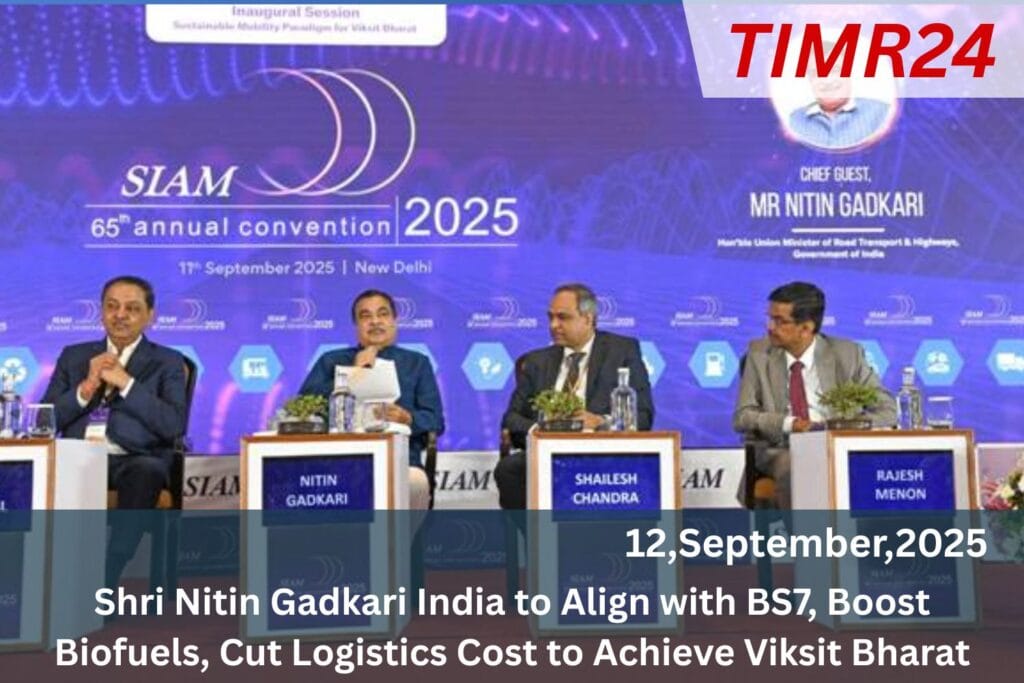
Shri Nitin India Gadkari Union Minister of Road Transport & Highways, emphasized India’s focus on sustainable transportation, addressing air pollution issues and transitioning to biofuels. He highlighted the scrappage policy, which has reduced over 3 lakh vehicles and benefitted industry, government, and environment. He also highlighted the need for public campaigns and NGO engagement to improve road safety and offered Rs. 25,000 to ‘Rah-Veers’ for accident victims. India is at a defining stage in its growth journey, and the ambitious vision of Viksit Bharat 2047 has become a roadmap for long-term development across infrastructure, energy, transport, and sustainability.
Recently, Union Minister Shri highlighted key focus areas that will shape India’s economic and environmental future the adoption of BS7 emission norms, the promotion of biofuels, and significant reductions in logistics costs. These pillars are expected to create a clean, competitive, and future-ready nation, driving growth while protecting the environment. The journey is not only about technology but also about creating a balanced ecosystem that integrates rural prosperity, urban efficiency, and global competitiveness. The first major milestone in this vision is the transition towards BS7 emission standards, which are being designed to tackle air pollution more.
Automakers will have to adopt advanced
Effectively while aligning India with global environmental benchmarks. Previous Bharat Stage norms such as BS4 and BS6 brought noticeable improvements in air quality, and BS7 is expected to accelerate this shift by enforcing stricter vehicle emission limits. Automakers will have to adopt advanced catalytic converters, hybrid systems, and energy-efficient engines, leading to a new era of clean mobility. This shift is not only about reducing carbon footprints but also about ensuring that India’s cities become healthier and more livable. For example, initiatives like the highlight how cleaner fuel transitions in one sector can complement similar shifts in road transport.
Together, these changes will play a critical role in shaping India’s climate action goals while fostering innovation within the automobile industry Alongside emission norms, the promotion of biofuels has emerged as a cornerstone of India’s energy strategy. Gadkari has consistently stressed that India must cut down its dependency on crude oil imports by adopting homegrown alternatives. Ethanol-blended fuel, biodiesel, and compressed biogas are being scaled up across the country to provide affordable, eco-friendly, and farmer-driven energy solutions. Ethanol blending, in particular, is targeted to reach 20% by 2025, which will significantly reduce fuel costs while supporting.
The agricultural economy. Farmers will benefit as sugarcane, maize, and other crops find higher demand in the energy sector. This creates a strong rural-urban connection, where the farm economy directly supports India’s urban transport and industrial systems. Such measures align closely with efforts already underway in India’s National Green Hydrogen Mission, which also aims to build an Learn more from (Ministry of Petroleum & Natural) alternative clean fuel ecosystem as seen in Together, biofuels and hydrogen are set to reshape India’s energy balance while creating jobs and reducing emissions Another crucial part of the roadmap is reducing logistics costs, which currently account for nearly 13–14% of India’s GDP.
development of expressways economic corridors
Compared to the global benchmark of around 8%. This cost imbalance makes Indian exports less competitive in global markets and increases the price burden on domestic consumers. Gadkari’s emphasis on lowering logistics costs involves strengthening multimodal transport networks, improving highway infrastructure, and integrating waterways, rail, and digital logistics platforms. The development of expressways, economic corridors, and smart warehousing is already underway to improve the efficiency of goods movement. Reduced logistics costs mean Indian companies can deliver faster, cheaper, and more sustainably, which in turn boosts trade competitiveness.
For instance, the digitalization of supply chains will connect seamlessly with innovations happening in sectors like real estate and smart cities, such as the (Luxury Project In Gurugram) that also emphasizes connectivity and sustainability. This interconnected approach ensures that infrastructure growth supports both economic efficiency and environmental responsibility Beyond these three core pillars, Gadkari’s vision ties deeply into the idea of a green infrastructure revolution, where roads, highways, and transport systems are not just about connectivity but also about sustainability. The integration of electric vehicles, charging stations, hydrogen fuel cells, and smart traffic.
Management systems is redefining what India’s roads of the future will look like. Large-scale projects like the Delhi-Mumbai Expressway are not just reducing travel time but also lowering fuel consumption and emissions by offering smoother, congestion-free routes. These reforms echo broader national initiatives like which show how infrastructure, lifestyle, and sustainable growth are interconnected at both personal and industrial levels. The focus is clear infrastructure must be green, resilient, and designed for long-term efficiency In the broader context of Viksit Bharat 2047, Gadkari’s initiatives are not isolated measures but part of a deeply integrated strategy.
emphasizes innovation and indigenous technologies
The combination of emission standards, renewable fuels, and logistics reform contributes to multiple national objectives reducing pollution, creating jobs, enhancing farmer income, boosting exports, and achieving net-zero commitments. The plan also emphasizes innovation and indigenous technologies, where India develops its own solutions rather than relying solely on global imports. For instance, investments in research and development of biofuel engines and hydrogen-compatible vehicles will not only create domestic opportunities but also allow India to export clean technologies to other countries. This self-reliant approach reflects the spirit of Atmanirbhar Bharat.
Ensuring that India’s growth is sustainable and globally competitive At the same time, the government’s roadmap is designed to foster public-private partnerships, encouraging industries to collaborate with the state in driving innovation and scaling solutions. Large energy firms, logistics companies, and automotive manufacturers are already aligning with the government’s vision by investing in sustainable alternatives. For example, initiatives like showcase how private companies are contributing to India’s decarbonization journey. As these partnerships deepen, India will be able to accelerate its green transition while creating millions of jobs in both rural and urban areas.
Looking ahead, the success of this vision will depend on how effectively India manages the balance between growth and sustainability. With BS7 emission standards set to transform vehicle manufacturing, biofuels boosting energy security, and logistics reforms strengthening trade competitiveness, India is laying a robust foundation for the coming decades. The integrated approach ensures that development is not just about economic progress but also about social inclusion and environmental responsibility. The concept of Viksit Bharat 2047 therefore becomes a holistic vision one that promises cleaner air, affordable energy, efficient transport, and global leadership for India.
Shri Nitin Gadkari roadmap of aligning with BS7, boosting biofuels, and cutting logistics costs represents much more than policy announcements; it is a blueprint for India’s transformation into a developed, sustainable, and globally respected nation by 2047. As these measures gain momentum, India will emerge not just as an economic powerhouse but as a model for sustainable growth, proving that development and environmental care can move hand in hand.
Q1 What is BS7 emission standard and why is it important?
BS7 will reduce vehicular emissions and align India with global clean mobility standards.
Q2 How will biofuels impact India’s economy?
Biofuels will reduce oil imports, support farmers, and lower carbon emissions.
Q3 Why is reducing logistics cost crucial for India?
Lower logistics costs improve trade competitiveness and strengthen supply chains.
Q4 How does this align with Viksit Bharat 2047?
It supports sustainable, inclusive, and innovation-driven economic growth.
Q5 What role will renewable energy play in this vision?
Renewables like biofuels, EVs, and hydrogen will power a cleaner future.