











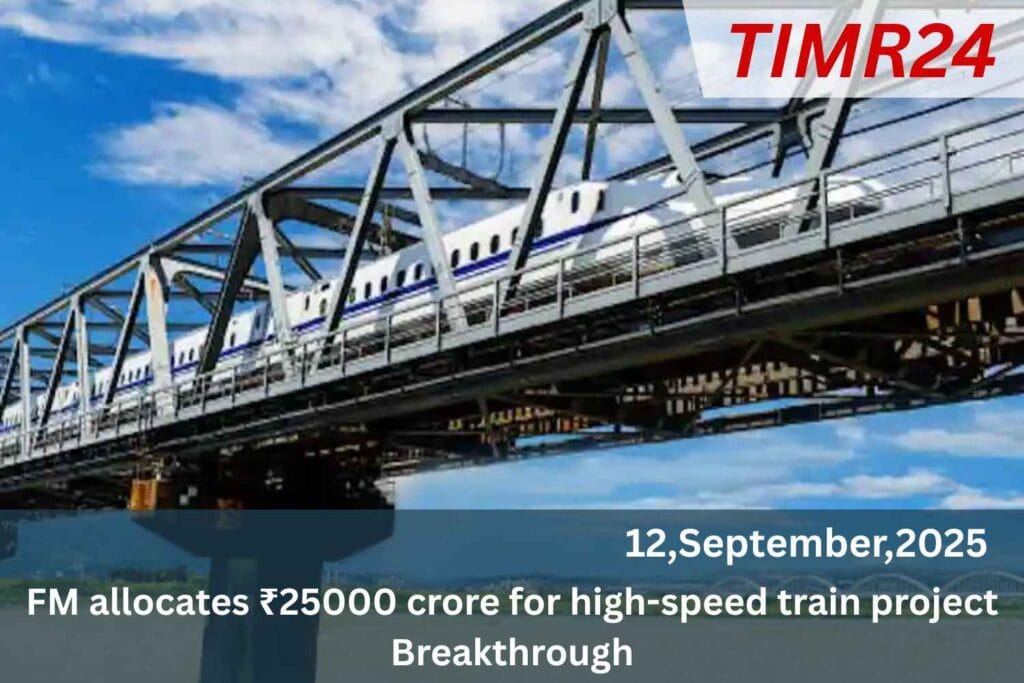
Finance Minister Nirmala Sitharaman increased the National High Speed Rail Corporation’s budgetary allocation to ₹25,000 crore for FY’25, while the Dedicated Freight Corridor Corporation of India’s allocation was reduced to ₹4155 crore for fiscal 2024-25. NHSRCL completed 100% land acquisition for the Mumbai-Ahmedabad Rail Corridor, funded by JICA. The Finance Minister’s announcement of allocating ₹25,000 crore towards the high-speed train project has created a wave of optimism across the country. India, which has been working on multiple infrastructure reforms in the railway sector, now stands at the brink of a new era in passenger mobility.
The project is not just about bringing speed to Indian railways but about redefining connectivity, fueling economic growth, and making India globally competitive in transport infrastructure. The Mumbai Ahmedabad bullet train corridor is at the center of this transformation, and the newly allocated funds will accelerate construction, technology transfer, and station development. For readers interested in broader rail budget updates, our detailed coverage on (Indian Railways Budget 2025) highlights how this allocation fits into the government’s larger modernization plan. The high-speed train project is one of the most ambitious ventures of the Government of India under.
The modernization program of Indian Railways. Managed by the (NHSRCL), the Mumbai–Ahmedabad corridor is the pilot project that will eventually expand into a network covering major metros such as Delhi, Varanasi, Nagpur, and Chennai. With the allocation of ₹25,000 crore in FY 2025–26, the government aims to ensure faster completion of civil works, land acquisition, and technological integration. This financial boost also signals a clear policy direction: India is determined to shift from traditional transport models to futuristic high-speed connectivity. For more details on transport initiatives, you can also explore our section on The immediate effect of the ₹25,000 crore allocation will be.
Economic Impact and Job Creation
seen in job generation and economic activities surrounding construction hubs. Thousands of jobs will be created across engineering, construction, architecture, and allied industries such as cement, steel, and electronics. The corridor will also open up new business opportunities for small and medium enterprises (SMEs) around station areas. Urban development near high-speed train stations is expected to mirror global examples like Japan’s Shinkansen, where entire business districts flourished around train hubs. The economic boost will not be limited to metros but will extend to semi-urban areas like Surat, Vadodara, and Anand, where new station infrastructure is under construction.
To understand the larger picture of infrastructure-driven growth, you can visit our detailed report on For passengers, the high-speed train project promises a world-class travel experience. The Mumbai Ahmedabad route, which currently takes 6–7 hours by conventional train, will be reduced to just over 2 hours. This time-saving measure is crucial for both business travellers and families, as it will create seamless connectivity between financial hubs and cultural centers. Passengers can expect advanced safety systems, modern seating arrangements, digital ticketing platforms, and enhanced onboard services that meet global standards. The project is also expected to shift travel.
Technological Advancements and International Collaboration
Demand from air to rail in short-to-medium-distance corridors, reducing congestion in airports and highways. A comparative study of shows how high-speed trains reshaped passenger behaviour and boosted economic integration across regions The bullet train project is backed by strong international collaboration, particularly with Japan. The Japanese government and Japan International Cooperation Agency (JICA) have been instrumental in providing both technical expertise and soft loans for the project. This ensures that India benefits from decades of Japanese experience in building and running high-speed trains, while also localizing technology through domestic.
Manufacturing The adoption of earthquake-resilient designs, aerodynamic train structures, and energy-efficient systems ensures that the project is not only fast but also safe and sustainable. This aligns with India’s larger climate goals, which you can read more about in our High-speed train stations are not just travel hubs but also drivers of regional growth. Around Mumbai, Surat, and Ahmedabad, real estate activity has already picked up, with developers launching residential and commercial projects targeting future commuters. Cities like Vadodara and Anand are expected to become new economic clusters due to improved accessibility. The project will integrate with existing.
Transport systems, ensuring last-mile connectivity through metro rail, bus rapid transit systems, and road networks. This integrated approach will allow smoother passenger movement across cities and states, creating a new model of urban-rural connectivity While the Mumbai Ahmedabad line is the starting point, the government’s long-term vision is to develop a nationwide high-speed rail network. Plans for Delhi Varanasi, Delhi Ahmedabad, and Mumbai Nagpur corridors are already under discussion. The success of the current project will lay the foundation for these expansions. Each new corridor will further strengthen India’s position as a leader in modern rail infrastructure.
Making cross-country travel faster, safer, and more sustainable. For policy updates and expansion details, our readers can check Large-scale projects often face challenges, and India’s bullet train is no exception. Land acquisition, financing, and environmental clearances have posed hurdles in the past. However, with the ₹25,000 crore allocation, many of these bottlenecks can now be addressed. The government has already streamlined processes for land acquisition, while advanced environmental planning ensures that ecological impact is minimized. The project also emphasizes local manufacturing under the “Make in India” initiative, which will reduce dependency on imports and boost domestic industry.
The Finance Minister’s allocation of ₹25,000 crore for the high-speed train project is more than just a budgetary announcement it is a declaration of India’s intent to lead in future mobility. By combining economic growth, technological advancement, and sustainability, the bullet train project will transform how India travels and does business. Once operational, it will not only change passenger experiences but also reshape cities, generate jobs, and strengthen India’s global standing. As India races ahead with this ambitious project, it is clear that the journey towards modern, fast, and sustainable mobility has truly begun.
Q1. What is the purpose of allocating ₹25,000 crore for the high-speed train project?
The fund will accelerate India’s bullet train initiative, enhance connectivity, and reduce travel time between major cities.
Q2. Which routes are covered under the high-speed train project?
The Mumbai Ahmedabad corridor is the primary focus, with expansion plans to connect Delhi, Varanasi, and other metros in future phases.
Q3. How will the high-speed train benefit passengers?
It will reduce travel time significantly, provide world-class facilities, and boost convenience for both business and leisure travellers.
Q4. What economic impact will the project bring?
It will generate employment, boost real estate around station hubs, and support allied industries like steel, cement, and construction.
Q5. When is the project expected to be completed?
The Mumbai Ahmedabad bullet train is targeted for partial operations by 2027, with full operation by 2030.