
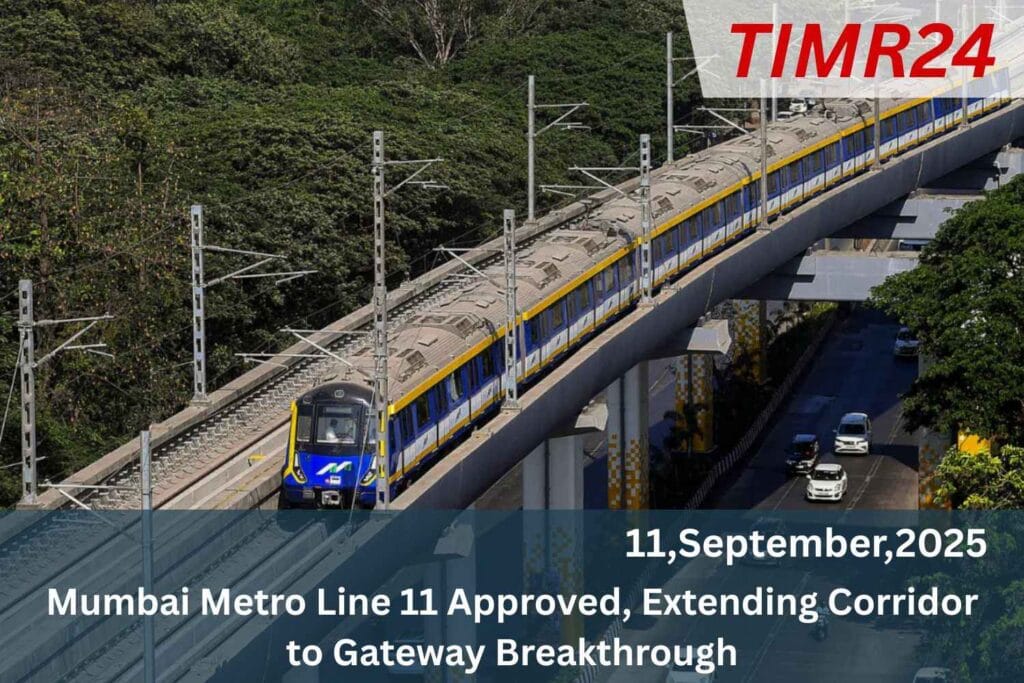
The Maharashtra Cabinet has approved the Mumbai Metro Line 11 project, which will extend Line 4 along the Wadala–Thane–Kasarvadavli route to the Gateway of India. The 17.5 km corridor, estimated to cost Rs 23,488 crore, will feature 14 stations and connect landmarks like the Gateway of India, Flora Fountain, Crawford Market, and Fort. The Mumbai Metropolitan Region Development Authority will implement the project, with central government support provided through equity and interest-free subordinate debt. The line will also provide metro access to Nagpada, Bhendi Bazaar, Ballard Estate, and Crawford Market, and bring the Gateway of India within one kilometre of a station for the first time.
The project will receive approximately Rs 1,338 crore in central equity and Rs 917 crore as interest-free debt, with further support expected from the Japan International Cooperation Agency. The decision to extend Mumbai Metro Line 11 all the way to the Gateway of India marks a historic milestone for the city’s rapidly expanding urban transport system. Designed to provide direct connectivity from Wadala to South Mumbai, the corridor’s approval reflects both the growing demand for mass rapid transit and the government’s commitment to reshaping mobility in one of the world’s busiest metropolitan regions. This ambitious extension is more than just an infrastructure update.
It is a cultural and economic bridge that will redefine how people move across the city Mumbai’s transport struggles are no secret overcrowded local trains, road traffic bottlenecks, and high dependency on limited corridors have long burdened daily commuters. The conceptualization of Metro Line 11 emerged from the need to address South Mumbai’s transport gaps, particularly the critical stretch connecting Wadala, CSMT, and now the iconic Gateway of India. According to the (MMRDA), the line is expected to complement ongoing metro projects, creating a comprehensive grid that spans the entire metropolitan region To understand this project in context.
It’s useful to look at related initiatives such as the which extends connectivity between Thane and Wadala. Together, these corridors symbolize Mumbai’s evolution toward a smarter, interconnected transport ecosystem What makes Line 11 especially transformative is its ability to integrate seamlessly with other metro corridors. Once operational, commuters will be able to interchange with Metro Line 2, which runs along Mumbai’s western suburbs, and the underground Metro Line 3 (Colaba-Bandra-SEEPZ), which has been designed to cut travel time across major business hubs. By connecting with Metro Line 4, the new extension creates a north-south artery.
That aligns perfectly with Mumbai’s expanding residential and commercial growth This integration ensures reduced travel times and smoother passenger flow. For instance, a traveller from Thane using Line 4 will have a direct link to South Mumbai without shifting to overcrowded local trains. This not only enhances efficiency but also redefines last-mile connectivity. Related updates about corridor synergies can also be seen in our detailed art Developers have already shown heightened interest in locations near upcoming metro stations, much like what was observed during the rollout of Line 2A and Line 7. Improved connectivity translates into increased property demand, and Mumbai’s south.
Tourism and Heritage Linkages
Corridor will likely witness a blend of modern housing projects alongside heritage conservation. A similar trend was recorded during where metro expansions directly influenced city planning and real estate patterns. Unlike other metro lines primarily focused on daily commuting, Line 11 has a unique dimension it extends into the heritage heart of Mumbai. The Gateway of India, a global tourist landmark, is often packed with visitors who currently rely on taxis, buses, and congested roads. With the metro’s arrival, accessibility to the Gateway, Colaba Causeway, and nearby heritage spots like the Taj Mahal Palace Hotel will drastically improve Tourism boards anticipate that this project will increase visitor.
Numbers while reducing road congestion in South Mumbai. According to improved infrastructure directly impacts footfall in heritage zones. This integration of modern transit with historical landmarks symbolizes Mumbai’s dual identity embracing the future while preserving its past. One of the critical challenges Mumbai faces is environmental degradation from vehicular emissions. Expanding the metro network is a direct response to this issue. With Line 11, thousands of cars and taxis could be replaced by clean, electric metro travel every day, reducing pollution levels and contributing to climate goals By promoting sustainable mobility, the corridor aligns with India’s broader vision of eco-friendly urban development.
Social and Commuter Benefits
The project echoes initiatives like the (Solar Project) where renewable energy is used to power infrastructure. Similarly, Metro Line 11 will integrate energy-efficient technology, signaling a shift toward greener cities For the people of Mumbai, the metro is not just about speed it’s about dignity of travel. Daily struggles of overcrowded trains and endless traffic jams often leave commuters exhausted. With Line 11, travel between the suburbs and South Mumbai could be cut down significantly, offering comfort and predictability For office-goers working in Nariman Point or Colaba, students attending South Mumbai colleges, and tourists heading to heritage sites, the metro will be a game-changer.
It reflects a promise of equitable mobility where all sections of society irrespective of income gain access to efficient public transport. Of course, such a mega project does not come without challenges. South Mumbai’s dense construction, heritage structures, and underground utility networks pose engineering hurdles. Land acquisition, coordination with existing underground Metro Line 3, and balancing heritage preservation will test planners However, Mumbai has already shown resilience with complex projects like which navigated sensitive zones and archaeological sites. Learning from those experiences, the Line 11 project is expected to use advanced tunnelling technologies and strict heritage conservation measures.
Conclusion: Mumbai’s Next Big Leap
The approval of Mumbai Metro Line 11 with its extension to the Gateway of India is not just about building another transport corridor it is about reimagining the city. From economic growth and tourism to sustainability and social equity, the project ticks every box of progressive urban development. By connecting one of the world’s busiest urban centers with its most iconic landmark, the line becomes both functional and symbolic—a true breakthrough for Mumbai’s future As Mumbai continues to expand its metro grid, residents can look forward to a city where travel is smoother, cleaner, and more efficient. The journey of Line 11 is just beginning, but its promise to transform everyday life is already clear.
Q1. What is Mumbai Metro Line 11?
Line 11 is the metro extension from Wadala to CSMT, now approved up to Gateway of India.
Q2. How will Line 11 benefit commuters?
It will ease congestion, reduce travel time, and provide direct connectivity to South Mumbai.
Q3. When will Mumbai Metro Line 11 be completed?
Construction is expected to align with ongoing metro phases, with tentative completion by 2030.
Q4. Which metro lines will connect with Line 11?
It will integrate with Line 2, Line 3 (Colaba-Bandra-SEEPZ), and Line 4, ensuring seamless travel.
Q5. What impact will the extension have on Mumbai?
It will boost economic activity, tourism, and reduce the load on local trains and buses.