






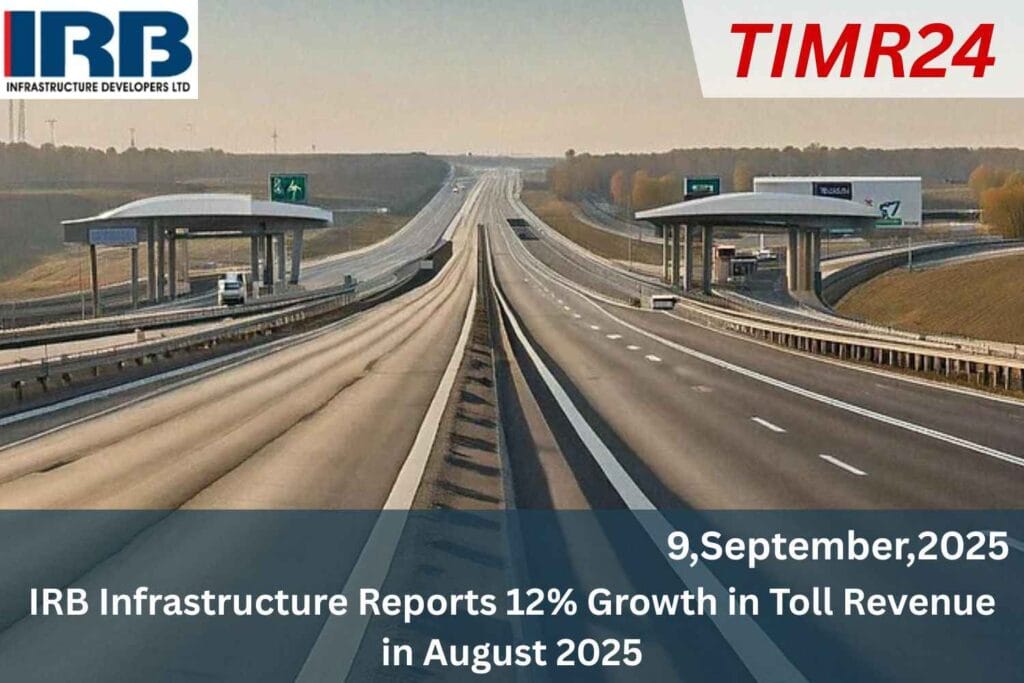
IRB Infrastructure Developers Ltd and IRB Infrastructure Trust in India reported a 12% year-on-year increase in toll revenue for August 2025, reaching ₹563 crore, compared to ₹503 crore in August 2024. The growth is attributed to continued economic growth and the impact of weather conditions on traffic. IRB Infrastructure Developers Ltd, India’s leading integrated highway developer, has once again shown why it holds a dominant position in the country’s road sector by reporting a 12% year-on-year growth in toll revenue during August 2025. This performance reflects not only the company’s operational efficiency but also India’s broader economic resurgence, where increased mobility.
Growing freight movement, and rising vehicle ownership have translated into higher toll collections across national highways. With one of the largest BOT (Build-Operate-Transfer) portfolios in the private sector, IRB Infrastructure continues to benefit from strategic locations of its toll plazas, expansion into new projects, and strong execution capabilities. The 12% growth figure is significant when placed in the context of India’s infrastructure landscape. The month of August typically sees both passenger and commercial vehicle traffic rise due to economic activity after the monsoon slowdown. In IRB’s case, strong traffic movement on highways across Maharashtra, Gujarat, Rajasthan.
Government Policies and Sector Tailwinds
Karnataka has been the backbone of this surge. Passenger car movement has been supported by urbanization and increased intercity travel, while commercial freight has benefited from higher industrial output and logistics demand. Together, they have boosted toll revenues, providing a steady cash flow to fund ongoing and upcoming projects Behind IRB’s revenue success lies India’s ambitious push for infrastructure growth. The Bharatmala Pariyojana, a flagship program by the Ministry of Road Transport & Highways (MoRTH), has paved the way for world-class highways that are directly enhancing toll collections. The National Infrastructure Pipeline (NIP) and the PM Gati.
Shakti Master Plan have further supported faster project clearances and better connectivity across states. As a private sector leader, IRB Infrastructure has positioned itself to take maximum advantage of these policy frameworks. With Hybrid Annuity Model (HAM) and Toll-Operate-Transfer (TOT) contracts from the National Highways Authority of India (NHAI), the company has secured long-term revenue visibility, ensuring that monthly growth figures are not isolated spikes but part of a sustained upward trend.
Financial Strength and Investor Confidence
For investors, this 12% toll revenue growth translates into confidence about IRB’s financial stability. Regular toll income ensures healthy debt servicing, dividend pay-outs, and reinvestment opportunities. Over the years, IRB has attracted interest from global institutional investors, including foreign pension funds and infrastructure-focused equity groups. With stable monthly revenues and robust project execution, the company positions itself as one of the most attractive infrastructure investment stories in India. This is particularly relevant at a time when global investors are keenly watching India’s infrastructure push as a driver of long-term growth When we compare IRB’s growth with other infrastructure.
Announcements in India, a broader picture of sectoral momentum emerges. For example, the foundation stone of the Gurugram Metro Project with an investment of ₹5,600 crore highlights how urban mobility is expanding (read here). Similarly, the Mumbai Ahmedabad Bullet Train project is reshaping intercity connectivity at a high-speed level (learn more). Together, these projects indicate that India’s infrastructure ecosystem is not just about highways, but also about multi-modal connectivity where road, rail, and metro networks work in tandem to drive economic efficiency. In this ecosystem, toll revenues are a critical indicator of usage, demand, and infrastructure effectiveness.
Operational Excellence of IRB
IRB Infrastructure’s operational strength comes from its deep expertise in BOT models. Unlike construction-only companies not only builds but also operates and maintains roads over a long concession period. This means that toll revenues are not just one-time wins but part of a long-term cycle of recurring income. Moreover, IRB has been able to maintain efficiency in toll collection through digital platforms like FASTag, which has improved compliance and reduced leakages. The company’s operational control across states also allows it to monitor traffic flows and optimize revenue collection, making the 12% growth a result of both structural factors and smart management practices.
Highway toll growth is more than a corporate achievement it directly impacts the national economy. A rise in toll collections signifies increased trade movement, more efficient logistics, and better last-mile connectivity. India’s booming e-commerce sector, growing agricultural output, and rising industrial freight have all contributed to higher usage of highways. IRB, by operating strategically important toll roads, becomes a key enabler of this economic cycle. When industries move goods faster and more efficiently, it reduces costs, improves competitiveness, and boosts GDP growth. Thus, the company’s August 2025 revenue report reflects not only its own performance but also India’s economic vitality.
Future Expansion and Strategic Vision
Looking ahead, IRB Infrastructure is expected to expand aggressively into new states while also strengthening its portfolio of TOT projects. With the government’s increasing focus on private participation in highway development, IRB is well-placed to acquire new concessions. The company’s recent focus on sustainability such as adopting green practices in construction aligns with India’s broader shift toward (Road Transport & Highways) environmentally friendly infrastructure. Linking this with future opportunities, IRB may also benefit from synergies with green hydrogen adoption in transport and logistics, similar to how India inaugurated.
Despite its strong growth, IRB Infrastructure faces challenges common to the sector. Rising construction costs, land acquisition delays, and regulatory hurdles remain risks. Competition from other infrastructure developers in BOT and HAM models could also put pressure on margins. However, IRB’s long-standing reputation, strong relationships with government authorities, and proven track record in project execution give it a competitive edge. The 12% revenue growth serves as a cushion against such challenges, showcasing the resilience of its business model The 12% growth in toll revenue for August 2025 is more than just a financial update; it is a reflection of IRB Infrastructure’s.
Leadership in India’s highway development story. By integrating operational excellence with supportive government policies and growing transport demand, IRB has created a sustainable revenue stream that powers both its own expansion and India’s economic journey. As the company looks to the future, its role will not be limited to toll operations but will expand into shaping how India travels, trades, and connects across its vast landscape. In the coming years, with projects spanning expressways, logistics corridors, and sustainable infrastructure, IRB Infrastructure is set to remain a cornerstone of India’s ambitious growth path.
Q1. What is IRB Infrastructure’s toll revenue growth in August 2025?
IRB Infrastructure reported a 12% year-on-year growth in toll revenue during August 2025.
Q2. What factors contributed to IRB Infrastructure’s revenue increase?
Factors include higher traffic volumes, improved road infrastructure, and growing highway usage.
Q3. How does this growth impact IRB’s future projects?
Strong revenue supports ongoing and upcoming highway, expressway, and BOT projects.
Q4. Where does IRB Infrastructure operate toll projects?
IRB manages major toll roads and expressways across states including Maharashtra, Gujarat, Rajasthan, and more.
Q5. What is the outlook for IRB Infrastructure in FY 2025–26?
Continued growth is expected due to rising vehicle movement, government infrastructure push, and expansion plans.