















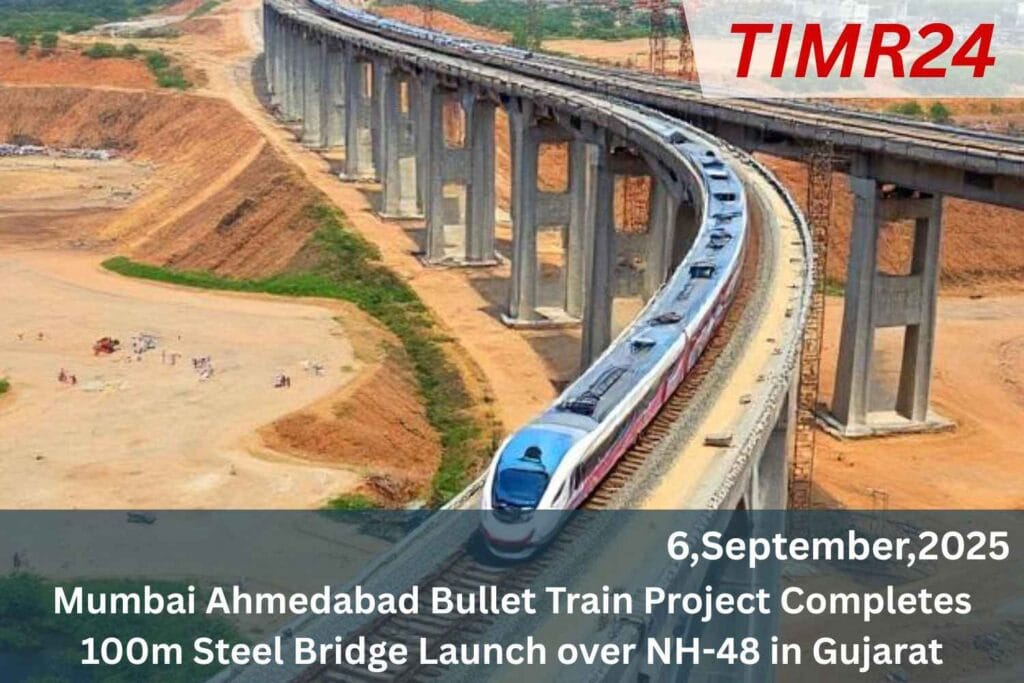
A 2×100 m steel bridge has been successfully launched over NH-48 near Nadiad, Gujarat, for the Mumbai-Ahmedabad Bullet Train project. The bridge, weighing 2,884 metric tons, stands 14.6 meters tall and 14.3 meters wide. The bridge, designed for a 100-year lifespan, was launched across the busy highway. The bridge is constructed with 1,14,172 Tor-Shear Type High Strength bolts, C5 system painting, and elastomeric bearings. Nine out of the 28 planned steel bridges in Gujarat are now complete. The Mumbai-Ahmedabad High-Speed Rail (MAHSR) project, popularly known as the Bullet Train Project, has been progressing steadily and recently marked a.
historic milestone with the successful launch of a 100-metre long steel bridge over National Highway 48 (NH-48) in Gujarat. This breakthrough is being hailed as one of the most complex engineering achievements of the project so far, not just for its sheer scale but also for the precision and safety standards it demanded. The bridge, weighing hundreds of tonnes, was assembled in a systematic manner and launched with advanced technology to ensure minimal disruption to traffic movement on one of the busiest highways connecting major cities like Surat, Bharuch, and Vadodara. For India’s first bullet train corridor, such engineering feats are essential, as the high-speed rail has to maintain.
Uninterrupted alignment across rivers, highways, and dense urban zones, ensuring seamless connectivity between Mumbai and Ahmedabad The Mumbai-Ahmedabad Bullet Train project is designed to run trains at a speed of 320 km/h, cutting down travel time between the two financial hubs to about 2 hours from the current 6–7 hours. The total length of the corridor is about 508 km, with Gujarat covering the larger stretch and Maharashtra hosting the terminal station at the Bandra-Kurla Complex (BKC) in Mumbai. Building a project of this scale requires massive groundwork, from acquiring land across districts to executing viaducts, tunnels, bridges, and station designs. The NH-48 steel.
Bridge launch reflects how Indian engineers, along with Japanese expertise under the Shinkansen technology framework, are tackling each challenge with cutting-edge techniques. Similar feats have already been executed earlier, such as the construction of river bridges across the Narmada, Tape, and Mahi rivers, but the NH-48 launch stands out because of its strategic importance for smooth highway movement and the sheer coordination it involved The process of launching a steel bridge of this magnitude is not a simple lift-and-place operation. It involves months of planning, prefabrication, transportation of segments, and stepwise assembly. The National High-Speed Rail.
Corporation Limited (NHSRCL), which is the nodal agency implementing the project, collaborated with top construction firms and adopted advanced heavy-lifting technology. Engineers had to ensure safety for highway commuters while simultaneously guaranteeing perfect alignment for the bullet train’s elevated viaduct. This dual focus is critical, because even a small deviation in track alignment at high speed could lead to safety issues. With this launch, NHSRCL demonstrated that India’s construction ecosystem has matured to execute projects of global standards, integrating Japanese Shinkansen safety parameters into local conditions.
Beyond the engineering marvel, the launch also symbolizes India’s growing capacity to execute mega-infrastructure projects. The bullet train corridor is not just a transport project but a catalyst for regional development, boosting real estate, industrial clusters, and tourism along the route. Gujarat has already witnessed significant momentum in terms of ancillary industries being developed around the bullet train construction zones. The launch over NH-48 is expected to improve construction logistics further, allowing uninterrupted progress in adjoining stretches. For commuters on NH-48, which handles thousands of vehicles daily, the smooth execution without.
Prolonged traffic disruption comes as a relief, showcasing the government’s ability to balance mega projects with everyday mobility needs When we look at the broader picture, the bullet train project is reshaping India’s railway engineering landscape. The steel bridge launches, such as this one, highlight the project’s unique requirement compared to conventional Indian Railways projects. Unlike regular trains, the bullet train requires a completely dedicated corridor, elevated in most sections to avoid level crossings, and engineered with extreme precision for high-speed runs. Bridges over rivers, roads, and rail crossings therefore become vital nodes in the project.
The NH-48 breakthrough shows how such bridges are being integrated with minimal land impact while still meeting international safety standards. It also sets a benchmark for upcoming high-speed rail projects in other corridors like Delhi-Varanasi and Mumbai-Nagpur, which are in various stages of planning and discussion Another fascinating angle of this launch is its alignment with India’s ‘Make in India’ initiative. (Railways India) A large portion of the steel used in this bridge has been manufactured domestically, with fabrication carried out in Indian facilities under strict supervision to meet Japanese Shinkansen specifications. This reflects how technology transfer is enabling Indian companies to.
upgrade their capabilities and become part of the global supply chain for high-speed rail projects. The skill development impact is equally significant: hundreds of engineers, welders, and workers are being trained in specialized techniques such as heavy steel fabrication, precision alignment, and stress-testing. This knowledge base will remain in India, ready to be deployed for future mega infrastructure endeavours While the focus remains on Gujarat due to the faster progress there, it is important to recognize the Maharashtra stretch as well. The BKC underground station, which is set to be India’s largest underground transit hub, is under active development.
In the long run, the NH-48 bridge launch will serve as a reference point for upcoming bridge launches in Maharashtra, where the challenges of urban density and traffic are even more pronounced. By completing this bridge smoothly, NHSRCL has gained both confidence and credibility in handling complex construction environments, something that will prove crucial when the corridor enters more challenging terrains near Mumbai. Looking at the economic and social implications, the bullet train corridor is expected to transform how people move between Mumbai, Surat, Vadodara, and Ahmedabad. The NH-48 breakthrough feeds into this vision by ensuring.
The corridor remains on schedule. Businesses in Gujarat and Maharashtra stand to gain from reduced travel time, quicker access to markets, and enhanced logistics connectivity. For individuals, the bullet train promises a reliable, world-class alternative to congested air and road routes. The bridge over NH-48, though just a single piece of the puzzle, demonstrates how every milestone is directly linked to this larger vision of mobility transformation. Environmental considerations also played a major role in the project. The bridge design included measures to reduce noise, vibration, and construction dust, ensuring minimal ecological disruption in surrounding areas.
The fact that such a massive structure could be launched over a national highway without long-term traffic diversions indicates the strong environmental and social planning that underpins the bullet train project. Sustainability is central to high-speed rail systems globally, and India’s execution of this bridge launch shows a commitment to balancing growth with responsibility the 100m steel bridge launch over NH-48 in Gujarat is not just a construction update but a symbol of India’s progress toward modern, high-speed mobility. It blends engineering innovation, safety, economic vision, and sustainable practices, representing what the Mumbai-Ahmedabad Bullet Train Project stands for.
As further milestones are achieved whether it is the undersea tunnel near Thane Creek, the mega stations in Mumbai and Ahmedabad, or other complex bridge launches the project continues to inspire confidence that India is ready to step into a new era of rail connectivity. (NHSRCL) The NH-48 breakthrough will likely be remembered as one of the most defining engineering feats of the project, bridging not only highways but also the gap between India’s infrastructure aspirations and their realization.
Q1. What is the significance of the NH-48 bridge in the bullet train project?
It’s a 100m steel bridge that marks a major engineering breakthrough, ensuring the project stays on track while crossing a busy national highway.
Q2. Who is implementing the Mumbai–Ahmedabad Bullet Train project?
The project is being implemented by the National High-Speed Rail Corporation Limited (NHSRCL).
Q3. When will the Mumbai Ahmedabad Bullet Train start operations?
Phase-wise operations are expected from 2028 onwards, with Gujarat sections likely to open first.
Q4. How will the bullet train benefit Gujarat and Maharashtra?
It will reduce travel time drastically, boost industrial growth, attract investment, and enhance regional connectivity.
Q5. What technologies are being used in this project?
The project adapts Japanese Shinkansen technology, advanced steel bridge engineering, earthquake-resistant design, and sustainable construction methods.