








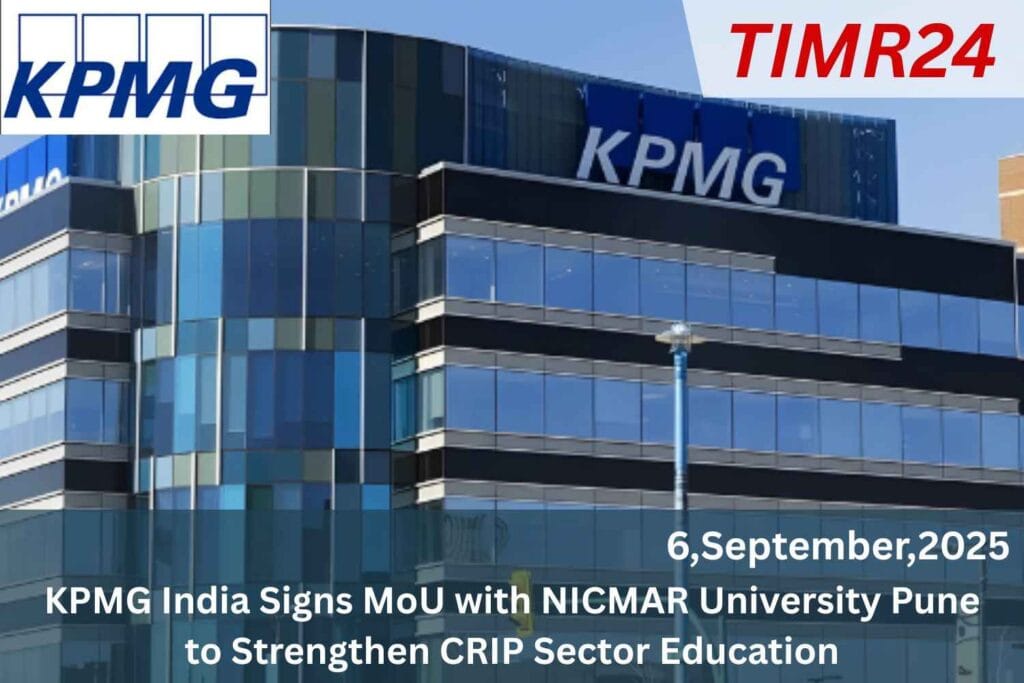
KPMG in India has signed a Memorandum of Understanding (MoU) with NICMAR University, Pune, to bridge the gap between academia and industry. The partnership aims to foster innovation, enhance learning opportunities, and build a pipeline of future-ready professionals. KPMG’s industry expertise will be combined with NICMAR’s academic excellence to create immersive learning programs. The initiative will equip students with real-world insights, hands-on experience, and leadership skills, enabling them to thrive in the CRIP sector. The partnership is part of KPMG’s commitment to cultivating talent with future-ready skills.
The Indian education and infrastructure landscape is undergoing rapid transformation, with academia and industry coming together to create a workforce that is not only skilled but also future-ready. A significant step in this direction has been taken through the Memorandum of Understanding (MoU) signed between (KPMG India) The collaboration focuses on enhancing education in the Construction, Real Estate, Infrastructure, and Projects (CRIP) sector, which is one of the most critical drivers of India’s economic growth. This agreement is not just a formal partnership but an effort to bridge the long-standing gap between classroom knowledge and practical industry requirements.
The Vision Behind the MoU
The partnership between KPMG India and NICMAR University Pune aims to create a new standard of excellence in CRIP education. By combining KPMG’s global expertise in consulting and advisory services with NICMAR’s specialization in construction and project management education, the MoU represents a shared vision of preparing students for the real-world challenges of infrastructure development. The agreement focuses on curriculum innovation, knowledge exchange, and exposure to live projects, thereby giving students a chance to work on solutions that directly impact India’s growing infrastructure needs.
The CRIP sector is central to India’s development, with projects ranging from metro rail expansions, highways, smart cities, and housing initiatives under schemes like PM Awas Yojana. These projects require skilled professionals who understand not just technical aspects but also project finance, sustainability, and modern technologies like Building Information Modelling (BIM) and Artificial Intelligence in construction. According to, India’s urban population is expected to reach nearly 600 million by 2036, which makes capacity building in construction and infrastructure management a national priority. Education partnerships such as this MoU will play a vital role in producing experts who can manage this unprecedented demand.
Role of KPMG India in the Collaboration
KPMG India brings with it decades of consulting experience across sectors, including infrastructure, real estate, and sustainability. The firm will contribute by designing specialized modules that focus on practical industry applications. Students at NICMAR can expect sessions on project risk management, digital transformation in CRIP, sustainability frameworks, and global case studies that showcase successful infrastructure projects. KPMG’s involvement will also mean access to mentorship from industry professionals, live project assessments, and even opportunities for internships where theory meets practice. This will not only enhance employability but also create leaders capable of driving India’s infrastructure revolution.
On the academic side, NICMAR University Pune has been recognized for decades as a premier institution dedicated to construction, infrastructure, and project management studies. By partnering with KPMG, NICMAR aims to enrich its curriculum with cutting-edge knowledge and research-driven practices. The university plans to integrate KPMG-designed content into its programs, while also expanding opportunities for students to participate in workshops, seminars, and collaborative research. NICMAR’s strong alumni base in the CRIP sector will further strengthen the impact of this MoU, as students benefit from networking opportunities and professional mentorship.
Student-Centric Advantages of the MoU
For students, the partnership represents a gateway to industry-oriented education. They will no longer rely solely on textbooks but will engage with real case studies, simulation exercises, and problem-solving workshops led by KPMG experts. The exposure to global practices will prepare them to compete not just in India but also in international markets. Moreover, this collaboration will open doors for internships, certifications, and placement opportunities, ensuring that graduates are industry-ready from day one. For instance, courses on sustainable construction practices will now include hands-on insights into green certifications, renewable energy. integration in real estate, and financial.
Modeling for large-scale infrastructure projects. Similarly, modules on project management will be enhanced with KPMG’s frameworks that are applied by top corporates worldwide. The CRIP industry has been evolving with the introduction of digital tools, automation, and sustainable technologies. This MoU directly supports that evolution by equipping students with the skills to adopt and implement such innovations. As India continues to invest heavily in mega infrastructure projects like highways, smart cities, and metro rail networks, there is a pressing need for professionals who can manage complexity, ensure efficiency, and maintain sustainability.
Building Research and Innovation Opportunities
This collaboration guarantees that NICMAR graduates will play a pivotal role in shaping the CRIP sector for years to come Another important dimension of the MoU is its focus on research and innovation. NICMAR and KPMG will work together on studies related to construction management, infrastructure financing, digital technologies, and urban development. Such collaborations will not only produce academic publications but also create actionable solutions for industry challenges. By focusing on innovation, the partnership aims to position India as a leader in modern infrastructure practices, blending global standards with local requirements.
The collaboration aligns seamlessly with government initiatives such as National Infrastructure Pipeline and PM GatiShakti. These programs aim to streamline multi-modal infrastructure development and require a skilled workforce for execution. Through this MoU, (Cabinet Approves)students trained at NICMAR with KPMG’s expertise will become key contributors to these national goals. For instance, their training in project finance and sustainability can directly support infrastructure initiatives that emphasize both growth and environmental responsibility.
Internal Links to Related Updates
This partnership also resonates with other developments in the infrastructure and education ecosystem. For example, the recent demonstrates the scale of opportunities for CRIP professionals across India. Similarly, the shows how urban projects are constantly creating demand for skilled project managers. These internal connections underline how education-industry collaborations can help in meeting the growing needs of India’s development story. The signing of the MoU between KPMG India and NICMAR University Pune is a landmark moment for CRIP education in India. It represents a forward-thinking approach to bridging academia and industry, ensuring.
That students gain not just knowledge but also practical skills, exposure, and confidence to thrive in the real world. The collaboration is set to produce professionals who can handle the scale, complexity, and innovation required in India’s infrastructure and real estate sectors. As the country marches toward becoming a global economic powerhouse, partnerships like this will be critical in shaping a workforce that is ready for the challenges and opportunities ahead.
Q1 What is the focus of the MoU between KPMG India and NICMAR University Pune?
The MoU aims to enhance education and training in the Construction, Real Estate, Infrastructure, and Projects (CRIP) sector.
Q2 How will this collaboration benefit students?
Students will gain industry-relevant skills, access to expert-led workshops, internships, and updated CRIP curriculum.
Q3 Why is CRIP education important in India?
With rapid urbanization and infrastructure growth, CRIP-trained professionals are in high demand across India.
Q4 What role will KPMG India play in this partnership?
KPMG will provide technical expertise, knowledge sharing, and support in building industry-ready programs.
Q5 How will NICMAR University Pune implement the MoU?
NICMAR will integrate advanced courses, research, and practical training into its curriculum to align with industry standards.