















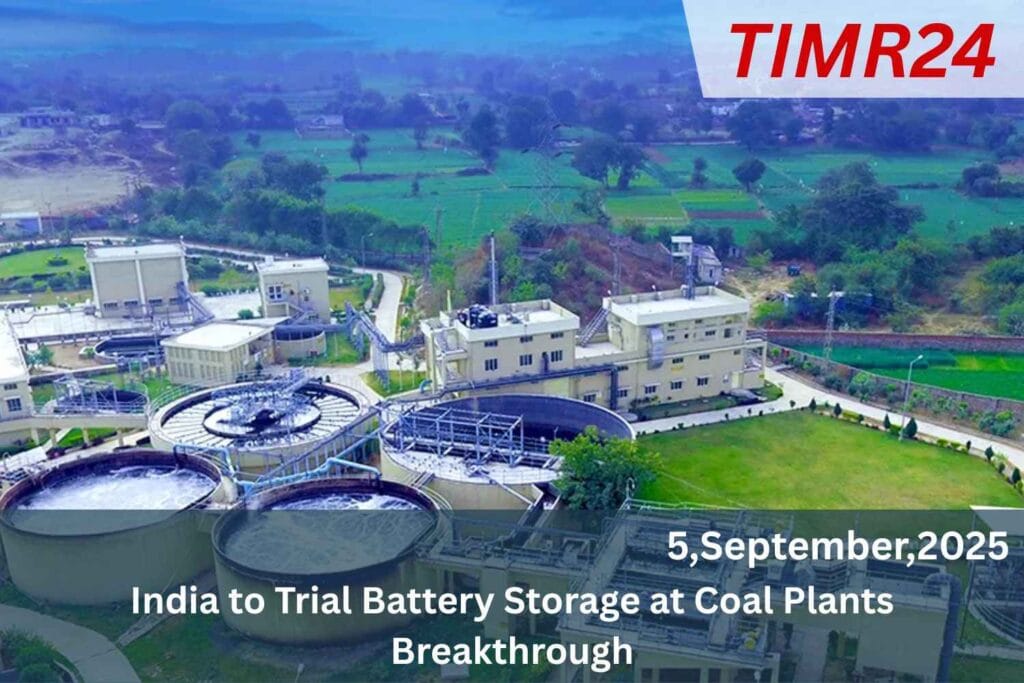
India is set to trial the installation of battery storage systems at select coal-fired power plants as part of a strategy to integrate the country’s expanding solar capacity while ensuring a steady and reliable power supply. The initiative, led by NTPC with support from the Ministry of Power, aims to absorb excess solar energy during the day and dispatch it during peak evening hours, allowing coal plants to run at a stable output, reducing costs and extending equipment life. The Central Electricity Authority (CEA) is drafting technical guidelines for minimum load requirements at coal-based power stations as India rapidly Ramps up its renewable energy installations.
Battery storage is also emerging as a commercially viable component of the power market, with merchant Battery Energy Storage Systems (BESS) recording their first-ever profitability in 2024. India’s power sector is entering a transformative phase with the announcement that battery storage will be trailed at coal plants. For decades, coal has been the backbone of the country’s electricity generation, supplying over 70 percent of total demand. Yet, coal’s environmental cost has long been a pressing challenge. The new initiative to integrate advanced battery storage technologies with coal-based generation represents a
Potential turning point, where old infrastructure can be modernized to meet new sustainability demands. Unlike traditional upgrades This trial does not simply focus on efficiency improvements but reimagines how coal plants interact with the national grid, renewable sources, and emission control strategies The dependence on coal has always created a paradox for India: it provides affordable, reliable power but contributes heavily to air pollution and greenhouse gas emissions. As the government aims to meet ambitious climate commitments under the Paris Agreement, there is increasing urgency to bridge this gap. Battery storage offers a unique solution. By allowing coal plants to capture surplus power during low-demand hours and release it during peaks, efficiency is maximized while emissions are reduced.
How Battery Storage Changes the Grid
This makes the existing fleet more sustainable without forcing a sudden abandonment of coal. For readers who want to explore the country’s detailed electricity profile, the (GST Council) provides official statistics and planning documents that highlight the scale of India’s dependency on coal and the opportunities for reform. One of the most significant impacts of this trial lies in its potential to stabilize the grid. India has been rapidly increasing its share of solar and wind power, both of which are intermittent by nature. Sudden spikes of solar output during sunny afternoons or unexpected drops in wind speed at night create volatility that the grid must manage.
Coal plants, once considered inflexible, could now become dynamic players in balancing demand and supply through battery storage. With batteries absorbing excess renewable energy when production is high and discharging it when supply dips, coal plants shift from being inflexible “base load providers” to becoming flexible grid partners. For deeper insights into how energy systems are evolving worldwide, readers can check resources.
Integration with Renewable Energy Targets
India has committed to installing 500 GW of non-fossil fuel capacity by 2030, a goal set under its Nationally Determined Contributions. Battery storage trials at coal plants fit neatly into this larger picture. They act as a bridge technology, ensuring that renewables can be integrated at scale without threatening reliability. For example, solar farms often generate power at midday when demand is relatively low, and without adequate storage, much of that clean energy is wasted. With coal plants equipped with batteries, this energy can be stored and re-released at night when demand is higher. This not only improves the economics of renewable projects but also builds public confidence that green energy can support everyday needs.
The trial is expected to be coordinated by the Ministry of Power with support from NTPC and selected private sector partners. India has previously experimented with grid-scale storage in renewable parks, but applying it directly to coal plants is an unprecedented step. Policy support will be crucial in determining how quickly such innovations can move from pilot to national rollout. Subsidies, tariff structures, and regulatory clarity on energy storage ownership models are all under discussion. Early results will not only guide India’s domestic strategy but may also set benchmarks for other developing nations struggling with similar energy transition dilemmas. To stay updated on such policy frameworks frequently releases updates and consultation papers.
Economic and Environmental Impacts
From an economic standpoint, battery storage integration has the potential to reduce operational costs in the long term. While upfront investment is significant, reduced fuel consumption, lower maintenance expenses, and better plant efficiency provide financial returns. Additionally, battery systems can help avoid the need for constructing entirely new plants, thus saving billions in capital expenditure. Environmentally, the impact could be substantial. Even a modest reduction in emissions from coal plants can move the needle on India’s climate goals, considering the sheer volume of coal currently burned. By cutting peak-time overuse and supporting renewable integration, the initiative supports India’s pledge to achieve net zero by 2070. Readers interested in India’s climate goals can explore detailed documentation at.
Globally, many developing countries continue to rely on coal as their primary energy source. India’s trial, therefore, carries weight beyond its borders. If successful, it could offer a replicable model for countries in Africa, Southeast Asia, and Latin America that face the same dilemma of balancing economic growth with environmental responsibility. The concept of making coal plants “cleaner” through technology, rather than shutting them down prematurely, could become a vital part of the global energy transition narrative. For global perspectives program provides case studies and reports on innovative clean energy projects worldwide.
Technology and Innovation Angle
Battery storage technologies themselves are advancing rapidly, with lithium-ion systems currently dominating the market. However, India’s trial may also explore alternatives like flow batteries, which are better suited for long-duration storage. Domestic manufacturing under the Production-Linked Incentive (PLI) scheme could further reduce costs and make large-scale adoption feasible. The synergy between local battery manufacturing and energy storage deployment could also create new job opportunities, adding an economic growth dimension to what is primarily seen as an environmental reform.
Within this broader narrative, readers may also find it useful to explore India’s other clean energy efforts. For instance, the (National Green Hydrogen) is laying the foundation for an entirely new fuel economy, while highlight how the country’s largest power producer is repositioning itself for a greener future. Similarly, trends in showcase how renewable energy is steadily gaining momentum despite infrastructure challenges.
Looking Ahead
As trials begin in late 2025, all eyes will be on the results. Will battery storage significantly reduce emissions at coal plants? Can it stabilize the grid while boosting renewable adoption? And, most importantly, will the economics justify large-scale deployment? While uncertainties remain, the symbolic importance of this step cannot be overstated. It demonstrates India’s willingness to innovate within constraints, to adapt old structures for new realities, and to balance immediate energy security with long-term sustainability.
Q1 What is the purpose of India’s battery storage trial at coal plants?
The trial aims to modernize coal plants by adding battery storage for better efficiency, grid stability, and emission reduction.
Q2 How will battery storage benefit coal-based power generation?
It will balance load, store surplus energy, reduce emissions, and support renewable energy integration.
Q3 Which agencies are involved in this breakthrough trial?
The Ministry of Power, NTPC, and private sector partners are expected to collaborate.
Q4 How does this initiative support India’s climate goals?
By reducing carbon footprint, improving efficiency, and enabling a cleaner transition to renewables.
Q5 When will the pilot projects start?
The trials are scheduled to begin in late 2025, with full-scale adoption depending on results.