













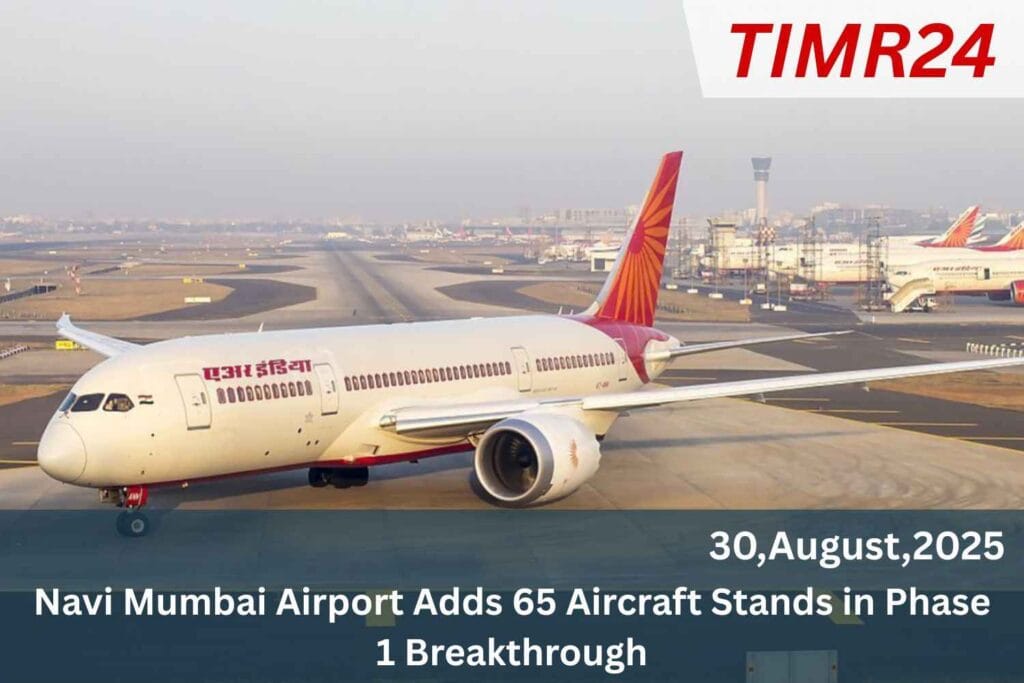
Navi Mumbai International Airport (NMIA) has completed Phase 1 of its infrastructure development, introducing parking capacity for 42 commercial aircraft and 23 stands for private jets and general aviation. The project aims to handle 20 million passengers annually and lays the foundation for future expansion, with plans to scale up to over 360 commercial aircraft stands, 89 positions for private aircraft, and a robust cargo handling network. The airport will feature India’s largest general aviation tower, equipped with hangars and apron space for corporate and leisure aircraft. The airport’s terminal 1 will have 19 private jet slots, all of which will be shifted to NMIA, which is expected to be inaugurated in September.
The airport will also feature an integrated cargo terminal with around 79 dedicated stands, including semi-automated material handling systems, cold chain logistics, specialized storage areas, and 100% screening for export cargo. The much-awaited Navi Mumbai International Airport (NMIA) has reached another major breakthrough as the first phase will feature 65 aircraft stands, making it one of the most ambitious aviation projects in India’s history. For decades, Mumbai’s aviation network has been struggling to handle the rising passenger load, with Chhatrapati Shivaji Maharaj International Airport (CSMIA) operating near its saturation limit. The development of NMIA represents not only relief from congestion but also a new era in India’s aviation and infrastructure planning.
The announcement of 65 aircraft stands in Phase 1 highlights the project’s scale and efficiency-oriented design, reflecting the government’s determination to strengthen India’s position as a global aviation hub The importance of Navi Mumbai Airport becomes clearer when seen in the context of Mumbai’s economic and cultural dominance. The city is the financial capital of India, hosting major industries, corporate headquarters, and a thriving tourism sector. As traffic at CSMIA soared past 45 million passengers annually, expansion became impossible due to space limitations, forcing the government and its partners to push forward the second international airport. According to the (Airports Authority of India) India’s air traffic is expected to double in the next.
NMIA, Mumbai’s aviation system
Decade, and without NMIA, Mumbai’s aviation system would face severe constraints. The addition of 65 aircraft stands in the very first phase underlines the foresight of planners, as it allows for quicker turnaround times, efficient management of growing airlines, and an overall boost to passenger satisfaction The Phase 1 design is ambitious and forward-looking. Apart from 65 aircraft stands, the airport will feature runways designed for simultaneous operations, cutting-edge passenger terminals with integrated technology, and advanced cargo-handling facilities that will support India’s booming trade sector. The airport will have the capacity to handle 20 million passengers annually in Phase 1, with scalability to accommodate future growth.
This aligns with broader national infrastructure initiatives, such as and both of which are reshaping the way India connects cities and people. Together, these projects represent India’s determination to modernize its transport systems while also addressing long-term urban challenges Passenger convenience remains a central theme of Navi Mumbai Airport’s planning. Travelers in Mumbai currently face long waiting times, limited landing slots, and frequent delays due to congestion. With NMIA’s 65 aircraft stands, these challenges will significantly reduce, making air travel smoother and more reliable. Airlines will also benefit from greater operational efficiency, as more stands mean quicker gate allocation and faster aircraft turnaround.
According to India is projected to become the third-largest aviation market globally by 2030, and this kind of infrastructure expansion is essential to keep pace with rising demand. The airport’s design also focuses on modern passenger experiences, offering smart terminals, improved baggage systems, and seamless international connectivity The impact of NMIA extends beyond aviation into the realm of economic development. Airports are known to be economic engines, and Navi Mumbai is expected to create thousands of direct and indirect jobs during construction and operation. The real estate sector in Navi Mumbai has already witnessed rapid appreciation, as connectivity improvements attract both investors and residents.
Tourism, business travel, and cargo trade will also benefit
Tourism, business travel, and cargo trade will also benefit, adding to Mumbai’s role as a global city. In a broader sense, this mirrors the growth strategies seen in other projects such as the in Bengaluru where infrastructure investment directly stimulates regional growth and urban development Cargo operations will form a crucial part of NMIA’s functioning. India’s trade network is expanding, and with the rise of e-commerce and global logistics, efficient cargo terminals are vital. The airport’s design includes integrated cargo handling, making it easier for businesses to move goods quickly. This is particularly significant for Mumbai, which already hosts India’s busiest port systems. By complementing.
The region, NMIA strengthens India’s logistics ecosystem and provides exporters with faster turnaround for shipments. The synergy between seaports, airports, and railway projects like the RRTS creates a seamless multi-modal transport framework Equally important is the focus on sustainability. Infrastructure projects of this scale often draw criticism for environmental impact, but Navi Mumbai Airport is being built with eco-conscious practices. The design incorporates rainwater harvesting, renewable energy, energy-efficient lighting, and noise reduction technologies. Efforts are being made to maintain balance with the local ecosystem, which includes sensitive mangrove areas. India has been advancing sustainable practices in large projects, supported by
Frameworks like encourage developers to align with green building principles The adoption of such practices ensures that while NMIA brings economic and transport benefits, it does not compromise on environmental responsibility. Another critical aspect of NMIA is its role in global connectivity. With more international airlines entering the Indian market, Mumbai’s second airport will provide additional slots for long-haul flights, boosting the city’s position as a hub for both Asia and Europe. International connectivity is key for India’s business ecosystem, as global companies rely on direct flights for trade and collaboration The new airport will also enhance connectivity for.
airport will also influence surrounding infrastructure
Domestic travellers, allowing smaller cities greater access to international destinations via Mumbai. In this sense, NMIA acts as both a regional hub and a global connector, bridging India with world markets more efficiently. From an urban planning perspective, the airport will also influence surrounding infrastructure. Road and metro connectivity to the airport is being developed in coordination with state government plans, ensuring that passengers have smooth access from across Mumbai and Navi Mumbai. This complements India’s broader push for integrated urban transport, visible in projects like Mumbai By linking.
NMIA with metro lines, expressways, and other public transport systems, planners aim to avoid the congestion pitfalls faced by many global cities the announcement that Phase 1 of Navi Mumbai International Airport will feature 65 aircraft stands is more than just a statistic it is (Airports) a milestone for India’s aviation future It symbolizes the ambition of a country ready to meet rising passenger demand, expand its trade capabilities, and reinforce its place in the global economy. With its modern design, strong focus on passenger convenience, integration with other infrastructure projects, and commitment to sustainability, NMIA represents a new chapter in India’s urban and economic growth.
Q1. What is the significance of Navi Mumbai Airport Phase 1?
Phase 1 adds 65 aircraft stands, easing congestion at Mumbai Airport.
Q2. When will Navi Mumbai Airport Phase 1 be operational?
The first phase is expected to begin operations by 2025–26.
Q3. How will this expansion benefit travelers?
It will reduce delays, improve connectivity, and enhance passenger experience.
Q4. Who is developing Navi Mumbai Airport?
The project is led by GVK Group and CIDCO, with support from government agencies.
Q5. How does Navi Mumbai Airport support India’s aviation growth?
It increases aircraft handling capacity and supports rising domestic & international traffic.