





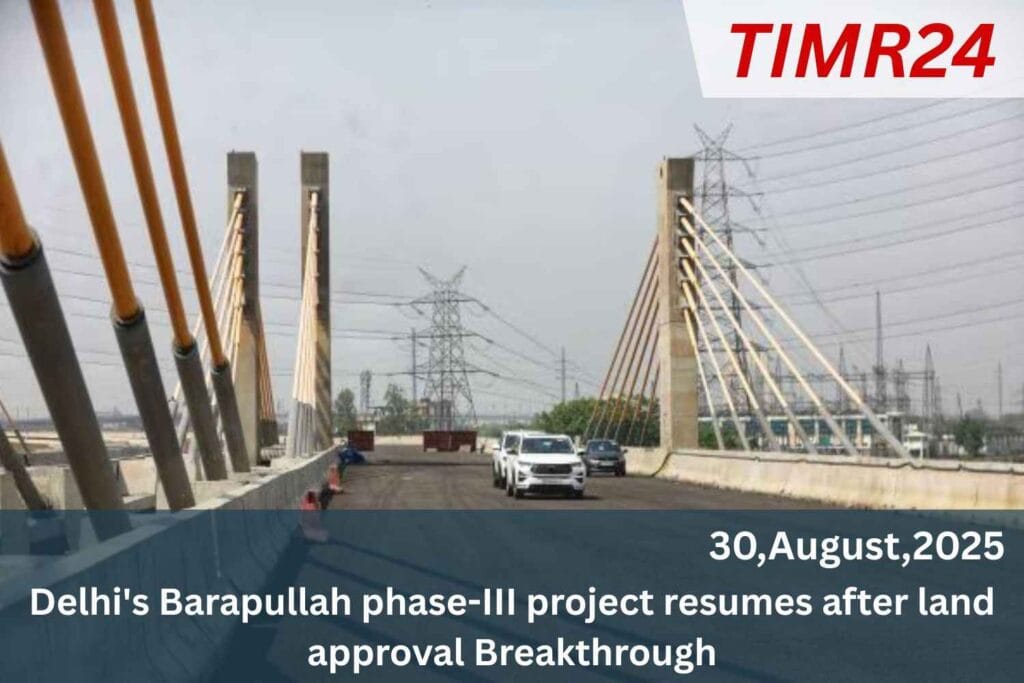
The Delhi’s Baramulla Phase-III project has been approved by the Lieutenant Governor after an inquiry into delayed planning and land assessment. The approval includes two parcels in Nangloi Ramapir, causing a six-year setback and cost escalation of Rs 362 crore. Delhi has long struggled with traffic congestion, and one of the key steps taken to address this challenge has been the development of the Barapullah elevated corridor. While Phase-I and Phase-II are already operational, the much-awaited Barapullah Phase-III project had been facing hurdles due to land acquisition delays. After prolonged negotiations and administrative approvals.
The government has finally cleared the land requirements, and construction activities are set to resume. This breakthrough is not just about completing another flyover but about ensuring faster connectivity, reduced travel time, and better urban mobility for millions of daily commuters. The Barapullah elevated corridor was conceptualized as a dedicated high-speed corridor to link East Delhi with South Delhi. Phase-I connected Sarai Kale Khan to Jawaharlal Nehru Stadium, while Phase-II extended it towards INA. Both phases significantly reduced commuting time during the Commonwealth Games and have since remained crucial for traffic management.
However, Phase-III, which aims to connect Sarai Kale Khan to Mayur Vihar, remained stuck for years because of land-related disputes and clearance issues. With approvals now granted, the project is being revived, and its successful execution could become a turning point in Delhi’s infrastructure expansion strategy.
(Internal link suggestion: Link to your article on (Delhi Metro) to show how parallel projects improve connectivity Delhi’s road network has been under immense pressure, with areas like NH-24 and Ring Road often witnessing bumper-to-bumper traffic. The addition of Barapullah Phase-III will serve as a bypass for daily commuters.
Importance of Phase-III for Delhi’s Traffic
Easing traffic load on existing routes. The corridor will create a seamless east-west connection, cutting down travel time between Sarai Kale Khan and Mayur Vihar, which are important residential and commercial hubs. It will also benefit intercity travellers coming from Noida, Ghaziabad, and Haryana by providing them a direct, faster route into the heart of Delhi. Phase-III will include flyovers, bridges, and elevated stretches designed to handle high traffic volumes. It is expected to be equipped with modern design standards to ensure safety and smooth movement. According to officials, the design will not only improve traffic flow but also reduce fuel consumption and vehicular pollution by cutting down idle time spent in congestion.
The primary reason for the delay in Phase-III was the land acquisition process. Multiple stakeholders, including government agencies and local landowners, had to be aligned for the project to move forward. Legal complexities and coordination issues caused repeated postponements, frustrating commuters and policymakers alike. However, with land clearance now finalized, the Public Works Department (PWD) has announced that construction will be accelerated. This decision reflects a larger trend in Delhi where stalled projects are being revived under strict monitoring to ensure timely delivery.
Broader Impact on Delhi’s Infrastructure
The resumption of Barapullah Phase-III is not just about traffic relief it fits into the larger framework of Delhi’s Master Plan 2041, which emphasizes sustainable and efficient transport. By providing alternate routes, it will help reduce vehicular load on existing highways and improve last-mile connectivity with Delhi Metro and bus networks. This synergy between road and metro projects is vital for a city with a population as dense as Delhi. To understand more about this planning, readers. Authorities have expressed confidence that now, with all approvals in place, the construction will be expedited. The project is expected to be completed within the next two to three years, provided no further obstacles arise.
Once operational, it will handle lakhs of daily commuters and play a central role in Delhi’s transformation into a more connected and commuter-friendly city. For residents, the project will mean more reliable travel options, while for policymakers, it will stand as an example of perseverance in the face of bureaucratic hurdles.
(Internal link suggestion: Link this to your content on (Green Projects) since reduced congestion aligns with eco-friendly goals).
The revival of the Barapullah Phase-III project marks a major milestone in Delhi’s journey towards smarter infrastructure. Its successful execution will not only ease traffic pressure but also contribute to environmental sustainability by cutting down emissions. More importantly, it will provide relief to thousands of commuters who struggle daily with traffic jams on arterial roads. This development proves how crucial coordinated governance and timely decision-making are in shaping the future of urban mobility. With this breakthrough, Delhi is a step closer to realizing its vision of becoming a modern, efficient, and commuter-friendly metropolis.
The Barapullah Phase-III project in Delhi has resumed construction after long-pending land approval, bringing new hopes for improved connectivity between Sarai Kale Khan and Mayur Vihar. The project is designed to decongest Delhi’s traffic and enhance travel speed across the capital. With modern flyovers, bridges, and improved infrastructure, Barapullah Phase-III will significantly reduce travel time for commuters, linking South and East Delhi more efficiently. The long-awaited resumption is expected to accelerate Delhi’s smart mobility mission. This update comes as a major breakthrough for the city’s infrastructure development, offering relief to thousands of daily commuters and easing pressure on existing routes. The government’s clearance is likely to boost project timelines, ensuring better urban connectivity.
Barapullah Phase-III project
Delhi’s Barapullah Phase-III project has finally resumed after receiving crucial land approval. This much-awaited infrastructure project aims to improve city traffic flow by connecting Sarai Kale Khan to Mayur Vihar, easing pressure on existing road network. The project is part of the city’s long-term vision of developing smart mobility solutions. The Barapullah elevated corridor has been developed in phases to improve east-west connectivity in Delhi. While Phase-I and Phase-II are already operational, Phase-III faced significant hurdles due to land disputes and delayed approvals. Now, with clearance granted, construction will resume, marking a breakthrough for commuters.
Q1 What is the Barapullah Phase-III project in Delhi?
It is the third phase of the Barapullah elevated corridor, connecting Sarai Kale Khan to Mayur Vihar for faster travel across East and South Delhi.
Q2 Why was the project delayed?
The project faced delays due to prolonged land acquisition and approval challenges.
Q3 How will Phase-III benefit Delhi commuters?
A: It will reduce travel time, ease congestion, and improve connectivity between important hubs.
Q4 When is the expected completion of Barapullah Phase-III?
With land approvals now cleared, construction is expected to be fast-tracked and completed in the next 2–3 years.
Q5 Which agencies are involved in this project?
The Delhi Government and Public Works Department (PWD) are leading the project, with cooperation from central agencies.