
















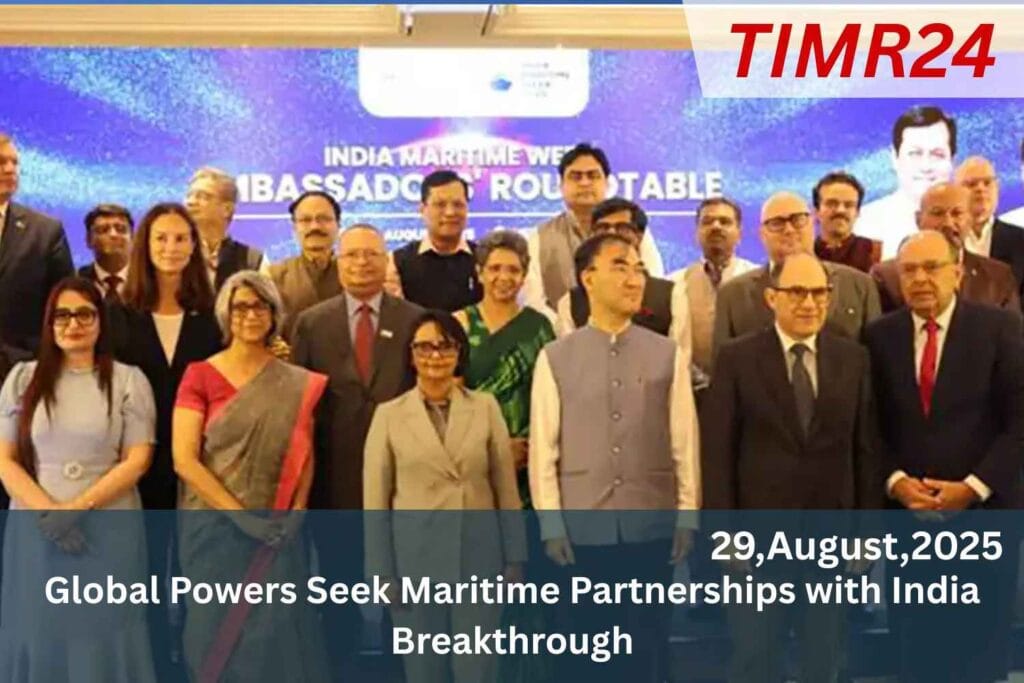
India’s Ministry of Ports, Shipping and Waterways (MoPSW) hosted an Ambassadors’ Roundtable Meet in Delhi, attracting delegates from 28 nations to discuss collaboration ahead of India Maritime Week 2025. The event, chaired by Union Minister for Ports, Shipping and Waterways Shri Sarbananda Sonowal, highlighted India’s growing role in global maritime trade, sustainable shipping, and the blue economy. The event highlighted the government’s $1 trillion maritime investment roadmap, urging global partners to view India as a hub for investment and innovation. The session also highlighted the opportunities in India’s maritime sector, such as port modernisation Inland waterways expansion, and green and digital shipping.
The session also highlighted the importance of technology in enhancing port efficiency and global competitiveness. The event emphasized India’s core maritime priorities, including strengthening shipbuilding capacity and port-led development to position the country as a global hub. Global powers seeking maritime partnerships with India represent a historic shift in the way global trade, security, and diplomacy converge in the Indo-Pacific region, and India’s role in this transformation is both strategic and inevitable because of its unique geographical positioning and rapidly growing influence. Located at the crossroads of some of the busiest shipping lanes, including the Strait of Hormuz and the Strait of Malacca, India has emerged as a natural hub for maritime.
Cooperation, and this is why countries such as the United States, Japan, Australia, France, the United Kingdom, and the European Union are showing increasing interest in expanding their naval, economic, and technological collaborations with New Delhi. For India, the importance of maritime security is not limited to safeguarding its waters but extends to ensuring that global trade routes remain open, stable, and secure, since more than ninety percent of its trade by volume and eighty percent by value is carried through the seas. This makes initiatives like the (Sagarmala Project) vital for port modernization and logistics efficiency, while simultaneously giving international partners confidence that India can play the role of a trusted guardian of critical sea lanes.
Maritime security partnerships have expanded through multilateral exercises such as the Malabar Naval Drill, where India collaborates with the United States, Japan, and Australia under the broader framework of the Quad, strengthening collective defense and establishing India as a net security provider in the Indian Ocean Region. In addition to traditional security collaborations, bilateral naval agreements with France and the UK, which include joint patrols and maritime domain awareness programs, illustrate how India’s defense diplomacy is extending beyond Asia and into global waters, making it a key contributor to international stability and freedom of navigation. These developments naturally.
Japan, and Australia under the broader
where naval exercises and strategic pacts play an important role in shaping the larger Indo-Pacific vision. While defense remains a crucial aspect of maritime partnerships, economic cooperation is equally important, as India’s ports are becoming attractive to global investors under the government’s where public-private partnerships are encouraged to modernize infrastructure, develop smart ports, and improve supply chain management. The integration of green shipping corridors with the European Union, digital port logistics with ASEAN, and sustainable maritime technology with Nordic nations highlights how trade partnerships are evolving beyond simple cargo movement to embrace the goals of long-term sustainability, climate change.
Resilience, and technological innovation. These projects are linked with India’s which focuses on attracting global investments through strong maritime infrastructure. Furthermore, the role of the blue economy has grown significantly, as India recognizes the importance of oceans for renewable energy, fisheries, seabed exploration, and environmental preservation. Collaborations with countries like Norway and Denmark in green shipping, offshore wind energy, and oceanic research demonstrate that maritime partnerships are not just security arrangements but also catalysts for environmental and technological breakthroughs, directly supporting India’s Another dimension of this breakthrough is the geopolitical influence India gains through maritime.
Partnerships, as it carefully balances ties with the U.S. and its allies on one side while maintaining strategic autonomy and diplomatic engagement with countries in the Middle East, Africa, and Southeast Asia on the other. This multipolar engagement allows India to avoid the pitfalls of alignment with a single bloc, instead presenting itself as an independent, reliable, and influential power capable of shaping the maritime order in a way that serves global stability. This is best reflected in India’s where freedom of navigation, inclusive growth, and open cooperation form the central pillars. The partnership also boosts India’s capacity to act as a humanitarian and disaster relief provider in the region, with the Indian Navy increasingly engaging in evacuation operations.
Anti-piracy missions, and regional disaster response. Such actions not only strengthen India’s reputation as a responsible stakeholder but also give global powers further incentive to work closely with it, ensuring mutual benefits for security, trade, and diplomacy. For India’s domestic economy, these partnerships bring in foreign direct investment, create opportunities for advanced shipbuilding and logistics technology, and open avenues for skill development in maritime industries, ultimately contributing to long-term growth. The integration of digital maritime technologies, artificial intelligence for port logistics, and blockchain-based trade tracking systems through collaboration with global partners represents the modernization of Indian ports in alignment with international standards. Moreover, the involvement of international financial institutions like.
The agencies like in India’s maritime projects underscores the level of global trust and recognition India enjoys as a stable partner in this sector. On the other hand, from the perspective of global powers, partnering with India ensures that they gain access to a democratic, rules-based, and strategically located ally that can help balance the influence of other rising powers in the Indo-Pacific. By working with India, these countries secure not only trade routes but also their long-term strategic goals of maintaining an open and multipolar maritime order. This synergy of security, trade, technology, and diplomacy underlines why the breakthrough in maritime partnerships with India is not an isolated development.
But part of a much larger realignment in global relations. Looking ahead, India’s maritime strategy is expected to focus on further expanding port connectivity, investing in sustainable shipping practices, strengthening naval infrastructure, and enhancing international cooperation (Indo-Pacific) With an ambitious vision backed by strategic actions, India is well on its way to becoming a central pillar of the global maritime order, offering both security and prosperity to its partners while reinforcing its own position as a leader in shaping the future of the seas.
Q1 Why are global powers interested in maritime partnerships with India?
India’s strategic location in the Indian Ocean and its growing naval capabilities make it vital for trade security and regional stability.
Q2 Which countries are strengthening maritime ties with India?
The U.S., Japan, Australia, France, the UK, and the European Union are among the key partners.
Q3 How do maritime partnerships benefit India?
They improve defense cooperation, attract global investments, boost trade logistics, and support green shipping technologies.
Q4 What role does India play in Indo-Pacific security?
India acts as a net security provider, conducting joint naval exercises and monitoring vital sea lanes.
Q5 What is the future of India’s maritime strategy?
India aims to expand its blue economy, modernize ports, and become a global leader in sustainable maritime practices.