





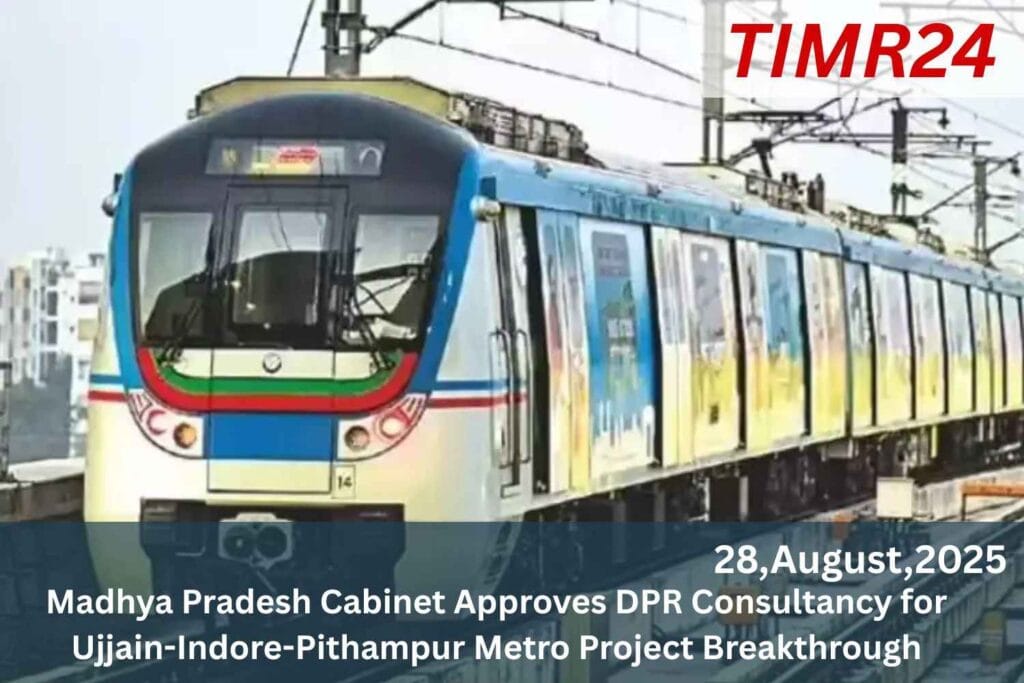
The Madhya Pradesh cabinet has approved consultancy fees for the Ujjain Indore Pithampur Metro Rail Project, with Delhi Metro Rail Corporation Ltd. assigned the work at ₹9 lakh per km (plus GST). Additionally, the cabinet approved the purchase of 25,000 tablets for the ‘E-Vivechana App’ project. The Madhya Pradesh Cabinet’s decision to approve the consultancy for preparing the Detailed Project Report (DPR) of the Ujjain-Indore-Pithampur Metro Project has sparked renewed interest in the state’s growing infrastructure landscape. This landmark move reflects the government’s commitment to sustainable, modern, and future-ready urban transport solutions. Connecting Ujjain.
A spiritual and cultural hub; Indore, the financial and commercial capital of Madhya Pradesh; and Pithampur, one of India’s largest industrial belts, the project has the potential to transform regional mobility, boost economic competitiveness, and strengthen tourism while aligning with India’s national agenda of green and inclusive urban growth. Urban connectivity remains one of the biggest challenges in rapidly growing Indian cities. With the population of Indore expanding and Ujjain witnessing steady growth in tourism and migration, the metro project comes at a critical juncture. The decision to appoint a consultancy for
The DPR ensures that the planning process will evaluate not just technical and financial feasibility but also long-term sustainability. Indore already leads the state in terms of modern civic infrastructure, and the integration of metro lines extending towards Ujjain and Pithampur will provide a seamless network that reduces travel time, congestion, and dependence on road-based transport. Readers interested in similar transport expansion initiatives can also explore our article on (India’s Logistics) where we discuss how connectivity fuels national progress. As Madhya Pradesh’s largest city and commercial centre, Indore has long been the engine of regional development. Recognized as India’s cleanest city for consecutive years, Indore is now positioning itself as a smart urban hub.
The metro expansion beyond its borders reflects an ambitious vision to integrate surrounding districts into the city’s growth corridor. The Ujjain-Indore-Pithampur Metro will act as a circulatory system, linking residential, commercial, and industrial zones. This will not only reduce the strain on roadways but also create opportunities for real estate, retail, and service sectors. Our earlier coverage on the shows similar examples where infrastructure pushes a city into the next phase of urban growth, and the Indore metro extension is no different.
Boosting Industrial Competitiveness in Pithampur
Pithampur, often referred to as the “Detroit of India,” is one of the largest industrial townships in the country, hosting automobile manufacturers, engineering firms, and large-scale industries. The metro project will act as a logistical enabler, ensuring smoother connectivity for thousands of industrial workers commuting daily from Indore and surrounding areas. It will also reduce travel costs and provide a faster mode of transport, which can indirectly improve productivity and attract new investments. Infrastructural projects such as this are not just about transportation they are about creating ecosystems where industries thrive. Just as aims to push forward energy connectivity, the Ujjain-Indore-Pithampur Metro seeks to enhance industrial resilience and sustainability in Madhya Pradesh.
Ujjain is one of India’s oldest cities and a globally renowned pilgrimage destination. Home to the Mahakaleshwar Jyotirlinga, which draws millions of devotees annually, the city thrives on religious tourism. However, road congestion and limited public transport often disrupt pilgrim experiences. The proposed metro link between Indore and Ujjain will not only ease this challenge but also create an integrated tourism corridor, making it easier for visitors to combine spiritual journeys with business or leisure activities in Indore. Improved connectivity will also encourage investment in hotels, cultural centers, and hospitality services, reinforcing Ujjain’s place on the global tourism map.
To understand how transport infrastructure boosts tourism, readers can revisit our report on (India’s Green) where sustainable development was highlighted as a driver of tourism-based economies. One of the most significant advantages of the metro project is its contribution to sustainable urban mobility. By reducing the dependence on fossil fuel-based road transport, the project aligns with India’s commitment to reducing carbon emissions and promoting green infrastructure. With cities like Indore already working under the Smart Cities Mission, the Ujjain-Indore-Pithampur Metro will add another layer of environmentally friendly transit that supports both
Economic and ecological balance. Similar to the (SAIL), where domestic resources were aligned with national goals, the metro development emphasizes how regional initiatives can support global climate action commitments India’s urban development framework is increasingly shifting towards holistic, multimodal transport systems. The Ujjain-Indore-Pithampur Metro aligns with this national vision, which seeks to connect economic zones, industrial corridors, and cultural hubs. By linking three diverse yet complementary centers of Madhya Pradesh, the project demonstrates how infrastructure planning can create ripple effects across various sectors.
The DPR consultancy will play a pivotal role in identifying the best routes, stations, financial models, and technologies that ensure long-term sustainability. For readers following similar updates, our analysis of the provides context on how infrastructure projects are planned to serve long-term growth trajectories Beyond its economic and environmental aspects, the metro project is expected to have a profound social impact. Improved connectivity will enable students, healthcare workers, daily commuters, and local entrepreneurs to move more efficiently between cities. It also has the potential to reduce socio-economic gaps by linking smaller communities to larger urban.
Markets With safer, faster, and affordable transport, the metro system could reshape commuting patterns and lifestyles across the region. In our previous story on we highlighted how road connectivity brought about socio-economic transformation. The same principle applies here but on a more sustainable, mass-transit scale The approval of the DPR consultancy is only the beginning of this ambitious project. Once the report is prepared, the state will seek approvals from the central government and financial institutions. Construction timelines will depend on the scope defined in the DPR, funding availability, and clearances. However, the intent is clear.
Madhya Pradesh is determined to build an integrated, future-ready metro system that addresses both present and future mobility needs. Just as reflected innovation in the education sector, the metro development reflects innovation in public infrastructure. The Ujjain-Indore-Pithampur Metro Project is more than just a transport initiative it is a blueprint for Madhya Pradesh’s future growth. By connecting a spiritual hub, a commercial powerhouse, and an industrial giant, the project encapsulates the idea of balanced, inclusive, and sustainable development. The cabinet’s approval of DPR consultancy is a decisive step forward in translating vision into action.
Q1. What is the Ujjain-Indore-Pithampur Metro Project?
It is a proposed metro rail network connecting Ujjain, Indore, and Pithampur to improve urban and industrial connectivity.
Q2. Why did the Madhya Pradesh Cabinet approve DPR consultancy?
The DPR (Detailed Project Report) will assess technical, financial, and operational feasibility of the metro project.
Q3. How will this metro benefit Madhya Pradesh?
It will reduce travel time, enhance trade, support industries in Pithampur, and improve tourism in Ujjain.
Q4. When will the construction of this metro project begin?
Construction will commence after DPR finalization, approval from the central government, and funding clearance.
Q5. Who will prepare the DPR for the Ujjain-Indore-Pithampur Metro?
A specialized consultancy firm will be appointed by the Madhya Pradesh Metro Rail Corporation.