

















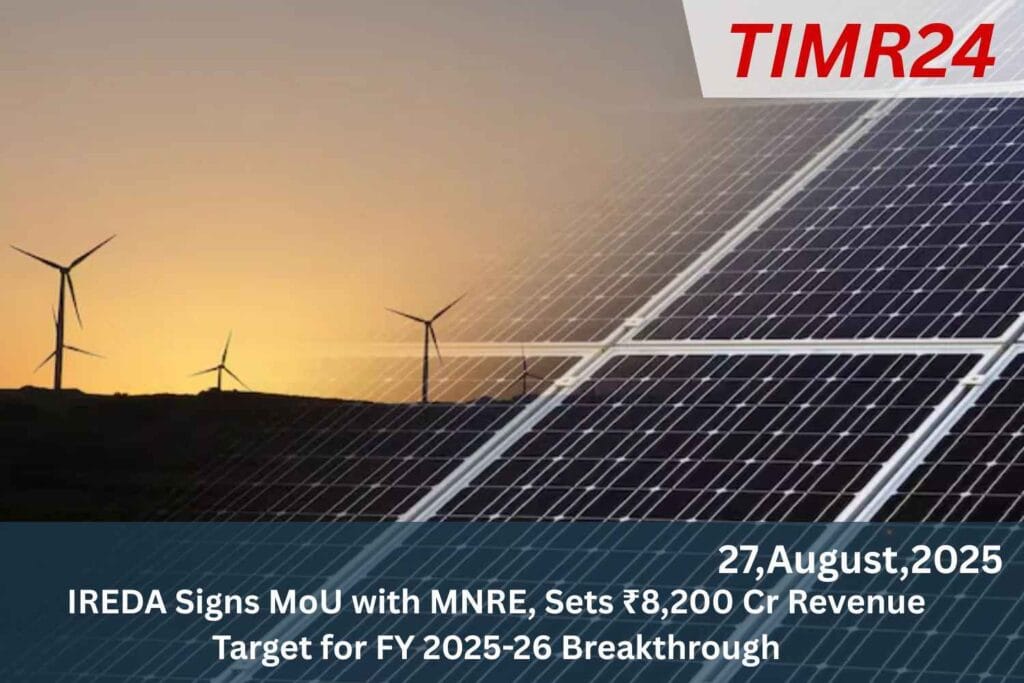
Indian Renewable Energy Development Agency Limited (IREDA) has signed a performance-based Memorandum of Understanding with the Indian Ministry of New and Renewable Energy (MNRE) to set strategic targets for the fiscal year 2025-26. The MoU outlines key performance parameters, including Return on Net Worth, Return on Capital Employed, NPA to Total Loans, Asset Turnover Ratio, and EBTDA. IREDA aims to strengthen its role in financing India’s renewable energy sector and support the government’s clean energy targets. The Indian Renewable Energy Development Agency (IREDA) has taken another decisive step in strengthening India’s clean energy ecosystem by signing a Memorandum of Understanding (MoU) with the Ministry of New and Renewable Energy (MNRE),
Setting an ambitious revenue target of ₹8,200 crore for FY 2025-26, a move that reflects both confidence in the nation’s renewable sector and commitment to accelerate financing of sustainable projects. This collaboration not only aligns with the government’s climate commitments but also provides an institutional framework to mobilize green investments and expand financial support for sectors such as solar, wind, bioenergy, and the emerging green hydrogen industry. Over the years, IREDA has become the backbone of renewable financing in India, and this MoU strengthens its mandate at a time when the country is targeting 500 GW of clean energy capacity by 2030, a goal that demands stronger partnerships, more robust capital infusion, and reliable institutions.
With this revenue target, IREDA is expected to enhance its lending portfolio, diversify its investments, and encourage public-private collaboration that will bring in both domestic and foreign investors looking for sustainable opportunities in India. The focus of this MoU goes beyond financial numbers it signals India’s resolve to embed green financing into the mainstream energy transition strategy, a critical requirement if the country wants to balance rapid economic growth with climate commitments. While traditional energy projects often dominate discussions, renewable energy initiatives supported by IREDA, such as (Solar Power) and bioenergy solutions, demonstrate that sustainable projects are viable, profitable, and capable of meeting large-scale energy demands.
The MoU also underscores the importance of creating a policy and financial ecosystem where innovation thrives, especially in green hydrogen, offshore wind, and hybrid renewable technologies, which are gaining traction globally. Financing mechanisms facilitated by IREDA will not only de-risk these projects for investors but also reduce borrowing costs for companies that are driving the clean energy transition on the ground. This becomes particularly significant in the context of India’s climate pledges at COP26, where the country committed to achieving net-zero emissions by 2070 and expanding non-fossil fuel energy capacity to 50 percent by 2030. By securing ₹8,200 crore in revenue, IREDA can channel funds into smaller players such as startups and MSMEs, who often struggle
Capital access but play an important role in innovation, technology adoption, and localized clean energy deployment. Furthermore, this agreement reaffirms MNRE’s role in shaping energy governance, ensuring that national policies translate into measurable outcomes in terms of project execution, job creation, and rural development, as renewable energy projects often benefit communities directly by providing electricity access and livelihood opportunities. For example, initiatives and rural mini-grid systems showcase how financial assistance can create social impact alongside economic growth. The global context also cannot be ignored international bodies like.
The highlight India as one of the fastest-growing clean energy markets, and with IREDA’s strengthened financial performance, India is poised to attract more global partnerships, technology transfers, and cross-border financing models. Another important aspect is sustainability reporting and environmental, social, and governance (ESG) compliance, where institutions like IREDA set benchmarks for responsible investing by ensuring that capital flows into projects that deliver long-term ecological benefits. The ₹8,200 crore revenue target is not just a financial milestone but a marker of confidence in the resilience and potential of India’s renewable sector, which must continue to grow despite global challenges such as supply chain disruptions.
Commodity price volatility, and geopolitical uncertainties affecting energy markets. Moving forward, the partnership between IREDA and MNRE will likely set a precedent for similar collaborations that integrate financial planning with policy objectives, ensuring that renewable energy expansion is not slowed by lack of capital or institutional support. This approach also demonstrates how India is gradually shifting towards a green economy where sustainable infrastructure is prioritized, and where projects such and green hydrogen missions gain traction with strong backing from public sector institutions. In conclusion, the MoU between IREDA and MNRE reflects India’s commitment to both climate leadership and economic sustainability.
As the revenue target for FY 2025-26 is expected to enhance renewable financing, build investor confidence, and create a resilient framework for energy transition. By supporting a wide spectrum of clean technologies and ensuring that financial flows are aligned with climate goals, IREDA is not (Department of Economic) only meeting its institutional mandate but also contributing significantly to India’s vision of becoming a global leader in renewable energy.
Q1. What is the revenue target set by IREDA for FY 2025-26?
IREDA has set a revenue target of ₹8,200 crore for FY 2025-26 through its MoU with MNRE.
Q2. Why did IREDA sign an MoU with MNRE?
The MoU ensures alignment with national renewable energy goals and supports financing for clean energy projects.
Q3. How will this agreement benefit renewable energy in India?
It will accelerate project funding, attract investments, and strengthen India’s push towards 500 GW renewable capacity by 2030.
Q4. Which sectors will gain the most from this collaboration?
Solar, wind, bioenergy, and green hydrogen projects will receive enhanced financial support.
Q5. How does IREDA’s performance impact India’s climate goals?
A strong IREDA helps channel funds into clean projects, reducing carbon emissions and promoting sustainable energy growth.