


















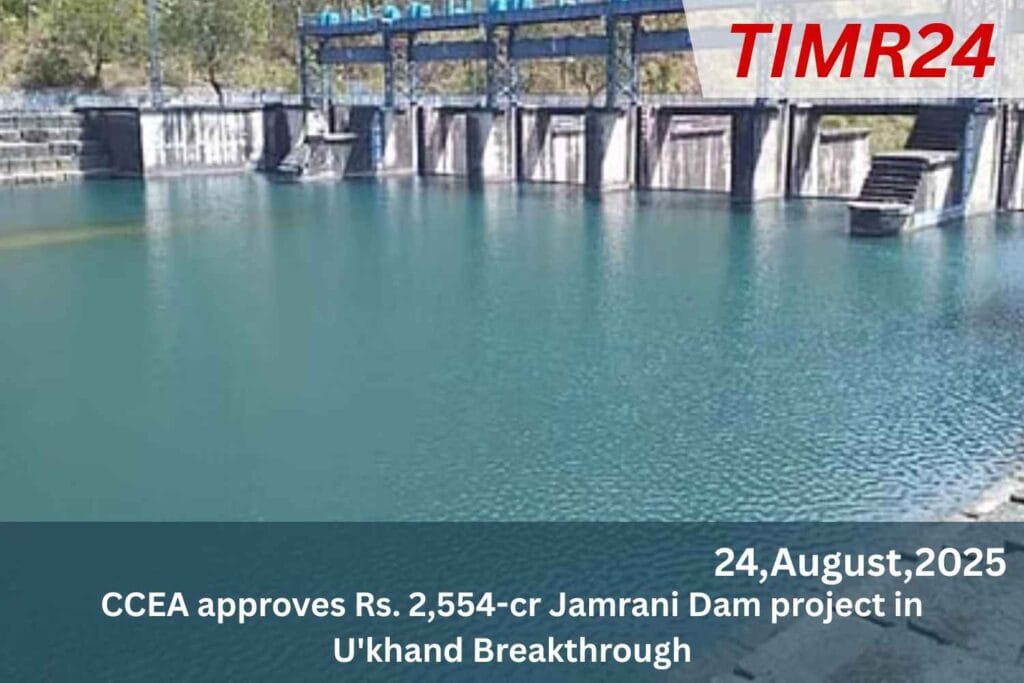
The Cabinet Committee on Economic Affairs has approved the Jamrani dam multipurpose project in Uttarakhand, involving an investment of Rs. 2,554 crore. The project, which will deliver 14 MW of hydropower and 42.70 million cubic meters of potable water to over 10.65 lakh residents, will be funded by the Centre. The Cabinet Committee on Economic Affairs (CCEA), chaired by the Prime Minister, has given its approval to the much-awaited Rs. 2,554-crore Jamrani Dam project in Uttarakhand. This landmark decision is expected to transform irrigation capacity, provide reliable drinking water, and generate hydropower in the region. The dam, to be built on the Gola River, marks a significant step in strengthening India’s water security and rural development infrastructure.
The Jamrani Dam will be constructed in the Nainital district of Uttarakhand. The Ministry of Jal Shakti is implementing the project under the Pradhan Mantri Krishi Sinchayee Yojana (PMKSY). The dam aims to benefit farmers, industries, and households by ensuring a consistent water supply. It will also provide clean drinking water to nearby towns like Haldwani, Rudrapur, and Pantnagar (Jal Shakti) A key focus of the Jamrani Dam project is irrigation. The project will provide assured irrigation to over 57,000 hectares of agricultural land. Uttarakhand and Uttar Pradesh. Farmers in the Terai region.
known for crops like wheat, rice, and sugarcane, will benefit from increased crop yield and reduced dependence on monsoon rains. Apart from agriculture, the dam will significantly improve drinking water supply. More than 15 lakh residents across districts including Nainital and Udham Singh Nagar will receive piped water. This will reduce water scarcity and improve living standards. The project aligns with the Jal Jeevan Mission, which aims to provide tap water to every household. Another highlight of the Jamrani Dam project is its potential to generate 14 MW of hydroelectric power, contributing to clean and renewable energy. This will not only support the state’s power supply but also reduce dependency on fossil fuels.
Economic and Employment Opportunities
The construction of the dam is expected to generate thousands of jobs, boosting the local economy. Small businesses, construction firms, and service providers will see growth. The long-term economic impact will extend to tourism, as the dam site is likely to attract visitors (ESR’s Nagpur) Large projects often raise environmental concerns. The government has assured that environmental impact assessments and rehabilitation measures will be strictly followed. Steps will be taken to protect biodiversity and ensure the displacement of affected families is minimized. The approval of the Jamrani Dam project in Uttarakhand is a turning point for water security.
Agriculture, and energy development in the region. With irrigation benefits, drinking water supply, renewable energy generation, and job creation, the project will have a multi-dimensional impact. This initiative not only secures the future of Uttarakhand’s farmers but also aligns with India’s vision of sustainable infrastructure.
Q1. What is the Jamrani Dam project?
The Jamrani Dam project is a multipurpose infrastructure scheme in Uttarakhand aimed at irrigation, drinking water supply, and power generation.
Q2. What is the total cost of the Jamrani Dam project?
The project is estimated at Rs. 2,554 crore, recently approved by the Cabinet Committee on Economic Affairs (CCEA).
Q3. What benefits will the Jamrani Dam bring to Uttarakhand?
It will provide irrigation to lakhs of hectares, ensure drinking water for cities like Haldwani, and generate hydropower.
Q4. Which ministry is implementing the Jamrani Dam project?
The Ministry of Jal Shakti, under the Government of India, is overseeing the project.
Q5. When is the Jamrani Dam project expected to be completed?
The project has a multi-year timeline and is expected to be completed within the next 5–7 years.