
















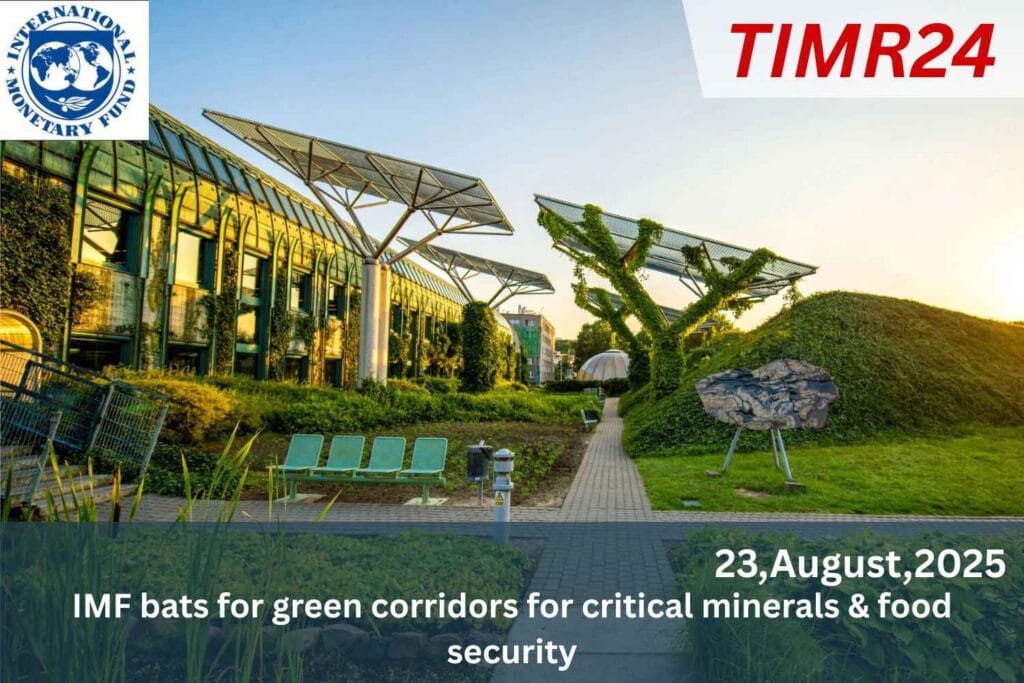
The IMF proposes a “green corridor” agreement for integrated minerals for decarbonisation and a “food corridor” agreement to ensure food access and prevent supply shocks. Both agreements aim to safeguard global goals of averting climate change and food insecurity. The International Monetary Fund (IMF) has recently emphasized the urgent need for establishing green corridors to strengthen supply chains for Critical Minerals and enhance food security. With the global economy increasingly relying on sustainable trade practices, green corridors present a strategic approach to balance growth with Environmental Responsibility. The IMF believes that such initiatives will not only safeguard future supplies but also help countries mitigate risks from climate change and geopolitical disruptions.
Green corridors are specialized trade and transport routes designed to minimize carbon emissions, promote clean logistics, and ensure sustainability in global trade. Unlike traditional supply chains, these corridors leverage renewable energy, digital tracking, and eco-friendly (Tiruchi Member) transportation methods to optimize the movement of goods. According to the IMF, integrating green practices into international trade will accelerate the transition towards a low-carbon economy, particularly in industries dependent on critical minerals and agriculture.
Critical minerals such as lithium, cobalt, nickel, and rare earth elements are indispensable for the development of clean technologies, electric vehicles, renewable energy storage, and digital infrastructure. The global demand for these resources is set to multiply as countries pursue ambitious climate goals. By establishing green corridors, the IMF aims to secure the steady supply of these minerals while reducing the environmental footprint of extraction and transportation. For more insights Food security remains a pressing global concern, with rising populations and climate-related disruptions putting pressure on supply chains. Green corridors can enhance food distribution by.
Improving logistics efficiency, reducing wastage, and cutting transit times. By adopting green shipping and energy-efficient warehousing, countries can ensure stable access to essential commodities Developing countries stand to gain the most from the IMF’s push for green corridors. Many of these nations are rich in critical minerals but lack efficient infrastructure to export resources sustainably. Green corridors provide them with opportunities to integrate into global value chains, attract foreign investment, and strengthen food systems. Additionally, by adopting climate-friendly trade practices The IMF highlights that green corridors not only improve resilience against supply disruptions.
But also reduce dependency on geopolitically sensitive regions. As conflicts and trade disputes threaten stability, eco-friendly corridors ensure smoother international cooperation. Moreover, by lowering carbon emissions in transport and mining, they contribute significantly to climate mitigation targets Looking ahead, the success of green corridors will depend on multilateral cooperation, financing, and adoption of innovative technologies. Public-private partnerships, digital trade facilitation, and green infrastructure investments will play a crucial role in bringing the IMF’s vision to reality. As global economies transition toward sustainable practices, green corridors may soon become the backbone of international trade.
The IMF’s call for green corridors is a pivotal step toward building resilient supply chains for both critical minerals and food security. By fostering sustainable logistics, reducing emissions (Climate) and promoting global cooperation, these corridors will not only strengthen economic stability but also safeguard future generations. Nations that adopt these practices early will be better positioned to thrive in a resource-constrained, climate-challenged world.
Q1. Why is the IMF promoting green corridors?
The IMF supports green corridors to ensure sustainable trade routes for critical minerals and food supply chains.
Q2. What are green corridors?
They are eco-friendly trade routes that reduce carbon emissions while enhancing global supply chain resilience.
Q3. How will this help food security?
Green corridors streamline logistics and reduce delays, ensuring faster and more reliable food distribution worldwide.
Q4. Why are critical minerals important?
Critical minerals are essential for clean energy technologies, electric vehicles, and digital infrastructure.
Q5. Which countries benefit most from green corridors?
Developing nations and resource-rich countries benefit by improving exports and ensuring food stability.