














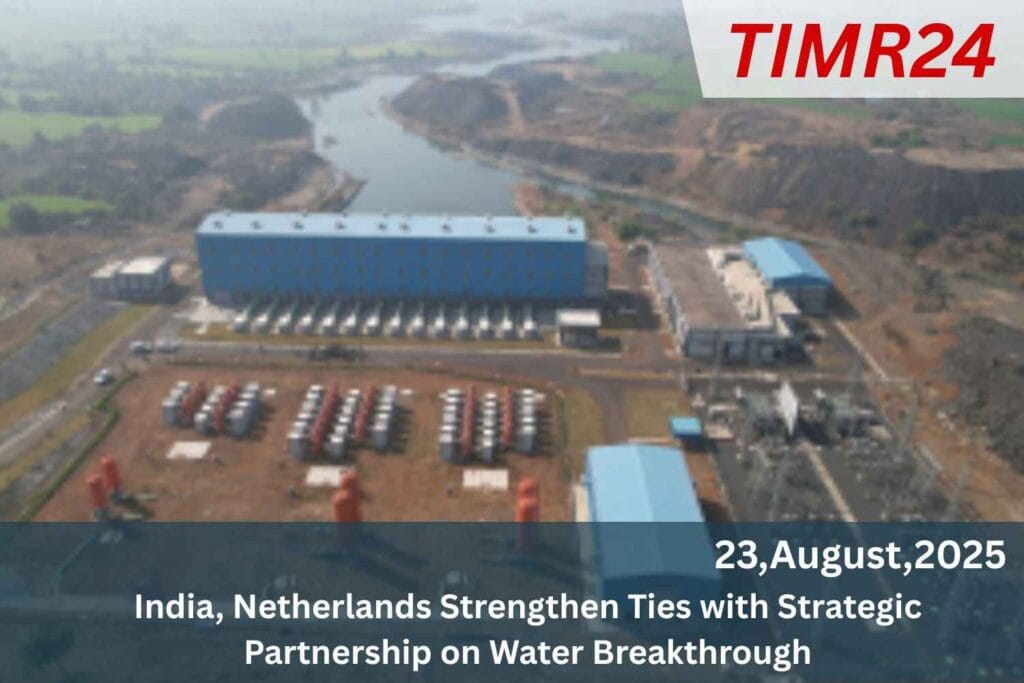
India and the Netherlands have established an Indo-Dutch Centre of Excellence (CoE) on Water, focusing on urban water management, artificial intelligence, and river dynamics modelling. The Coe is actively involved in projects like the Urban River Management Plan and pollution abatement infrastructure monitoring. An allocation of ₹36.23 crore has been made for its institutional framework. The recent announcement of the strategic partnership between India and the Netherlands on water management marks a significant milestone in global cooperation for sustainable development. Both nations share long-standing diplomatic and cultural ties, but this renewed focus on water.
Highlights how crucial collaboration has become in addressing pressing challenges like water scarcity, pollution, and climate-driven disasters. By combining India’s vast scale of water issues with Dutch expertise in water technology, this alliance sets the stage for impactful reforms in river rejuvenation, flood control, and smart infrastructure planning. Readers interested in learning more about previous collaborations (Water Management) is not just a resource; it is the lifeline of every nation’s economy, health, and ecosystem. India, with its rapidly growing population and industrial expansion. has been facing mounting challenges in managing its water resources. Issues like the irregular monsoons, and the rising stress on urban water supply have made the situation urgent.
The Netherlands, on the other hand, has built its global reputation on innovative water engineering, having transformed its own geography to survive below sea level. This complementarity India’s need and the Netherlands’ expertise creates a powerful foundation for meaningful collaboration. The partnership goes beyond symbolic agreements and directly addresses practical challenges. It focuses on flood risk management, where Dutch innovations like advanced dike systems and early-warning models will be adapted for India’s flood-prone states such.
Technology Transfer and Knowledge Sharing
As Bihar and Assam. Wastewater treatment is another critical area, especially with Indian cities like Delhi and Mumbai struggling to manage urban sewage. Dutch companies are expected to introduce decentralized wastewater solutions that can be scaled affordably across India’s urban and semi-urban regions. Another shared focus will be the rejuvenation of rivers, where both sides are working on integrating clean technology with Technology lies at the heart of this strategic water partnership. The Netherlands is a pioneer in smart water systems, using sensors, data analytics, and artificial intelligence to monitor and optimize water flow.
By transferring these technologies to India, both countries aim to create models that can be replicated across South Asia. Equally important is the exchange of knowledge between universities and research institutes, which will foster the next generation of water scientists and engineers. The Indian Institute of Technology (IITs) is already exploring joint research with Dutch institutions like Delft University of Technology. This ensures that the cooperation is not just governmental but also academic and industry-driven. Climate change has amplified the urgency of managing water resources. Rising sea levels threaten coastal cities, while erratic rainfall patterns disrupt agriculture. By working together, India and the Netherlands are strengthening their resilience against these threats.
For example, Dutch expertise in flood-resilient urban planning is being applied to coastal Indian cities like Chennai, which frequently faces flooding during cyclones. Similarly, sustainable agriculture techniques that use less water will be promoted in India’s drought-prone regions, ensuring food security alongside water conservation. Interested readers can explore global practices to understand how this partnership aligns with international goals Beyond the environmental benefits, this partnership carries significant economic and diplomatic weight. Water infrastructure projects require large investments, and Dutch companies see India as a fertile ground for.
Expanding their global reach. In return, India gains not just foreign investment but also job creation in the sectors of water technology, construction, and renewable energy. Diplomatically, this strengthens ties with the European Union, as the Netherlands often plays a leading role in EU’s sustainability policies. This partnership therefore contributes to India’s global image as a nation committed to climate action and sustainable growth The Netherlands strategic water partnership is not just about short-term projects but about building a long-term framework for cooperation. Future plans include setting up a joint innovation hub for water solutions, increasing.
Student exchanges, and launching pilot projects in both countries to test new technologies. The vision is to create models of success that can later be expanded to other developing nations, thereby positioning both and the Netherlands as global leaders in sustainable water governance (Ganga River) The strengthening of ties between and the Netherlands through a water-focused strategic partnership demonstrates how international collaboration can address one of humanity’s most urgent needs. It blends scale of challenges with Dutch innovation to create practical, scalable solutions that impact millions of lives. As both countries move forward. (Ganga River)
Q1. What is the India-Netherlands water partnership about?
It focuses on sustainable water management, technology sharing, and climate resilience.
Q2. Why are India and the Netherlands collaborating on water?
Because the Netherlands is a global leader in water technology, and India faces rising water challenges.
Q3. What areas will the partnership cover?
Flood control, clean rivers, wastewater treatment, and smart water systems.
Q4. How will India benefit from this partnership?
India will gain advanced water technology, expertise, and support for sustainable development.
Q5. When was this partnership announced?
It was announced in August 2025 to strengthen long-term strategic ties.