



















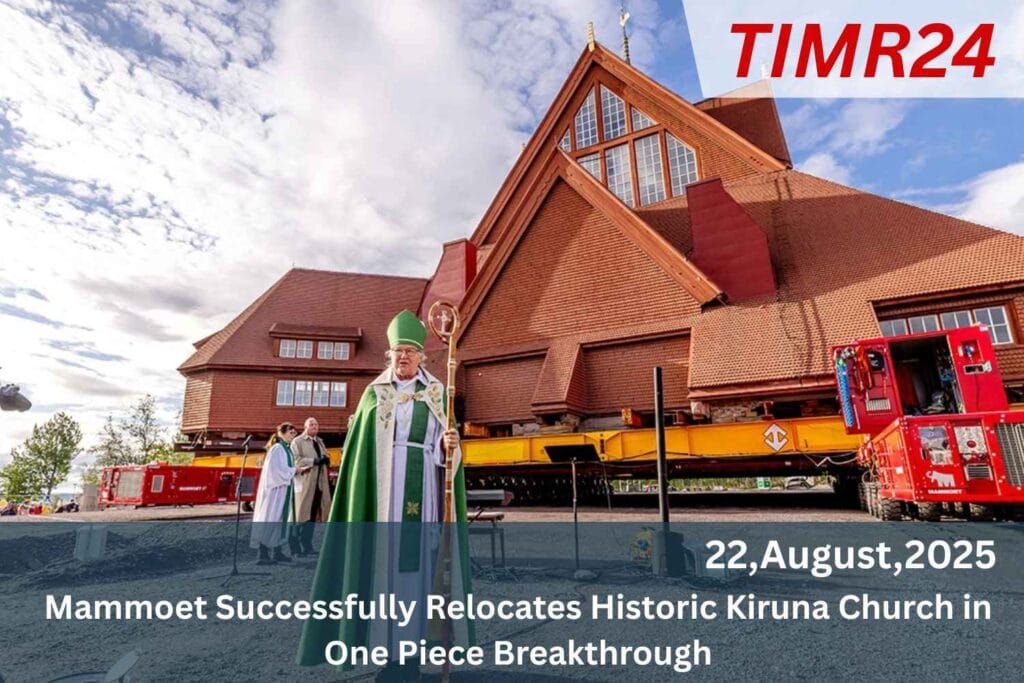
The Kiruna Church, one of Sweden’s most significant architectural landmarks, has been relocated by Mammoet, a company commissioned by Veidekke and LKAB. The 713-tonne wooden structure, built in the early 20th century, was moved due to the expansion of LKAB’s Kiruna mine. The move, dubbed “The Great Church Walk,” was a historic event that attracted thousands of spectators and showcased the power of precision engineering and collaboration. The church was placed on steel beams supported by Self-Propelled Modular Transporters (SPMTs) and a custom monitoring system to ensure stability. The move was completed during daylight hours on August 19 and 20.
The relocation of heritage structures is one of the most delicate engineering tasks in the world, and the recent achievement by Mammoet, a global leader in engineered heavy lifting and transport, has set a remarkable milestone. The company has successfully relocated (Urban Project) the Kiruna Church, one of Sweden’s most iconic wooden landmarks, in a single piece without dismantling it. This project not only demonstrates the power of modern engineering but also highlights the deep respect for cultural preservation during urban development.
Kiruna, Sweden’s northernmost town, has been undergoing a massive urban transformation due to the expansion of LKAB’s iron ore mining operations. The mining activities beneath the ground created subsidence risks, making it unsafe for the existing town centre to remain in its place. As a result, large parts of Kiruna are being moved to a newly developed area, including public buildings, housing, and essential infrastructure. Among these, the Kiruna Church, built in 1912 and considered one of the largest wooden buildings in Sweden, required special attention due to its cultural and spiritual importance.
Engineering Marvel How Mammoet Executed the Move
Relocating an entire church weighing several thousand tons is not just about strength—it requires precision. Mammoet used advanced self-propelled modular transporters (SPMTs) to lift and carefully move the church to its new location, nearly 3 kilometres away. The process took months of planning, ground preparation, and structural reinforcement to ensure the building remained intact during transportation This engineering feat is comparable to other global relocation projects, such as the shifting of temples in Egypt during the Aswan Dam construction, proving that modern technology can balance progress with heritage preservation. For more on heavy engineering solutions.
The Kiruna Church, designed by architect Gustaf Wickman, is not just a place of worship but a symbol of the town’s history and community identity. It is often recognized for its striking red-wooden structure and unique design influenced by Norwegian stave churches. By relocating the church in one piece, (Patna Metro Project) authorities ensured that residents would not lose a beloved landmark to mining expansion. The church now stands in the new Kiruna town centre, offering continuity and stability to its citizens during this historic urban shift.
Challenges Faced During the Relocation
Several challenges made this project unique:
- Structural Fragility: The wooden frame of the church required careful reinforcement.
- Weight Distribution: Managing thousands of tons across uneven terrain required advanced transporters.
- Weather Conditions: Kiruna, located in the Arctic Circle, posed additional challenges with cold temperatures and unpredictable conditions.
A Global Example of Engineering with Heritage in Mind
This successful relocation sets a benchmark for future projects worldwide. Cities undergoing rapid industrial development often face conflicts between progress and cultural preservation. Kiruna demonstrates that with the right planning and execution, both can coexist Much like the Aunta-Simaria Highway Project in India, which integrates modern infrastructure with regional connectivity, the Kiruna relocation proves how engineering excellence can serve both people and heritage simultaneously. The success of this project opens doors for more ambitious cultural preservation initiatives worldwide. As urbanization and industrial projects continue to grow, relocation techniques like.
These could save countless heritage buildings from destruction. Moreover, it serves as an inspiration for countries with vulnerable monuments at risk due to environmental or industrial pressures The relocation of the Kiruna Church by Mammoet is more than just a construction story it is a testament to human capability, respect for history, and the balance between development and preservation. In moving the church in one piece, Sweden has not only safeguarded a historical treasure but also set an example for the rest of the world on how to respect cultural roots while embracing modernization.
q1. What did Mammoet relocate?
Mammoet relocated the historic Kiruna Church in Sweden.
q2. Was the church moved in parts or whole?
The church was relocated in one piece
q3. Why was Kiruna Church moved?
It was moved due to urban transformation and mining expansion in Kiruna.
q4. How significant is this relocation?
It’s a major engineering achievement preserving cultural heritage.
q5. Where is the church now located?
The church has been successfully placed in the new Kiruna town Centre.