












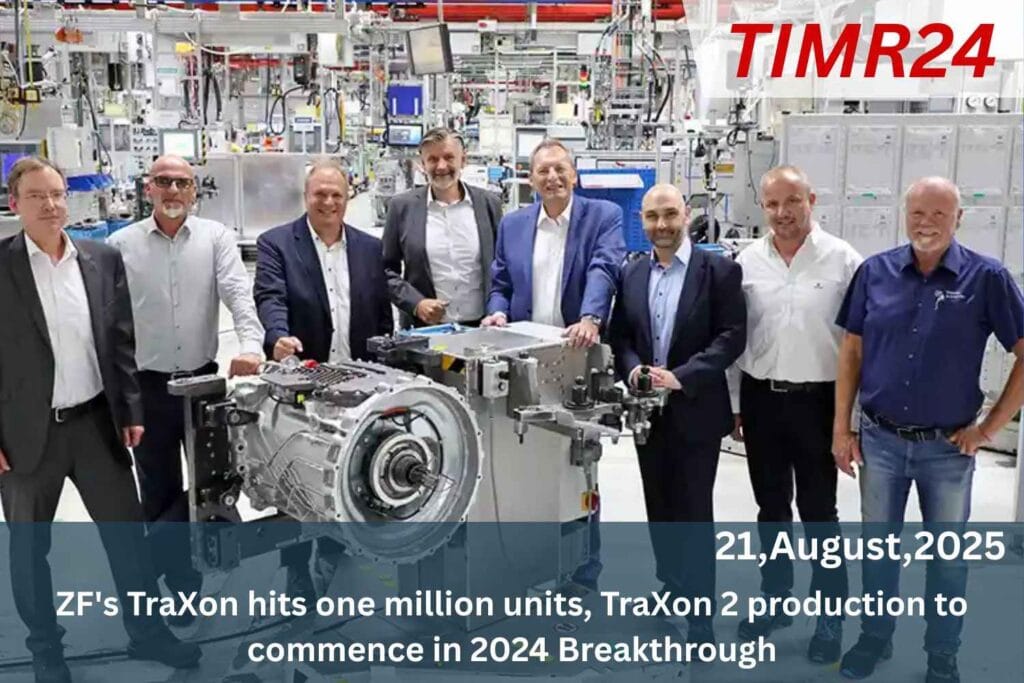
ZF’s TraXon Commercial Vehicle Solutions division has produced its TraXon transmission system, marking a significant milestone. The 1 millionth unit was assembled in Friedrichshafen, Germany, launched in 2014, is known for its efficiency and performance. ZF is preparing for its successor, TraXon 2, set to launch in 2024. The global automotive industry has been witnessing rapid innovation in the field of transmission technology, and one of the biggest milestones has recently come from ZF Friedrichshafen AG, a leading German technology company. Its highly acclaimed modular transmission system, TraXon, has crossed the production milestone of one million units,
Reaffirming its dominance in the heavy-duty commercial vehicle segment. This achievement not only highlights ZF’s strong foothold in the drivetrain solutions market but also sets the stage for the arrival of which is scheduled to go into production in 2024. The announcement marks a defining breakthrough in the evolution of next-generation transmissions that aim to blend performance, efficiency, and digital intelligence. Introduced as a modular and highly flexible transmission system, ZF’s TraXon has been a preferred choice for heavy-duty trucks and buses worldwide. Its adaptability to different driveline configurations, including hybrid and electric applications, made.
It a game-changer for original equipment manufacturers (OEMs). The system’s efficiency and robust performance allowed fleet operators to achieve reduced fuel consumption, optimized shifting, and lower operational costs. By surpassing one million units in production (PM Gati Shakti) has firmly established itself as a trusted solution in the logistics and transportation sector, much like how other infrastructure breakthroughs such as the PM Gati Shakti initiative have transformed supply chain planning in India. The one million production milestone reflects not just the popularity of the transmission system but also ZF’s ability to scale innovation globally. With commercial vehicle manufacturers.
Under pressure to meet stringent emission standards, the role of advanced transmissions has become critical. Taxon’s modular architecture, which allows customization for diverse vehicle platforms, has been instrumental in helping automakers balance regulatory compliance with real-world performance. This success positions ZF as a benchmark in the segment, much like other recent breakthroughs in the logistics and mobility ecosystem, such as Allcargo’s Grade A warehouses that focus on efficiency and sustainability.
The Next Step: TraXon 2 Production in 2024
The future of ZF’s transmission journey is set to unfold with the launch in 2024. According to ZF, the next-generation system will feature significant improvements in shifting speed, efficiency, and digital connectivity. Built with advanced sensors and software integration, TraXon 2 will not only improve mechanical performance but also enable predictive maintenance and data-driven operations. In an era where connected mobility and telematics are reshaping the commercial vehicle industry is designed to integrate seamlessly with fleet management systems. This aligns with broader industry trends, where digital intelligence in transport solutions similar to MoRTH’s plans for e-highways is becoming essential for future-ready mobility.
The introduction of TraXon 2 comes at a time when the logistics sector is undergoing massive transformation. With increasing demand for sustainable transport solutions, commercial vehicle OEMs are under pressure to innovate faster. TraXon 2’s design is expected to support not just traditional internal combustion engines but also hybrid and electric powertrains, ensuring long-term relevance in a decarbonizing world. Moreover, ZF’s strong global partnerships with truck manufacturers across Europe, Asia, and North America provide a solid platform for rapid adoption. Much like the Greenfield Airport projects in India, which are reshaping regional connectivity, ZF’s new transmission will redefine the standards of mobility infrastructure worldwide.
Innovation Beyond Transmission
Another noteworthy aspect of ZF’s journey is its focus on integrating mechanical components with digital ecosystems. for instance, is expected to feature enhanced electronic control units, predictive diagnostics, and software-over-the-air updates. This shift underscores the industry wide movement from hardware-centric to software-defined vehicles. By combining physical durability with smart digital tools, ZF is enabling fleet operators to achieve operational efficiency, cost savings, and reduced downtime an approach that resonates with the kind of digital transformation seen in infrastructure initiatives such as the National Logistics Policy in India.
ZF’s achievement of producing one million units and the announcement of TraXon 2 production in 2024 represent more than just a technological milestone; they signify a broader industry transformation. As heavy-duty vehicle manufacturers and fleet operators look for solutions that balance performance, cost, and sustainability, ZF’s TraXon systems stand out as a benchmark in innovation (National Logistics) The upcoming 2 promises to elevate these capabilities with faster shifts, higher efficiency, and intelligent digital integration. Much like the infrastructural revolutions underway in India and other parts of the world.
Q1. What is ZF’s TraXon?
TraXon is ZF’s modular automatic transmission system designed for heavy-duty commercial vehicles.
Q2. How many TraXon units have been produced?
ZF has achieved a milestone of producing 1 million TraXon units.
Q3. When will TraXon 2 production start?
TraXon 2 production is scheduled to commence in 2024.
Q4. What are the key benefits of TraXon 2?
TraXon 2 offers higher efficiency, faster shifting, and enhanced digital connectivity.
Q5. Which vehicles use ZF’s TraXon system?
TraXon is widely used in trucks, buses, and heavy-duty commercial vehicles across global markets.